



During this special period, culminating in the day of mourning, the 9th of Av – the day of the destruction of the Jerusalem Temple – Jews around the world pay particular attention to topics connected with the Beis HaMikdash. Studying the laws, descriptions, and meanings of the Temple during this mournful period is not merely a mournful remembrance of the past but an important step toward its future rebuilding.
It is stated in the Midrash Tanchuma that studying the structure of the Temple is equivalent to building it. The Rebbe emphasized that especially during these days before the 9th of Av, it is important not only to mourn the destruction but also to “live” with the future rebuilding – by strengthening faith, hope, and knowledge of the Temple and its service.
In this spirit, our website presents a series of texts to be studied during these days. They contain both basic historical information and a detailed description of the Temple Mount, the structure of the Temple itself, as well as its spiritual essence and significance for every Jew.
The Jerusalem Temple
The Holy Temple (Beis HaMikdash) was a magnificent structure that served as the center of Judaism, its holiest site. It stood atop Mount Moriah in Jerusalem. Our ancestors would come there three times a year to offer sacrifices and appear before G-d.
The first Beis HaMikdash was built by King Solomon in 833 BCE and destroyed by the Babylonians in 423 BCE. The second Beis HaMikdash was completed in 349 BCE by the Jews who returned from the Persian exile, rebuilt by King Herod in 19 BCE, and ultimately destroyed by the Romans in 69 CE, after which the present exile (galut) began.
For nearly 2,000 years, there has been no Holy Temple in Jerusalem. Nevertheless, it is an axiom of Jewish faith that the Temple will once again be rebuilt in Jerusalem.
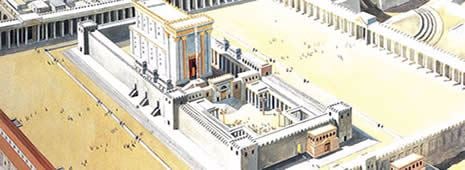
Har HaBayis – The Temple Mount
In the time of King Solomon, the dimensions of the Temple Mount were 500 by 500 cubits. There were five entrances to its area:
– On the southern side – the double gates of Chuldah
– On the western side – the Kiphonus Gate
– On the northern side – the Tadi Gate
– On the eastern side – the Shushan Gate
(King Herod, who expanded the area of the Temple Mount, added three additional gates on the western side.)
The main part of the Temple Mount was the central courtyard, which housed the Temple building. The remaining area of the Temple Mount contained various chambers and buildings, including:
- • The House of Study, where Talmudic law was taught and discussed.
• The Chamber of the minor Temple officials.
• The Armory, in case of enemy invasion.
• The Chamber with tools for repair work.
• The Trumpeting Place. The shofar (ram’s horn) was sounded from the roof of this building before the onset of Shabbos, so that people would know when they should cease work.