




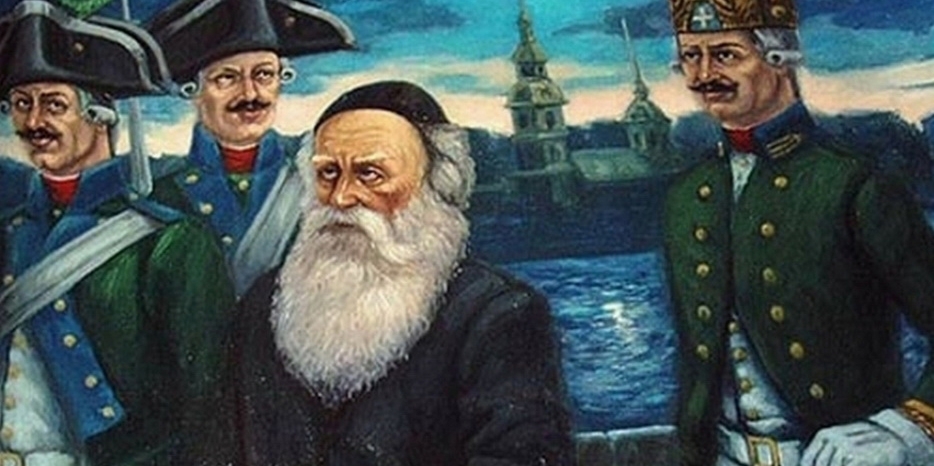
Every year on the 19th of Kislev (this year beginning tonight, December 8th, and lasting until sunset on December 9th), Jews worldwide celebrate the Day of Liberation of the Alter Rebbe, Rabbi Schneur Zalman of Liadi. This day – the New Year of Chassidism – is traditionally one of the most significant holidays for the majority of Jewish communities in Ukraine.
The holiday of the New Year of Chassidism originated 227 years ago. On the 19th of Kislev 5559 from the creation of the world (November 27, 1798), the Rebbe Schneur Zalman of Liadi, the founder of the Chabad-Lubavitch Chassidic movement, was released from imprisonment in the Peter and Paul Fortress, where he had spent nearly two months. His release became a sign of official recognition of the Chassidic movement in the Russian Empire. This event was considered so significant and miraculous at the time that the Chassidim even wanted to write a scroll for the 19th of Kislev, similar to the Scroll of Esther, to read it every year, but the Alter Rebbe did not give his consent.
In one of his talks, the Rebbe Rayatz recounted:
“When the Alter Rebbe was brought to the Peter and Paul Fortress, he was placed in the secret cells of the fortress. For over seven weeks (53 days), he was held in that fortress. For the first three weeks, the Rebbe was under extremely harsh confinement, in cells intended for rebels against the kingdom, since one of the main accusations in the denunciation was that the Alter Rebbe was [allegedly] collecting money and transferring it to the Turkish Sultan. Later, he was transferred to a place with milder conditions [of confinement] within the same fortress.
All the days while the Alter Rebbe was in [confinement] at the Peter and Paul Fortress, special sessions were held, gathering and reworking the materials of the denunciation against our Rebbe. After that, the Rebbe was interrogated. The interrogations did not take place in the fortress, but in the offices of the ‘Secret Council,’ to which the Rebbe was transported each time by boat across the Neva River—from the fortress to the offices.
The Tsarist ministers themselves interrogated the Alter Rebbe, and he answered all their questions. The answers and questions were recorded and sent to the Senate for study. Everyone saw in the Alter Rebbe’s answers his amazing wisdom and the purity of his heart.
On Tuesday, the 19th of Kislev, the verdict concerning the Alter Rebbe was issued, stating that he was free of any guilt, and a decision was made for his release.”
It is known that Emperor Paul I himself wished to visit the Rebbe in his confinement. He did so disguised as a simple officer. Although the Alter Rebbe had never seen the Russian Tsar before, he immediately sensed who was before him and showed the Tsar signs of respect prescribed by Jewish law toward a monarch. From that moment, the Tsar referred to the Rebbe as none other than the “Holy Rabbi.” Emperor Paul I personally signed the final decision, which stated: “His Imperial Majesty has found nothing in the behavior of the Chassidim that is harmful to the integrity and tranquility of the state.” Thus, a new holiday appeared in the Jewish calendar: the 19th of Kislev – Rosh HaShanah of Chassidism, or the Chassidic New Year. Not much time passed, and the Chabad-Lubavitch movement advanced far beyond the borders of Ukraine, Belarus, and Russia, spreading the wellsprings of the Baal Shem Tov’s teachings throughout the world.
It is on the day of the 19th of Kislev that it is customary to begin the annual cycle of reading the foundational book of Chassidic philosophy written by the Alter Rebbe – the book “Tanya” (“Likutei Amarim”).