



Today, December 14th, the holiday of Hanukkah has begun, which lasts for eight days. This is a holiday of light and goodness, and at the same time – a holiday of freedom, as we recall how the Almighty helped the people fighting for their liberation from foreign invaders and the miracles He performed. In Hanukkah, we see a foreshadowing of the coming complete and final Redemption, and we ask the Creator of the world that we may, as soon as possible, merit to light the Menorah in the Temple, restored in the place designated by Him, in the holy city of Jerusalem.
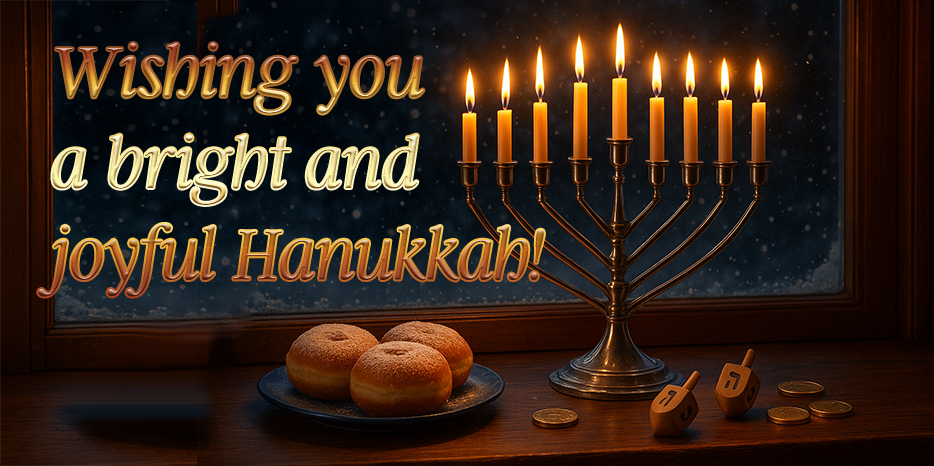
We congratulate our readers and wish them a bright and joyful Hanukkah!
Let us briefly recall the history, main commandments, and customs of the holiday.
History and Symbolism
In the 2nd century BCE, in Judea, which was under the rule of the Greco-Syrian Seleucid Empire, an uprising broke out. The cause was not so much the desire to gain political independence, but rather outrage at the cruel persecution of the Jewish religion. They became completely intolerable under Emperor Antiochus Epiphanes, who everywhere imposed the cult of Greek gods (and, in his zeal, even added his own humble person to them), and prohibited the observance of the laws of the Torah under penalty of death.
But the saddest thing is that many Jews abandoned the religion of their people. And not out of fear of repression, but quite willingly, tempted by Greek “enlightenment.” And being zealous members of the new society, they even reported to the authorities their fellow Jews who continued to secretly practice Judaism.
Nevertheless, the uprising, begun by a handful of heroes under the leadership of the Hasmonean brothers (Maccabees), over time became a national one and culminated in the liberation of Jerusalem and the Jerusalem Temple from the pagans. In 165 BCE, on the 25th of the month of Kislev, the Jews consecrated the Temple defiled by the Greeks and a new altar (the word “Hanukkah” means “dedication”). Upon liberating the Temple, they managed to find only one jug of ritually pure oil, undefiled by the Greeks, which had been buried in the ground and would have sufficed for only one night of burning the Menorah (the Temple lamp). But a miracle occurred: with this oil, they lit the Menorah for eight days – until new ritually pure oil was prepared. In memory of this, the sages of that generation decreed that every year these eight days would be days of the holiday, and each night during these days, Jews would light lamps at the entrance to their homes.
However, this should also remind us of another, truly main miracle of Hanukkah. For, despite the fact that the overwhelming majority of Jews had distanced themselves from the Almighty, nevertheless, the Hasmoneans managed to achieve not only a military victory over their enemies but a spiritual one as well, and to return their brethren to the religion of their fathers.
These two miracles are connected, and the first is a symbol for the second. For, just as among the huge amount of oil not destroyed by the Greeks but defiled by them, a small jug of ritually pure oil was still found, so too, in the depths of the soul of any Jew, no matter how low he has fallen, beneath the layers of impurity, a spark of faith in the Almighty still glimmers. And this is the guarantee that every Jew can return to the path of the Torah.
Lighting the Menorah
The Talmud says the following about lighting Hanukkah candles: “This is the commandment of the Hanukkah lamp: one light per household, and the optimal fulfillment is for each member of the family. As for the most optimal fulfillment, the School of Shammai says that on the first day, eight lights are lit and their number is decreased each day; and the School of Hillel says that on the first day, one is lit, and on each subsequent day, one more is added.”
We follow the School of Hillel, and on the first Hanukkah evening, we light one candle, on the second – two, and so on, so that on the eighth evening, eight lights are burning. A special lamp – a “menorah” or “hanukkiah” – is used for lighting.
The time for lighting Hanukkah candles is the beginning of the night. Before lighting them, it is forbidden to begin any other task. Many do not wait for the beginning of the night but light the Hanukkah lights after sunset, as soon as twilight begins. Each of these lights must burn for at least half an hour after the stars come out. The hanukkiah is placed in a location where everyone can see it because the main purpose of the commandment is to spread knowledge about the miracle that the Almighty performed for us.
There is a custom to place the hanukkiah at the entrance to the house: on the left, opposite the mezuzah attached to the right doorpost – so that a person entering the house is surrounded by commandments. The best way to fulfill this commandment is to light a lamp filled with olive oil: for the Hanukkah miracle in the Temple happened precisely with a jug of olive oil. However, one can also light paraffin or wax candles.
The flame of the Hanukkah candles may not be used for mundane purposes, so the lights of the menorah are lit from a special lamp (or candle) called the “shamash” (“servant”). It is needed so as not to light one light from another and for illumination.
On the first evening – in 2023, this is December 7th – the rightmost lamp is lit and three blessings are recited:
Baruch Ata Ado-nai Elo-heinu Melech HaOlam Asher Kidshanu B’mitzvotav V’tzivanu L’hadlik Ner Chanukah. (Blessed are You, Lord our God, King of the universe, who has sanctified us with His commandments and commanded us to kindle the Hanukkah light!)
Baruch Ata Ado-nai Elo-heinu Melech HaOlam She’asa Nisim La’avoteinu Ba’yamim Ha’heim Ba’zman Ha’ze. (Blessed are You, Lord our God, King of the universe, who performed miracles for our forefathers in those days, at this time!)
Baruch Ata Ado-nai Elo-heinu Melech HaOlam Shehecheyanu V’kiy’manu V’higi’anu La’zman Ha’ze. (Blessed are You, Lord our God, King of the universe, who has granted us life, sustained us, and enabled us to reach this occasion!)
On the following seven evenings, only the first two blessings are recited. However, if for some reason the lamp was not lit on the first day of Hanukkah, then when it is done for the first time, the third blessing is added to the first two.
On the other days of Hanukkah, one adds one light, lighting the next lamp in order: the second from the right, the third from the right, etc. Moreover, each evening they begin lighting the Hanukkah lights precisely with it. That is, lamps (or candles) are added from right to left, while each time the lights are lit from left to right.
On Friday, we light the Hanukkah lights before lighting the Sabbath candles. On this day, more oil than usual should be poured into the lamps (or larger candles should be taken) – so that the fire in the hanukkiah burns for at least another half hour after nightfall.
At the conclusion of the Sabbath, the order of lighting the Hanukkah lights in the synagogue (where they also light a hanukkiah to publicize the miracle) differs from the order at home. In the synagogue, they first light the Hanukkah lights, then perform “Havdalah” (the ceremony concluding the Sabbath); at home, however, they first perform “Havdalah” and only then light the Hanukkah lamp.
If the menorah was not lit at the very beginning of the night, it can be done later (but not after the onset of the Sabbath!), reciting the appropriate blessings the entire time until people in the city have gone to sleep – because then they see the Hanukkah lights and thereby participate in publicizing the miracle. If the hanukkiah is lit later, it should be done without blessings. If circumstances prevent a man from lighting the Hanukkah lamp, a woman may do so.
Women do not perform any household work the entire time the hanukkiah is burning.
Hanukkah Customs
In addition to the laws on how to observe Hanukkah, many customs associated with this holiday have developed. During Hanukkah, it is customary to prepare traditional Hanukkah dishes: potato pancakes (in Yiddish, “latkes”). The custom of eating doughnuts and other foods fried in vegetable oil during Hanukkah is also widespread. This custom reminds us that the Hanukkah miracle happened precisely with a jug of oil.
By custom, on the night of the fourth or fifth day of Hanukkah, parents give their children (regardless of age) “Hanukkah gelt” (“Chanuke gelt” in Yiddish or “dmei Chanukah” in Hebrew), which, in principle, may be used at their discretion. However, part of this money must be given to charity. Children should be taught this from a young age, especially since during Hanukkah it is customary to give more money to charity than usual.
By custom, during Hanukkah, children play with a dreidel (spinning top), nuts, etc. The most famous of the Hanukkah games is playing with a special four-sided dreidel (“dreidel” in Yiddish or “sevivon” in Hebrew). It is made in the form of a cube, on the four sides of which the letters “nun,” “gimel,” “hei,” and “shin” are written: the first letters of the words “Nes gadol haya sham,” which means – “A great miracle happened there,” i.e., in the Land of Israel. (In Israel, on sevivons, instead of the letter “shin,” they write the letter “pei,” meaning “here” or “in this place.” Thus, the letters form the acronym for the words “Nes gadol haya po” – “A great miracle happened here”).
Serafima Azimova from St. Petersburg recounts how Hanukkah was celebrated in Leningrad in the mid-20th century: “My father carved a ‘Dreidel’ for me, and the Hebrew letters were explained as follows: ‘ג – ganz – all; ה – halb – half; נ – nocheinmol – again; ש – schwer – difficult – a loss.’ We always sang the song ‘Chanike, oy Chanike, a yontev, a sheyner, a lustiker, a likhtiker, nito nokh a zeynem. Ale tog in dreydlekh shpilun mir, heise, zudeke latkes est on a shir. Est kinder, tsint kinder, di heilike likhtelakh on. Und zogt alkhanisem, und daynkt G-t far di nisem, un lozn mir tantsen in kon.’ I write it as I remember the song, although it would be more correct to write it in Yiddish and with notes, but few people know Yiddish now.”
One of the greatest disciples of Rabbi Israel Baal Shem Tov, Rabbi Pinchas of Korets, said: “Every year on Hanukkah, when the Hanukkah lamps are lit, the light created on the first day of Creation and then hidden by the Almighty is revealed in the world, and it is also the light of Mashiach.”
The Seventh Lubavitcher Rebbe, Menachem Mendel Schneerson, formulated the following rules, the observance of which contributes to the best fulfillment of the commandments and customs associated with Hanukkah:
a) Every Jew should try to persuade his neighbors and acquaintances to light Hanukkah lamps – so that not a single Jewish home remains without lights during the days of this holiday.
b) All men, regardless of age, including even small boys, should light Hanukkah lights.
c) During Hanukkah, adults should gather Jewish children, including those who have no concept of Judaism, tell them about the miracle of Hanukkah, and explain to them how to properly light the Hanukkah lamp.
d) It is desirable that all Jewish children – both boys and girls – receive “Hanukkah gelt.” Children should be explained that they must give part of this money to their friends as “Hanukkah gelt,” and give another part to charity (on Friday, twice as much money should be allocated for charity).
e) Children should be taught that during Hanukkah, more time should be devoted to studying the Torah, especially that which is connected with Hanukkah.