



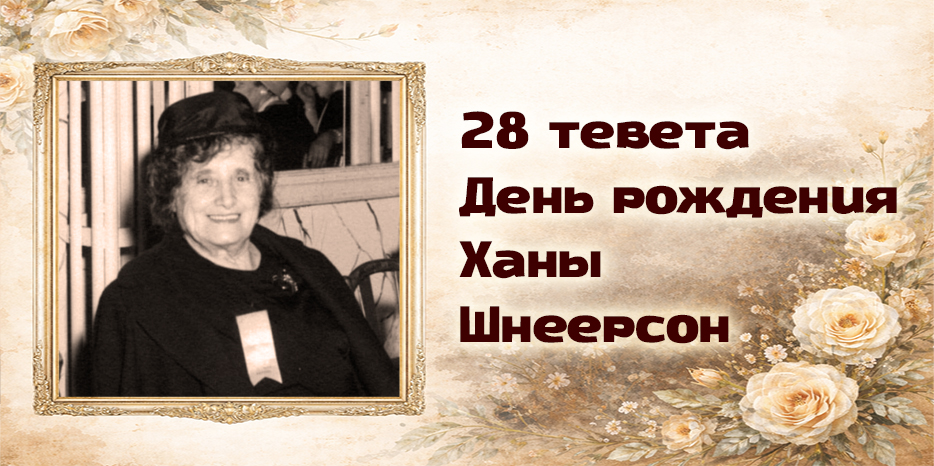
Tonight, with the onset of the 28th of Tevet, Jewish communities around the world mark the 146th anniversary of the Birthday of the righteous Chana Schneerson, mother of the Seventh Lubavitcher Rebbe, Menachem Mendel Schneerson, and wife of the Chief Rabbi of Yekaterinoslav-Dnipropetrovsk from 1909-1939, Levi Yitzchak Schneerson.
The unprecedented spiritual feat of this woman has only recently begun to be revealed in its entirety. An important source of information about the fate of the Schneerson family has been her “Memoirs,” the handwritten text of which was discovered several years ago. Their publication was a major event.
The name of her righteous husband is now borne by many Jewish institutions, including the Jewish school in Dnipro, while streets in many Ukrainian cities, including our own, are named in honor of her great son. In honor of Rebbetzin Chana herself, the International Humanitarian-Pedagogical Institute “Beit Chana” and the community’s women’s club are named. Not only in Dnipro but throughout the world, the memory of this woman, who became a symbol of Jewish courage and resistance to the Soviet regime, is held sacred, and hundreds of thousands of Jewish girls are named after her, along with many educational and charitable institutions.
We provide a brief biography of Rebbetzin Chana, based on the account by Shmuel Somin.
“Rebbetzin Chana Schneerson was born on the 28th of Tevet, 5640 (January 12, 1880), in the city of Nikolayev. Her parents were Rabbi Meir-Shlomo Yanovsky, who served as the rabbi of Nikolayev, and Rebbetzin Rachel, the daughter of Rabbi Yitzchak Pushnitz, the rabbi of the town of Dobrenk.
On the 13th of Sivan, 5660 (June 10, 1900), she married Rabbi Levi Yitzchak Schneerson. In 5669 (1909), Rabbi Levi Yitzchak assumed the position of rabbi of the city of Yekaterinoslav (as Dnipro was called at that time). For thirty years during his tenure as rabbi of Yekaterinoslav, the Rebbetzin stood by his side in his holy work. In addition to being well-versed in books and an educated woman, she was fluent in Russian, understood people, and knew how to communicate with them. In this, she contributed greatly to the success of her husband, the rabbi, and his influence on the Jews of Yekaterinoslav.
In 5699 (1939), Rabbi Levi Yitzchak was arrested for his active efforts to strengthen Judaism in Soviet Russia. He was soon sentenced to a long exile in the remote and dreadful place of Chiali (now renamed Shieli) – a remote urban-type settlement in Kazakhstan. As soon as the Rebbetzin learned of her husband’s whereabouts, she joined him, despite the difficulties and danger involved. Arriving in Chiali, she managed to alleviate the innumerable hardships and sufferings that befell her husband.
In the inhuman conditions of exile, Rebbetzin Chana herself, with her own hands, made homemade ink and procured paper to enable him to record his amazing Torah insights (these writings saw the light of day only thirty years later). In 1944, the soul of Rabbi Levi Yitzchak departed this material world.
In 5707 (1946), her wanderings also came to an end. Rebbetzin Chana traveled from Russia to Paris, where she was met by her eldest son, the son-in-law of the Sixth Chabad Rebbe, the future Seventh Lubavitcher Rebbe, whom she had not seen for over twenty years. From Paris, both proceeded to New York, where a new, happy period of life began for the Rebbetzin.
In Brooklyn, the Rebbetzin lived the last seventeen years of her life. She passed away on the holy Shabbos, 6 Tishrei, 5725 (1964), and was buried in New York. In memory of the Rebbetzin, Jewish educational institutions named “Beit Chana” and “Machon Chana” were established worldwide. The Rebbe established the “Keren Chana” fund in memory of his mother to provide financial assistance to young women wishing to continue their Torah studies.
On the 6th of Tishrei, 5746 (1985), the Rebbe said: ‘Despite all the difficulties and worries of daily life, (my mother) took upon herself an additional concern – the concern to make possible the publication of the Torah of my father – my teacher and my rabbi, so that many Jews could study his explanations of the inner ideas of Torah in the light of Chabad Chassidus. And all this in order to bring closer the true and complete redemption by Moshiach, our righteous one, which depends on spreading the wellsprings of Torah outward!..'”