




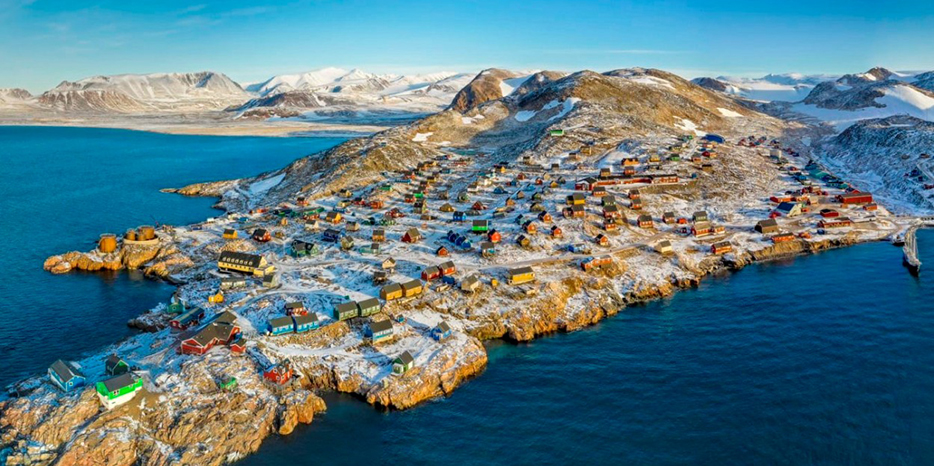
While the world watches whether Trump can annex Greenland straight from aircraft carriers in the Persian Gulf, we were interested in a different question. It’s about the history of Jewish presence on this huge piece of rock and ice. Greenland is the largest island in the world, with an area of over 2 million square kilometers. Approximately 80% of its territory is covered by a thick layer of ice, and its population of about 57,000 consists mainly of Inuit.
There has never been a permanent Jewish community or synagogue here. As of 2025, the only Jew permanently residing in Greenland is Paul Cohen — a translator who has been living in the city of Narsaq since 2001. Cohen and his family run a tourism business. But even before him, Greenland had a Jewish history.
According to research by historian Vilhjálmur Örn Vilhjálmsson, the first Jewish presence in Greenland likely dates back to the 16th century. Jews actively participated in the Dutch whaling industry, whose ships operated in Arctic waters around the island. Amidst the ice floes, fogs, and storms, Jewish prayers may have been heard for the first time on Greenlandic soil.
After Denmark fell under the onslaught of Nazi Germany in 1940, the Danish envoy Henrik Kauffmann signed an agreement allowing the United States to protect Denmark’s Arctic territories. In 1941, the U.S. Air Force established a base in Thule (later known as Thule Air Base), where thousands of American soldiers arrived — among them was an unprecedented number of Jews.
In Thule, Jewish soldiers organized what became known as “the world’s northernmost minyan.” Pilot William J. Gordon and Private Maurice Bettman founded a group, jokingly calling it “Bnei-Thule.” Holocaust survivors from Berlin prayed side by side with Jewish soldiers from Morocco drafted into the U.S. Army — a rare human mosaic in the very heart of the Arctic.
Military chaplain rabbis worked on the so-called “Northern Route” — a chain of bases in Greenland, Iceland, and the North Atlantic that protected Allied convoys. Every few months, a rabbi would fly between isolated outposts, transporting Torah scrolls, prayer books, and kosher food. By Passover, military aircraft delivered matzah, wine, and Haggadahs.
In the 1950s, a Jewish-tradition-observing nurse named Rita Sheftelowitz lived in Greenland. Raised in Denmark and saved during the Holocaust by her teacher (a Righteous Among the Nations), Sheftelowitz arrived in western Greenland in 1955 as a volunteer.
Keeping kosher was not easy, but it was possible. She mainly ate local kosher fish. Twice during the winter, supplies were dropped to her from an airplane. In one of the parcels, her mother from Denmark included matzah for Passover.
When seeing off visiting Jewish relatives from Germany, she would bid them farewell with the words, “Next year in Jerusalem.” Later, she indeed moved to Israel, started a family, and eventually returned to Denmark.