




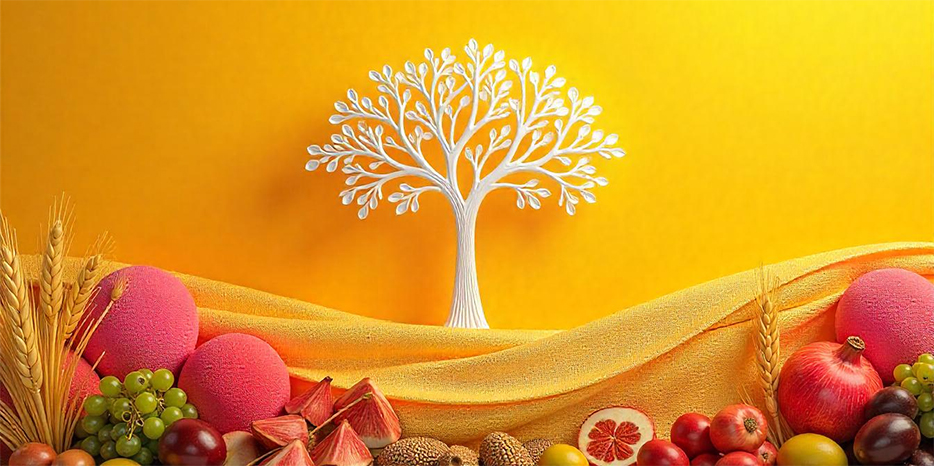
Today is the 15th of Shevat, the day the Jewish people celebrate the holiday of Tu BiShvat, or the New Year for Trees.
The holiday of Tu BiShvat is not mentioned in the Torah; it was established by the sages of the School of Hillel about 2,000 years ago and is first mentioned in the Talmudic tractate Rosh HaShanah. The Torah commands Jews to set aside ma’aser (a tithe) from the fruit harvest to give to the Kohanim and Levi’im, who served in the Temple and had no land allotments, or to the poor. Therefore, it was necessary to determine the exact date of the New Year for Trees, i.e., when a tree “matures” by a year. Our sages, who were experienced and observant farmers, determined that until approximately the middle of the month of Shevat, trees draw moisture that remained in the soil from the previous year, and from this time onward, they draw from the rainwater that fell in the current year. Therefore, the 15th day of Shevat became the New Year for Trees.
The sages recount that when the trees learned that G-d gave people a New Year, they became envious. The trees began to ask G-d to establish a holiday for them as well. G-d asked, “When?” The trees replied, “In Shevat. This month has much rain.” G-d agreed and wanted to set the holiday on the 1st of Shevat, but the trees asked Him to move the New Year to the middle of the month, since the 1st of Shevat is already a holiday – Rosh Chodesh. And to this day, we celebrate the holiday of trees on the 15th of Shevat.
Climatic conditions in different regions of Israel vary, so the spring awakening of nature begins earlier on the plains than in the mountains. However, by the 15th of Shevat, spring blossoming reached the mountainous regions as well.
The main custom of the holiday is to eat fruits that grew in the Land of Israel. It is also customary to eat fruits that grew in other countries: carob fruits, apples, and almonds. It is customary on Tu BiShvat to eat a fruit of the new harvest, reciting the blessing Shehecheyanu beforehand.
There is a custom to taste seven species of fruits on this day – those for which the Land of Israel is praised – wheat, barley, grapes, figs, pomegranates, olives, and dates. Another custom prescribes trying 15 different kinds of fruits on Tu BiShvat – in honor of the 15th day of the month of Shevat. However, most people follow the custom of serving as many different kinds of fruits as possible, both fresh and dried. In Eastern Jewish communities, it was customary to first eat dishes made from wheat and barley, and then fruits.
An important custom of the Tu BiShvat holiday is planting trees in Israel. This custom became widespread with the beginning of the Jewish people’s return to their homeland. On Tu BiShvat, many Israelis go out into nature with their children to strengthen their connection to their native land, planting young saplings that many years later will densely carpet the expanses of the Land of Israel. An exception is every seventh year – the Shmita (Sabbatical) year – when according to Torah law, any land cultivation is prohibited.
Outside the Land of Israel, especially in countries with harsh climates where the 15th of Shevat is still in the midst of winter, it is customary to purchase or transplant indoor plants and donate them to Jewish organizations. It is also customary to hold fundraising campaigns before the holiday, with the funds directed towards planting trees in Israel. With funds collected over the years by Jewish educational institutions in Dnipro for community development, entire groves of beautiful trees have been planted in many areas of Israel.