



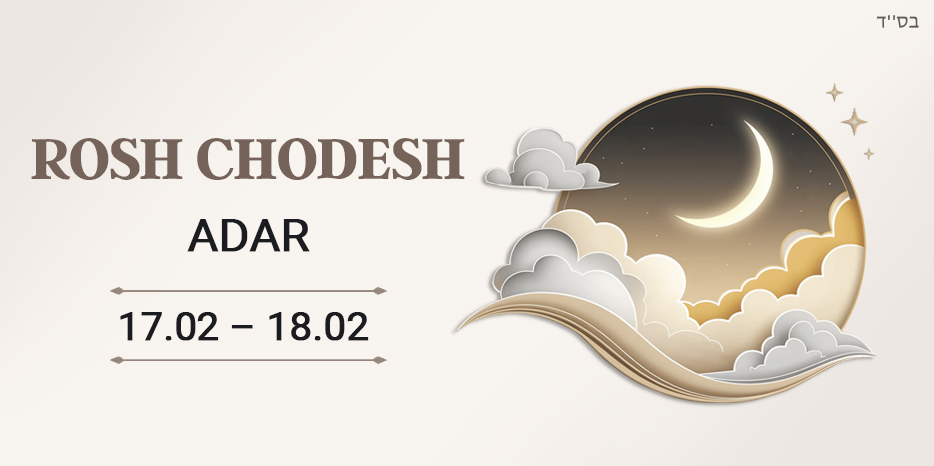
Today marks the beginning of the month of Adar, the last of the months in the Jewish calendar (but not the final month of the year). The Torah counts the months starting from Nissan—the month of the Exodus from Egypt—while the new calendar year begins on the 1st of Tishrei, the anniversary of the creation of the first man.
Rosh Chodesh Adar is celebrated for two days because the preceding month of Shevat always has 30 days. Adar is the only month that is doubled in a leap year, when an additional Adar is added. Nevertheless, it is always the same month—both the first and second Adar are the twelfth month of the year (Rosh Chodesh of the second, additional Adar also lasts two days, since in that case the first Adar has 30 days). This year we have only one Adar.
However, in an ordinary, non-leap year (like this one), the month of Adar is incomplete—it consists of 29 days. (Adar, which directly precedes the month of Nissan, always has 29 days, but if there are two Adars in a year, the first will have 30 days and the second 29.)
Adar is considered the most fortunate, successful, and favorable month, when even apparent misfortunes and troubles are transformed into good and turn into luck. In Adar, everything is overturned, emphasized the Lubavitcher Rebbe, and overturned for the better.
This was most vividly demonstrated in the times of Mordechai and Esther and the miraculous victory of the Jewish people over the wicked led by Haman. However, it should be remembered that not only the days of Purim are considered fortunate, but the entire month is called “increasing in joy.”
The Sages connect this with the zodiac sign of Adar—Pisces (in Hebrew, dagim). Thus, it is indicated: “Just as fish are strong, agile, and thrive in water—their natural environment—so too, Israel is strong and thrives in the world of Torah, whose waters rise during this month.” Thus, Torah brings them luck. No enemy can harm the people of Israel as long as their desire for Torah does not weaken, as happened during the first war with Amalek or in the story of Mordechai and Esther, when the constellation that protected Israel set, and a threat of destruction loomed over them. For as soon as Israel strengthens its connection with Torah, Hashem immediately frustrates the plans of the enemies, and the constellation protecting Israel rises high in the sky.
This is what the Baraisa teaches us (Berachos 61): “Once, hostile foreign (Roman) authorities forbade the Jews to study Torah. Papos ben Yehudah was traveling through Eretz Yisrael at that time and discovered that Rabbi Akiva was gathering large groups of students everywhere and publicly teaching Torah. He said to him: ‘Akiva! Are you not afraid of the Roman authorities?’ He replied: ‘I will tell you a parable that will explain our situation. A fox was once walking along the riverbank. Seeing fish gathering in one place and then another, he asked them: “What are you fleeing from?” The fish replied: “We are fleeing from the nets that people are setting for us.” The fox then said: “Would you like to come up onto the dry land, under my protection, and make a covenant with me like the one your ancestors made with mine?” The fish replied: “You are not what they say you are. They say you are the cleverest of animals, but you are simply a fool! If we are afraid in our natural environment, which gives us life, how much worse would it be in an environment that means certain death for us?” So it is with us. Now we sit and study Torah, of which it is written, “It is your life and the length of your days,” yet we are in such distress. How much worse would it be if we abandon it!'”
The source of Israel’s strength and joy lies in the rising waters of Torah. The month of Adar, created for joy, brings it only through the waves of Torah. Simply put, the days of Adar are more suited than any other days of the year to willingly, lovingly, and joyfully accept the yoke of Torah!