



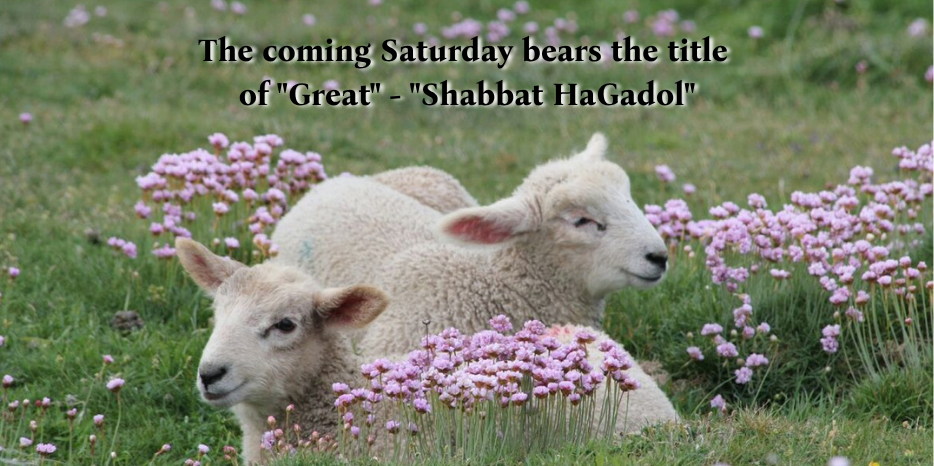
Shabbat, which falls on the evening of March 27, has a special status in the Jewish tradition – this Saturday is called “Great,” or, in the holy language, “Shabbat ha-Gadol,” and it is this Saturday that opens the celebration of Liberation, the Exodus from slavery.
The first “Great Sabbath” occurred a few days before the Exodus of the Jews from Egypt. That year, it fell on the 7th of the month of Nissan. At the beginning of Nissan, the Almighty commanded the Jews: “On the tenth day of this month, each of you shall take for himself a lamb for his family… And you shall keep it until the fourteenth day of this month, and then the whole assembly of the congregation of Israel shall slaughter it” (Exodus 12).
This is what is written in the Sefer HaPardes, a book according to a tradition written by the great Rashi (R. Shlomo Yitzchak): “On this day, the tenth of Nissan, the Sabbath preceding the liberation, the Jews chose a lamb for the Passover sacrifice. They said to themselves: ‘Now we will sacrifice the idol that the Egyptians worship, and they will not dare to attack us.’ The Almighty said to them: ‘You will now see the miracle that I will perform for you. Each of you choose a lamb and keep it with you until the fourteenth of Nissan.'”
When the Egyptians saw what the Jews were doing, they tried to avenge their idol, but they were immediately struck by terrible diseases, writhing in terrible agony and unable to harm the Jews. Because the Almighty performed miracles for Israel on this day, the Saturday before Passover was called the Great Saturday. Thus taught Rabbi Abraham, may the Garden of Eden be his portion.”
This commandment to prepare the lamb four days before offering it as a Passover sacrifice was given for fulfillment in the year of the Exodus from Egypt, and it does not apply to subsequent generations.
This Saturday is named Shabbat HaGadol in honor of this miracle. Why is it the Saturday that is celebrated in honor of this miracle? Because if it weren’t for the Saturday, the Egyptians would have paid no attention to the Jews’ actions. And only because the Egyptians knew that Jews do not touch animals on the Saturday did they react with surprise and ask, “Why do you need lambs?” Thus, the Jews found themselves in danger, and the Almighty sent them salvation.
Shabbat HaGadol customs vary among communities, but most consider it important to observe the following:
– It is customary to repeat the laws of Passover and read part of the Passover Haggadah.
Many communities have a tradition of adding poetry (piyyutim) to the Shacharit morning prayer on Holy Saturday, most of which are devoted to the laws of Passover. In this way, all members of the community “revise” the complex laws related to chametz and matzah, as well as other halachic regulations.
Shacharit includes the Barkha Nafshi portion and the fifteen Psalms of Shir HaMaalot, which are recited on all other winter Shabbat days during the Mincha prayer, as well as the portion of the Passover Haggadah that begins with the words “We were slaves of Pharaoh in Egypt” and ends with the words “To atone for all our sins” – since it was on Great Shabbat that liberation began.
Some authorities explain the custom of reading part of the Passover Haggadah on this day by citing the need to familiarize adolescents with it in advance, in order to best fulfill the Torah’s commandment “You shall tell your son (about how the Almighty led Israel out of Egypt)” on Passover night. This latter custom has not become widespread in Sephardic communities. It should be noted that the Vilna Gaon, Rabbi Elyahu, also never read the Passover Haggadah on Holy Saturday.
– Since the time of the tanai and amoraim, the following custom has existed: a rabbi in the synagogue gives a lecture on preparation for Passover.
During the times of the Mishnah and Talmud, it was customary in virtually all Jewish communities worldwide for the city’s most learned rabbi to address all its citizens on Holy Shabbat. In a lengthy speech, he provides them with instructions and prescriptions of both general and practical nature, explaining the pre-Passover laws of purifying vessels, eliminating chametz, and making matzah—so that the city’s residents, God forbid, would not make any mistakes, since after Passover, even the slightest admixture of forbidden chametz cannot be undone. It is customary to include in this speech various fascinating stories related to Holy Shabbat and Passover.
If the end of Holy Saturday coincides with the beginning of Passover, some communities reschedule the rabbi’s address for the preceding Saturday, as the laws he teaches must be applied in preparation for the holiday. If Holy Saturday immediately precedes Passover, all preparations for the holiday are completed before its onset.
– There is an ancient tradition: at the end of Holy Saturday, bake bread from the flour intended for making matzah and distribute it to those in need.
This bread is called “poor man’s challah” (similar to another name for matzo—”poor man’s bread”) or “synagogue challah” and is divided among the poor. Richer people bake more, poorer people less. One of our sages wrote: “When this custom began to be neglected, a curse fell on the harvest.”
Magarshal of Lublin explained this custom this way: “Every Jew must eat a small amount of bread made from the flour intended for baking matzah before Passover. Why? So that it can be assumed that even if a small amount of chametz did end up in the flour, it was concentrated in the portion eaten before Passover.”
Some believe that the custom of baking “poor man’s challah” is only slightly related to the reason taught by Maharshal. In reality, this challah was shared among the poor to fulfill the mitzvah of helping those in need, and the merit of fulfilling this crucial mitzvah helped with the difficult task of eliminating chametz and preparing for Passover.