



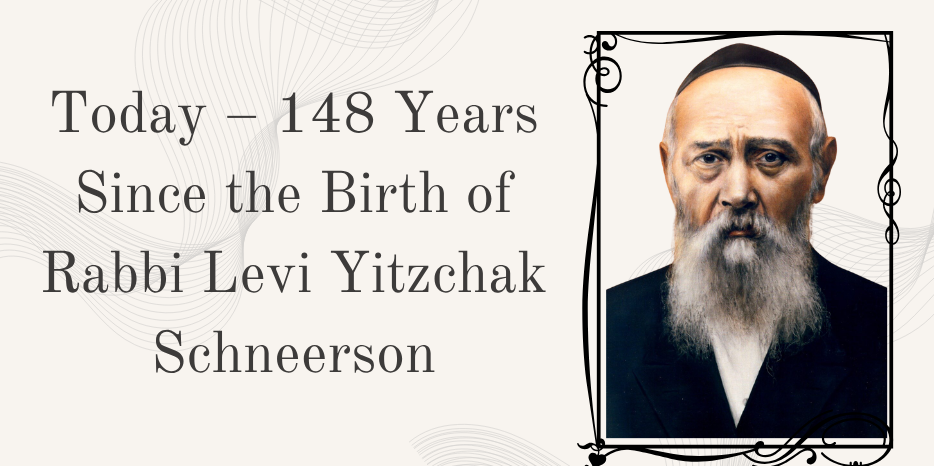
Today, on the third day of the Omer count, the 18th of Nissan, marks 148 years since the birth of the righteous Rabbi Levi Yitzchak Schneerson, who from 1909 to 1939 served as the Chief Rabbi of the city now called Dnipro, but which at that time was first named Yekaterinoslav and then Dnipropetrovsk. He was the father of the Leader of our generation, the Seventh Lubavitcher Rebbe, Menachem Mendel Schneerson.
The entire life of Rabbi Levi Yitzchak Schneerson is an example of selfless service to his people, unyielding fortitude of spirit, and a willingness to wage an uncompromising struggle for every Jew and for their right to observe the commandments and traditions with sanctity. Beyond his acknowledged spiritual leadership, Rabbi Levi Yitzchak Schneerson became renowned as one of the greatest religious thinkers of our time.
In Dnipro, the memory of this outstanding individual is held sacred – a lyceum and a yeshiva bear his name, and hundreds of Jewish boys in our city are named in his honor. On our website, his brief biography is posted in the “Founders” section: “Levi Yitzchak Zalmanovich Schneerson was born on 18 Nissan 5638 (1878) in the town of Poddobryanka near Gomel. His lineage traces back to the third Lubavitcher Rebbe, the Tzemach Tzedek. Levi Yitzchak began studying Torah under the guidance of the rabbi of Poddobryanka, Yoel Chaikin – his mother’s uncle. He quickly surpassed his teacher and continued his study of sacred texts independently. The Rebbe Rayatz wrote that ‘from an early age, Levi Yitzchak was distinguished by extraordinary abilities and diligence.’ He received his rabbinic ordination (semichah) from the greatest authorities of that time: Rabbi Eliyahu Chaim Meizel of Lodz and Rabbi Chaim of Brest.
In 1900, Rabbi Levi Yitzchak married Chana – the daughter of Rabbi Meir Shlomo Yanovsky. They were matched by the Fifth Lubavitcher Rebbe, Sholom DovBer Schneerson. After the wedding, the young couple moved to Nikolaev, where Chana’s father was the rabbi. In Nikolaev, on 11 Nissan 5662 (April 18, 1902), Levi Yitzchak and Chana’s son Menachem Mendel was born. Later, two more children were born into the family: DovBer and Yisroel Aryeh Leib.
In 1907, Rabbi Levi Yitzchak’s family moved to Yekaterinoslav. They settled on the second floor of 20 Zheleznaya (Mironova) Street. Later, from 1928 to 1934, they lived at 15 Zheleznaya and Ubornaya (Glinka) Street. Their final apartment was on Kudashevskaya Street (now Barrikadnaya, 16).
In 1909, at the age of 31, Rabbi Levi Yitzchak was invited to serve as the rabbi of the Yekaterinoslav community. Mikhail Karshenbaum wrote about the Yekaterinoslav period of Levi Yitzchak’s life in “ShSh” No. 2, 1991: ‘His election did not go smoothly. The local intelligentsia opposed the candidacy of the young rabbi, preferring to see a less orthodox person as the spiritual leader of the community. They turned to the most authoritative person in the city, engineer Sergei Pavlovich Paley, one of the leaders of the city’s Zionist organization, with a request that he use his influence to prevent the election of a Chassid from the Schneerson dynasty as rabbi. Paley said he did not like being led by others. He decided to meet the candidate himself and went to Rabbi Levi Yitzchak. They spoke for six hours straight, and after the conversation, Paley became one of the new rabbi’s most ardent supporters.’
By 1925, the authority of the Yekaterinoslav rabbi had grown to such an extent that he was offered the position of Chief Rabbi of Jerusalem. But he remained in Yekaterinoslav. A distinctive feature of Rabbi Levi Yitzchak’s activities was organizing aid for the needy. During the Beilis Affair, he participated in establishing a fund to pay for defense lawyers. With the outbreak of World War I, together with Rebbetzin Chana, he organized aid for refugees.
Young Menachem Mendel’s teachers in Yekaterinoslav, besides his father, included Shneur Zalman Vilkenkin. In the mid-1920s, Menachem Mendel moved to Leningrad and in 1927 left the USSR together with the family of the Sixth Lubavitcher Rebbe, Yosef Yitzchak Schneerson. In 1929, he married the Rebbe’s daughter, Chaya Mushka, in Warsaw. Congratulating his son on his marriage, Rabbi Levi Yitzchak wrote: ‘From the deepest depths of my heart, I bless you, my son, my joy, on your marriage to Chaya Mushka. In a good hour. May the G-d of our holy ancestors, through whose merits we act and live, spread a canopy of peace and well-being over your home, that it may stand unshakable. Enjoy happiness with your beloved woman in both the simplest and deepest sense. May the merits of your common ancestor, the Rebbe Tzemach Tzedek and his wife, whose names correspond to your name and your wife’s name, protect you always. By following the path of Torah and observing its mitzvos, may your life be full of peace, tranquility, and all the good that can be sent. May you be the pride and adornment of the Jewish people… Your father, who is always with you, truly with you.’
The situation in the country for Jews who observed the mitzvos of the Torah was difficult. They could not work in enterprises that operated on Shabbos. The authorities would not accommodate the religious. The situation of many families was catastrophic. Seeing this, Rabbi Levi Yitzchak organized a support fund for needy synagogue members, which provoked sharp irritation from the authorities.
In Kharkiv, a congress of Ukrainian rabbis was convened so that they would issue a statement favorable to the Bolsheviks that there was no religious discrimination in the USSR. Levi Yitzchak refused to sign the document prepared by the organizers. Rabbi Levi Yitzchak Schneerson did much for the religious Jews of the city. He managed to secure a meeting with M.I. Kalinin and received permission to personally supervise the kashrus of flour for matzah baking.
Using the formal statements of USSR leaders about freedom of religion and human rights, Rabbi Levi Yitzchak resolutely defended the religious needs of Jewish communities. Even in those years, Rabbi Levik became renowned as a tzaddik and great Torah scholar. Stories about him became legendary. For example, there is this one: one late evening, there was a knock on his door. A frightened woman stood on the threshold. ‘Rebbe, you must help us, my daughter is getting married. Surely a new family cannot begin without a Jewish wedding, without a chuppah.’ At midnight, Rabbi Levi Yitzchak and his wife, Rebbetzin Chana, summoned reliable people. They were still lacking one more, the tenth Jew – for although it is permitted, it is not customary to perform a chuppah without a minyan. In the same building, one floor up, lived a Jew who was the chairman of the building committee, and also, on the side, an NKVD informant assigned to monitor Rabbi Levik. This was the man the rabbi invited as the tenth! The wedding was held without music, without a feast, with a tablecloth stretched over four corners serving as the chuppah. But can any of this hinder true Jewish joy and the great miracle of the union of two pure Jewish souls, which no regime or prohibition can prevent? This family began its life according to all the rules, in defiance of everyone. Who knows how many children, grandchildren, or even great-grandchildren of this couple now live among us…
Early in the morning, while it was still dark, the guests began to leave. The happy bride and groom left with the mother – they still had seven festive days ahead, which they would also celebrate secretly at home. Rabbi Levik returned to his daily duties. But who said that arranging and conducting a Jewish wedding is not a daily duty of a rabbi? This story would be incomplete without one, by no means minor, detail.
What happened to the chairman of the building committee, that ‘tenth’ Jew? From that very day, or rather, from that very night, he became a devoted disciple of Rabbi Levik. Soon he fully returned to Judaism and more than once came to the Rebbe’s aid, interceding for him before the authorities. Unfortunately, his intercession was not always effective either. Rabbi Levi Yitzchak was ultimately exiled to Kazakhstan, where he died.
In 1927, Rabbi Menachem Mendel Schneerson left Russia forever. He was never to see his father again. His younger brother, Aryeh Leib, lived for several years in Leningrad. In the early 1930s, he went to the Holy Land. There he died quite young (in 1952). Rabbi Aryeh Leib was buried in the old cemetery in Tzfat. Little is known about the middle son of Rabbi Levik. We only know that he was shot by the Nazis together with the Jews in a hospital in the Ihren district.
Rabbi Levi Yitzchak’s ‘anti-Soviet’ (or rather, Jewish) activities inevitably incurred the wrath of the NKVD. In 1939, a population census was conducted in the USSR. The questionnaire required one to indicate – whether one was a believer or a non-believer. Many were afraid to tell the truth and wrote ‘no.’ Learning of this, Rabbi Levi Yitzchak delivered a fiery speech in the synagogue, stating that Jews must not hide their faith in the One G-d. Levi Yitzchak Schneerson was summoned by the head of the city’s NKVD to confirm the absence of discrimination against believers. The rabbi refused to lie, and on March 28, 1939, the following resolution was issued:
‘I CONFIRM’ Head of the NKVD Directorate of the Ukrainian SSR for the Dnipropetrovsk Region, Lieutenant of State Security (Komarovsky), March 28, 1939
RESOLUTION
City of Dnipropetrovsk, March 28, 1939.
The Head of the 2nd Section of the 2nd Department of the State Security Directorate of the NKVD for the Dnipropetrovsk Region – Lieutenant of State Security – PIVAK, having reviewed operational materials on the Chief Rabbi of Dnipropetrovsk, Shneerson Levik Zalmanovich,
FOUND:
Under the guise of religious activity, Shneerson L.Z. conducts active anti-Soviet agitation of a slanderous and defeatist nature. Maintaining regular contact with his son – the Chief Rabbi of Warsaw, who is a major agent of Polish intelligence, as well as with his close relative – the Chief Rabbi of Riga, Shneerson conducts organizational activities to assemble cadres of an anti-Soviet clerical underground. Suspected of espionage. Shneerson uses the privilege of delivering weekly sermons in the synagogue to slander the Soviet government and its leaders. He organizes material aid on a wide scale for repressed enemies and their families.
Based on the foregoing and considering the proposal of the NKVD of the Ukrainian SSR for Shneerson’s arrest,
I DECIDE:
To arrest SHNEERSON Levik Zalmanovich, born 1878, Jewish, non-partisan, by profession a religious minister, Chief Rabbi of the city of Dnipropetrovsk, initiating criminal prosecution under Article 54-10, Part II.
Head of the 2nd Section of the 2nd Department of the State Security Directorate, Lieutenant of State Security (Pivak)
‘AGREED’
Head of the 2nd Department of the State Security Directorate of the UNKVD, Lieutenant of State Security (Sapozhnikov)’
At 3 o’clock in the morning on March 29, NKVD officers searched the house at 13 Barrikadnaya Street, confiscating the arrested rabbi’s manuscripts and books. His interrogations led nowhere. The prisoner was transferred to Kyiv, but even the capital’s investigators were powerless. L.I. Shneerson was returned to Dnipropetrovsk. The rabbi’s arrest shocked the townspeople; the synagogue board members Lyakhov and Shifrin died suddenly from the shock. On May 14, synagogue workers Abram Samoilovich Rogalin, Shlema Vul’fovich Moskalik, and David Mordukhovich Perkas were arrested. David Perkas declared: ‘Europe will not let the arrest of Shneerson stand; he is a very prominent figure…’
But hope in Europe was in vain. The investigation intensified; the accomplices were interrogated by the deputy head of the investigative unit, Chulkov. Colleagues called him ‘The Terrible.’ Under torture, Rogalin and Moskalik signed their ‘confessions.’ Later, Rogalin claimed he had not been in control of himself at that moment. The appeal to the authorities from Abram Samoilovich Rogalin testifies to the methods of the investigation: ‘On May 14, 1939, I was arrested in the city of Dnipropetrovsk, where I permanently resided and worked. By a resolution of the Special Council of November 23, 1939, I was exiled for 5 years to the Kazakh SSR as socially dangerous.
After my arrest, in the NKVD prison in Dnipropetrovsk where I was held, I was offered to sign that I was part of a religious underground organization that operated with the aim of undermining Soviet power. The testimony I was offered to sign was written stating that our newspapers lie about the Spanish war and China, that under Soviet power Jews live worse, and abroad better, that we have nothing in the USSR, long queues everywhere, etc. In order to force me to sign the lies they proposed about me, I was brutally tortured, kept in the investigator’s office, completely deprived of sleep, food, drink, and not allowed to use the restroom.
The investigator Starchy placed some kind of bottle over my head and threatened me, burned my hair with a burning candle, cursed me with all sorts of shameful words, etc. The senior investigator Chulkov constantly gave instructions to the investigators torturing me to mock me, to wear out my guts and soul, to break my ribs, to torment me until I signed everything. Exhausted by such methods to the point of losing consciousness, not in control of myself, I signed everything they offered me…
What happened to me, I cannot understand at all. Why is this? Who needed this? For what purpose? All that they presented to me and which I was forced to sign – is complete lies, slander, injustice. I have never belonged to any organizations, never harbored any hostile malice towards the Soviet government. I am already an old man – I am 61 years old, now I am in very bad condition, separated from my family, in terrible material and moral conditions, deprived of everything human, living in filth, starving. Why must I bear this injustice? I ask that measures be taken to restore my truth.
A.S. Rogalin, January 29, 1941.’
On August 11, the Head of the UNKVD for the Dnipropetrovsk Region, Lieutenant of State Security Sedov, approved the ‘Indictment in Criminal Case No. 103129 charging Shneerson Leivik Zalmanovich, Rogalin Abram Samoilovich, Moskalik Shlema Vul’fovich, Perkas David Mordukhovich under Articles 54-10 Part 2 and 54-11 of the Criminal Code of the Ukrainian SSR.’ It stated that the anti-Soviet activities of Rogalin, Moskalik, and Perkas were carried out on the direct instructions of Shneerson. A few days later, the rabbi was presented with the charges, which included maintaining contact with ‘Jewish clerical circles abroad,’ establishing a network of illegal funds to aid relatives of repressed Jews, and carrying out anti-Soviet propaganda under the guise of religious rituals in the synagogue and at home. The case was transferred to Kyiv, where it was concluded that ‘the materials gathered for hearing the case in open court are insufficient.’ However, considering the social danger of the accused, it was recommended to refer the case to the Special Council under the NKVD of the USSR, also taking into account that the case materials contained ‘data that could not be used in a court hearing.’
On November 23, 1939, L.I. Shneerson and the others were sentenced by the Special Council to five years of exile in Kazakhstan. Repeated appeals by the relatives of the condemned to the authorities citing poor health and unbearable living conditions remained unanswered. One of L.I. Shneerson’s applications addressed to L. Beria was also considered by the Special Council on May 14, 1941, and a revision of the decision was denied. In this application, he wrote: ‘I am an old man, 70 years old, sick… Must I truly suffer innocently until the end of my life… All my life I served the Torah.’ Rabbi Levi Yitzchak served his exile in the station settlement of Chiili on the Tashkent Railway, located 128 km from the city of Kzyl-Orda. He arrived in Chiili in the winter of 1940. The conditions of life in Chiili for Rabbi Levi Yitzchak and Rebbetzin Chana Schneerson are evidenced by a letter the rabbi wrote to his children on March 11, 1943: ‘My dear beloved children! I wrote to you several weeks ago. Without waiting for your letter, I am writing again. I have been living here for about 4 years, and Mama came to me 2 years ago at Passover… All our belongings: blankets and the like – remained at home, and we are with nothing, without means of subsistence. We are, thank G-d, alive, but our health is very weak and we often get sick. Oh! How I wish in my old age to be near my children, but we are among strangers, there are no acquaintances. I ask you, immediately upon receiving this letter, to write to us about your health and how you are living, and also to send us parcels: clothing – underwear and warm clothing, fabric for suits, also shoes – for me (size 43) and for Mama (size 38) and the like, as well as a food parcel.
We await your letter with impatience. Kissing you firmly, your father, Levik.
Greetings from Mama. In the next letter, she will also write.’ Rebbetzin Chana did everything to enable her husband to live and work under these conditions. There was no ink or paper – she made ink from herbs and traded the most necessary items for paper. Thanks to this, Rabbi Levi Yitzchak was able to continue his brilliant commentaries on the Torah – “Likutei.” During these difficult years, Rabbi Levik wrote a series of books later published: “Likutei Levi Yitzchak” – commentaries on Tanya and the Zohar, and “Toras Levi Yitzchak” – commentaries on the Talmud.
After Levi Yitzchak’s death, the faithful Chana did everything to preserve and smuggle his works to America. In one of his articles, Rabbi Shmuel Kaminezki wrote: ‘Perhaps it all seems simple and ordinary now. But at that time, it was heroism. In doing so, she did more than a rabbi’s wife, and her deed should serve for all women as an example of self-sacrifice and devotion to the Great Cause. Today is not that time, and such self-denial is not required of us. The life and deeds of the wonderful Rebbetzin Chana, whose yahrzeit is observed on 6 Tishrei, continue to serve as an example: how in the most difficult and complex situations one must not lose spirit or give up… In the name Chana are the initial letters of three mitzvos most important for family life. A great woman bore this name with honor. We will always remember her.’ In April 1944, the rabbi and his wife were permitted to move to Alma-Ata. There were many Chassidim there, and on the first Shabbos, the rabbi prayed with a minyan on the outskirts of the city. The harsh conditions of exile took their toll. His old illnesses flared up. On the night of the 20th of Av, 5704, he awoke and asked for water to wash his hands. When the water was brought, he said: ‘We must move to the other side.’ These were his last words. He died on the 20th day of the month of Menachem Av, 5704 (1944), in Alma-Ata and was buried there in the local Jewish cemetery.
His grave in the Jewish cemetery in Alma-Ata became a site of pilgrimage.
Rabbi Levi Yitzchak Schneerson was rehabilitated in 1989.
In 1995, a three-volume biography of Levi Yitzchak was published in the United States and Israel.