


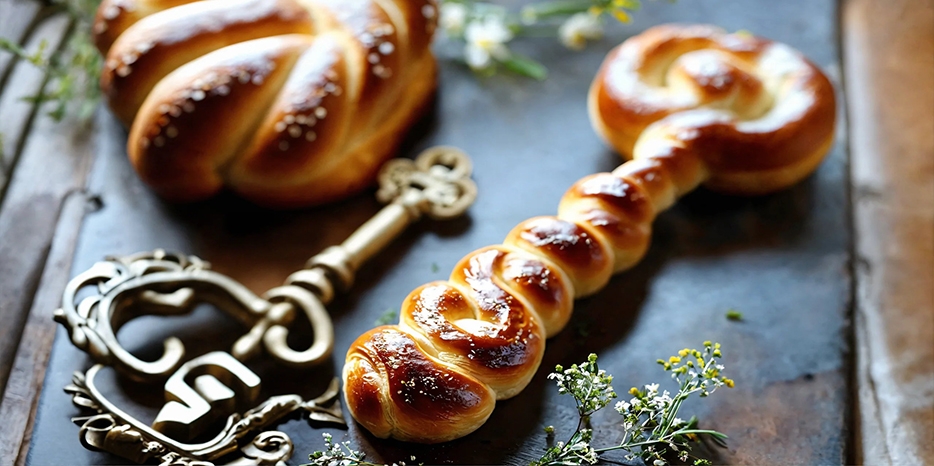
For the upcoming Shabbat, the first after Pesach, it is customary to bake challahs in a special shape resembling a key. In Yiddish, they are called “Shlissel Challahs” (“shlissel” means “key”).
There is an explanation for this beautiful custom: “There is a segulah — for there to be sustenance, a parnassah — one must open the way with a key specifically on this Shabbat, the first after Pesach ends. Those who know how bake challahs shaped like keys, but you can also simply place a key into the dough and bake the challah with the key inside. Then, when cutting the challahs, the key should be removed.”
“The most important thing is not the shape of the challah, but that you perform the separation of the dough. That is the great mitzvah of ‘hafrashas challah’ — that is the real ‘key, the shlissel.’ The shape of the challah is only a symbol,” explained Rebbetzin Chana Kaminezki. “The most important thing is to separate the challah and at that moment ask the Almighty — for health, for a livelihood, for whatever is urgently needed right now. Everyone is currently concerned about the serious challenges of making good shidduchim for our children; Jewish and non-Jewish mothers alike think about this. So, separating challah on this Shabbat greatly contributes to a good shidduch, and you can ask the Almighty for a good match for your children and for the children of your relatives and acquaintances.
“When making challah, especially the first one after Pesach — the first one after the Jewish people left slavery and became a free nation — it is very important to think correctly and about the right things. For example, consider the meaning of each ingredient in the challah, for they also comprise our entire lives.
“What is yeast? It is personal growth, development, learning, striving for improvement, progress — without which both an individual and all of society would degrade.
“What is sugar? It is our attention and love — the importance of sincerely noticing the good in people, telling them about it, and bringing understanding, friendship, and ‘Ahavas Yisroel’ into the world.
“What is salt? It is criticism — of which there should not be too much, but which must certainly exist. We must help people improve and correct them, but ‘oversalting’ is unacceptable in challah and in life.
“What are eggs? They are the mystery of the birth of new life, a symbol of family, creation, and the cycle of birth and rebirth.
“What is water? It is a symbol of life and Torah. Without water, there can be no life, just as without Torah — this is a very common symbol in Jewish tradition.
“And finally, what is flour? It is work — the act of creation that is our purpose in this world: to plant seeds, tend to them, harvest the crop, thresh it, grind it, and obtain flour as a symbol of transforming nature into civilization.
“One should think about these things when making challahs — but the main thing, I emphasize once again, is the separation of challah with the recitation of the brachah. That is what opens the Divine light for us.”