



Today, 9 Kislev, marks the 253rd anniversary of the birth and the 199th anniversary of the passing of the Second Rebbe of Chabad, Rabbi Dov Ber, also known as the Mitteler Rebbe, the “Middle Rebbe.” On Friday, 10 Kislev, the 200th anniversary of his release from the czarist prison is observed. Miracles and wonders accompanied him throughout his life.
His father, Rabbi Schneur Zalman of Liadi, founder of the Chabad movement, known as the Alter Rebbe, and his wife Rebbetzin Sterna had no sons for fourteen years, over which they grieved greatly. On the eve of his passing from this world, the great tzaddik and disseminator of the teachings of Chassidus, the Mezritcher Maggid, disciple and successor of the Baal Shem Tov, summoned the Alter Rebbe and, informing him that a son would soon be born to him, instructed that he be named after him. A year later, a boy was born to the Alter Rebbe, who received the name Dov Ber.
It was the Mitteler Rebbe who was destined to establish the capital of Chabad in Lubavitch, although after the passing of the Alter Rebbe, Rabbi Dov Ber lived for some time in Kremenchug. Then, as if yielding to the insistence of the Belarusian chassidim, he set out for Lubavitch, and on the site of the burnt ruins where the house in which the Alter Rebbe had studied under Issachar Dov had once stood, he established his residence and blessed the city as the capital of Chassidus and the place of residence of the leaders of Chabad.
The Rebbe Rayatz explained the reason why such an unassuming shtetl as Lubavitch received the status of capital: “It was not by chance that Lubavitch was destined to occupy so significant a place in the lives of the hidden tzaddikim, and later in the lives of the rebbes and chassidim of Chabad. For people of spirit, Lubavitch, by reason of its particular geographic position, was a place especially suited for separating from the outside world and devoting oneself entirely to Torah and the service of Hashem, or for beginning a new life founded on the traditional pure foundation of Torah.” For more than a century from that day, Lubavitch was the residence of four generations of Chabad leaders, and the movement itself came to be called Lubavitch, and so too the head of Chabad came to be called.
The Mitteler Rebbe established a special committee that dealt with the restoration of the Jewish communities of Belarus affected by the war of 1812; he obtained from the czarist government the allocation of land plots in the Kherson province and established Jewish agricultural settlements on them, including the famous colony “Nahar Tov” on the Dobraya River (now the urban-type settlement of Bereznegovatoye in the Nikolayev region) and many others.
The Mitteler Rebbe also established the first Lubavitch settlement in Eretz Yisrael, in the city of Chevron. The Rebbe traveled extensively, visiting even remote Jewish towns, conducting active fundraising for needy Jews in the Holy Land. It was precisely this assistance directed to Eretz Yisrael that served as the formal pretext for the Rebbe’s arrest by the czarist authorities. He was accused of transferring money to Russia’s enemy — the Ottoman Empire, which at that time formally possessed Eretz Yisrael. The informers even forged a letter of the Rebbe, and on this basis he was imprisoned. However, the Mitteler Rebbe demolished all the accusations, proving their complete baselessness, and was released on 10 Kislev 1826, the day after his 53rd birthday.
The Rebbe foresaw that the following year, 5588, would be a year of great persecution and evil decrees for the Jews. Thus, for example, the decree “On the Cantonists” was announced — the conscription of Jewish children into the czarist army with the aim of tearing them away from Judaism — along with other anti-Jewish government enactments. On Rosh Hashanah and Yom Kippur in 5588, the Mitteler Rebbe set out for Gadyach to pray at the ohel of his father, the Alter Rebbe. He was accompanied by thousands of chassidim, and the Mitteler Rebbe said to them: “I have obtained from my father that he release me from the position of Rebbe.” The chassidim decided that he intended to travel to Eretz Yisrael and murmured that he was leaving them like cattle without a shepherd. The Mitteler Rebbe answered them: “My son-in-law, Rabbi Menachem Mendel, is with you, and he will be a faithful shepherd to you.”
Immediately after the holidays of the month of Tishrei, the Rebbe fell gravely ill. Setting out from Gadyach to Lubavitch, he reached only the town of Nizhin, where the progressing illness confined him to bed. The greatest physicians were unable to ease his suffering, but the Rebbe urged the chassidim not to despair and to be joyful, for the world is in distress, and joy softens the judgment. On his 54th birthday, the Rebbe lost consciousness repeatedly, and in the evening, having instructed that he be dressed entirely in white, he began to speak to the chassidim, explaining to them the verse “After Hashem shall you go.” Before the morning dawn, he concluded his discourse with the words: “For with You is the source of life, from the life of life itself,” and having uttered them, the Mitteler Rebbe departed the material world.
His son-in-law, the Tzemach Tzedek, said: “Such a departure from the world we do not find since the departure from the world of the Rashbi, who passed away in the midst of the recitation of Torah.” On that same day he was buried in the city of Nizhin, and the first anniversary of his release — 10 Kislev, which the chassidim had prepared to observe with great joy — became a day of heavy mourning for the entire Jewish people.
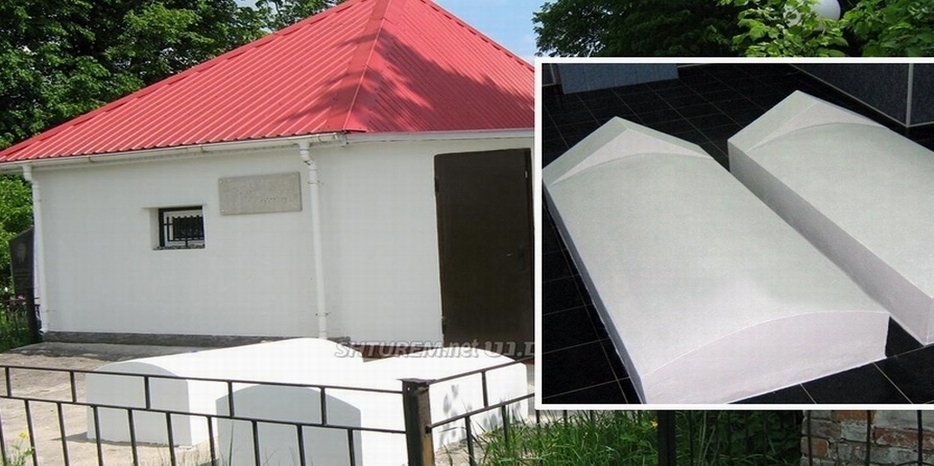
The photo shows the ohel of the Mitteler Rebbe in the city of Nizhin, Chernigov region.