



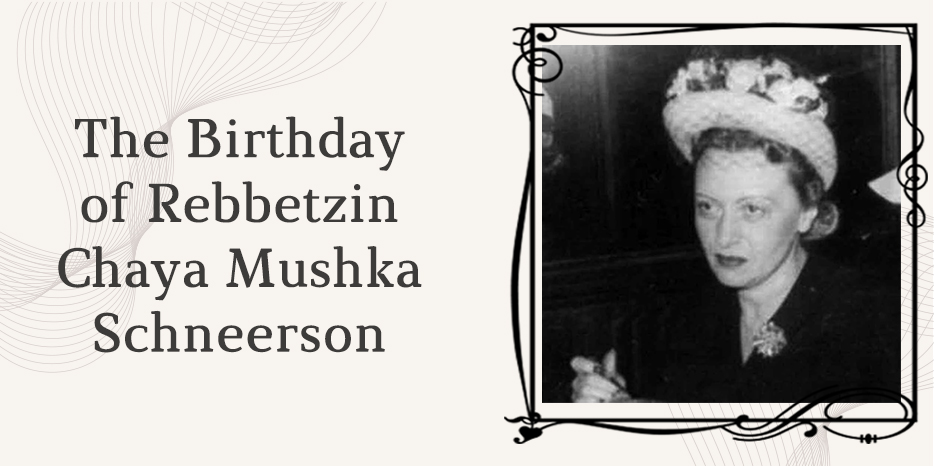
This evening, with the onset of the 25th day of the month of Adar, the entire world marks the 125th anniversary of the birth of the righteous Rebbetzin Chaya Mushka Schneerson, wife of the Seventh Lubavitcher Rebbe, Menachem Mendel Schneerson, and daughter of the Sixth Rebbe of Chabad.
Although the righteous Rebbetzin Chaya Mushka held the status of “wife of the King and daughter of the King,” for both her father and her husband held the highest title of Leader of the Generation – the Lubavitcher Rebbe – she was a very modest person, a faithful companion and reliable support for her great husband. Rebbetzin Chaya Mushka became a role model for many Jewish women in the current generation; daughters in tens of thousands of Jewish families are named after her, countless charitable and educational institutions around the world bear her name, and the anniversaries of the major events of her life have become honored dates in Jewish tradition.
We are pleased to reproduce a brief biographical sketch of Rebbetzin Chaya Mushka.
Childhood
Rebbetzin Chaya Mushka was born in Babinovichi – a town neighboring Lubavitch – on one of the Shabbos days of the month of Adar in 1901, to Rabbi Yosef Yitzchak, the future Sixth Lubavitcher Rebbe, and Rebbetzin Nechama Dina. The name for the newborn was suggested by her grandfather, the Fifth Lubavitcher Rebbe, Sholom DovBer. This was the name of her great-grandmother, the wife of the Third Lubavitcher Rebbe, Menachem Mendel, known as the Tzemach Tzedek.
Chaya Mushka’s early childhood was spent in Lubavitch, in the home of her parents and grandfather. Rabbi Sholom DovBer had a special affection for his granddaughter and exerted a tremendous influence on her. In her later years, Rebbetzin Chaya Mushka recalled: “His prayers, full of genuine feeling, remained in my memory forever. I can repeat every word he uttered.”
Youth
Chaya Mushka’s youth coincided with the difficult years of the revolution and the Red Terror, when everything connected with Judaism or religion was brutally suppressed.
In 1920, after the passing of Rebbe Sholom DovBer, her father became the leader of the Chabad movement, and in those years, this meant – the leader of Jewish resistance in general. He established underground cheders, yeshivas, and mikvahs across communist Russia.
Chaya Mushka was a devoted chassid and assistant to her father, actively participating in his dangerous work. Naturally, not everything about this secret activity is known today, but here is one fact: for a long time, at great risk to her life, Chaya Mushka carried candles and food to the underground yeshiva.
Later, when the family moved to Petrograd, Rebbe Yosef Yitzchak gave his daughter power of attorney to receive all official and unofficial mail addressed to him, with the right of delegation. This meant two things: first, Chaya Mushka was a member of the underground who could be trusted. Second, by receiving her father’s mail, she took a risk, and her father trusted in her courage and ability to extricate herself from difficult situations.
Marriage
Early in her youth, at the initiative of her grandfather, Rebbe Sholom DovBer, Chaya Mushka became engaged to Menachem Mendel Schneerson, a direct descendant of the Rebbe Tzemach Tzedek. In 1928, after the family managed to escape from Soviet Russia, the wedding took place in Warsaw. The wedding was attended by the greatest rabbis of Poland, leaders of Chassidic courts, heads of yeshivas, and Jewish communal figures, but hardly any of them could have imagined the true significance of this event: just over twenty years later, the son-in-law of Rebbe Yosef Yitzchak would become his successor, the leader of the Chabad movement, transforming the Jewish, and indeed not only the Jewish, world.
Spared No Effort for Kashrus
After the wedding, the young couple lived in Berlin, and after the Nazis came to power, they moved to Paris. Eyewitnesses recall the Schneerson family’s strict adherence to the laws of kosher food under conditions where obtaining kosher products was extremely difficult. Rebbetzin Chaya Mushka would walk several kilometers to the suburbs of Paris to be present at the milking (the presence of a Jewish observer during milking makes the milk “Jewish”). In Paris, it was impossible to buy matzah that met the Schneerson family’s high standards of kashrus, so the Rebbetzin personally sorted the wheat, grain by grain, ground it in a hand mill, and baked the matzah.
In Burning Europe
After the outbreak of World War II, their wanderings began: Vichy, Nice, Marseille… But even as refugees, the Rebbe and Rebbetzin did not compromise, continuing to observe Jewish laws and customs in the strictest manner.
Later, the Rebbetzin recalled one episode from this flight. During a bombing, she had to push a hesitant Jew who was next to her to the ground. “Of course I pushed him to save his life,” she said with a smile, “but nevertheless, I pushed a Jew. So I had to repent and ask for forgiveness.”
America
In 1940, after much effort by Jewish communities worldwide, Rebbe Yosef Yitzchak was rescued from Nazi-occupied Europe and arrived in the United States. He immediately began taking steps to rescue his daughter and son-in-law. In 1941, Rabbi Menachem Mendel and Rebbetzin Chaya Mushka reached the American shore.
In 1950, Rebbe Yosef Yitzchak passed away. The majority of chassidim demanded that Rabbi Menachem Mendel succeed him as leader of Chabad. In 1951, on the first anniversary of the Rebbe’s passing, Rabbi Menachem Mendel publicly delivered his first maamar – a discourse on G-dliness that only a Rebbe can deliver.
Rebbetzin Chaya Mushka was among those who urged Rabbi Menachem Mendel to accept the position of Rebbe. She understood what this meant for her: her husband would have no personal time; he would cease to belong to himself and his family. But she had grown up in a home where self-sacrifice was an everyday matter. And she understood that her husband was the only person capable of continuing and expanding the work of her father, Rebbe Yosef Yitzchak.
The Rebbe’s Wife
For forty-five years, Rebbetzin Chaya Mushka lived in the world headquarters of the Chabad movement in the heart of a bustling Jewish neighborhood in New York, yet, despite this, almost nothing is known about her and her life. She never once participated in public celebrations or gatherings; she never appeared in public. She shopped only in stores where she was not recognized and was treated like any other customer. One incident is known: when she encountered the wife of the leader of another Chassidic court in a store, and that woman, excitedly greeting her, informed the salespeople whom they had the honor of… Without finishing her shopping, the Rebbetzin left the store and never returned.
The little that we know about Rebbetzin Chaya Mushka was shared after her death by people close to the Rebbe’s family or those who worked in his home. They revealed, among other things, the extraordinary relationship between the Rebbe and his wife.
On those nights when the Rebbe was delayed at farbrengens or meeting with people, which sometimes lasted until dawn, the Rebbetzin would not go to sleep, waiting for him.
In her later years, suffering from a serious illness, she did everything to hide it from her husband – and this despite the fact that Jews from all over the world would tell him of their troubles and ask for his blessings. One close person asked the Rebbetzin why she did not ask her great husband for a blessing for recovery. “It is important for me not to upset him,” was her reply.
“All the Chassidim Are My Children…”
Rebbetzin Chaya Mushka was talking at the table with a Chassidic couple who had come to visit her, while their young children were exploring the house. Returning to the living room, one of the children asked, “Where are your children?” Another, hearing his brother’s question, replied, “You see, there are no toys anywhere. They must have grown up and left.” The parents were embarrassed by such a tactless question. The Rebbetzin was silent for a moment, then hugged the little ones and answered, “You are my children.”
Another time, she answered a similar question: “All the chassidim are my children.”
“She Too Can Bless”
A group of Chabad women sent Rebbetzin Chaya Mushka a bouquet of flowers for her birthday, along with an envelope containing names of people in need of a blessing. The secretary gave the bouquet to the Rebbetzin and the envelope to the Rebbe. The Rebbe read his wife’s name on the envelope and asked the secretary why he had brought the envelope to him. The secretary explained that it contained a list of people needing a blessing. “Well, she too can bless,” the Rebbe replied, completely seriously.
“Both the Rebbe and His Books Belong to the Chassidim…”
In 1985, a trial took place concerning the theft of books from the library of Rabbi Yosef Yitzchak, the Rebbetzin’s father. The thief – the Rebbetzin’s nephew and the Rebbe’s grandson – believed he was one of the heirs and had taken the books by right. The Chabad organization, however, argued that the Rebbe’s library was not a private collection and that inheritance laws did not apply. When the Rebbetzin, as one of the key witnesses, was asked to whom the books belonged, she replied with a phrase that became famous: “Both the Rebbe and his books belong to the chassidim.”
Passing
In the last week before her death, the Rebbetzin called all her close friends and acquaintances and spoke with each one for a long time. As if she knew…
Feeling a sudden weakness, the Rebbetzin called a doctor. After an examination, the doctor suggested she go to the hospital for tests. The next day, the 21st of Shevat, the Rebbetzin arrived at the hospital. The attending physician began filling out a form, asking her questions.
The Rebbetzin asked for a drink. They brought her a glass of water. She recited a blessing, took a sip, and turned pale. “Are you alright?” the doctor asked. She nodded. A few moments later, she turned pale again. The doctor asked again, “Are you alright?” But she did not answer. It was the evening before the 22nd of Shevat, 1988.
Thousands of people participated in the funeral held the next day. And soon after, Jewish educational institutions for women and girls began opening around the world, bearing her name.
Every year in the month of Shevat, in memory of Rebbetzin Chaya Mushka, the international convention of the Rebbe’s shluchos takes place in New York. Her image serves for them and for countless other Jewish women as an example of self-sacrifice and modesty.