



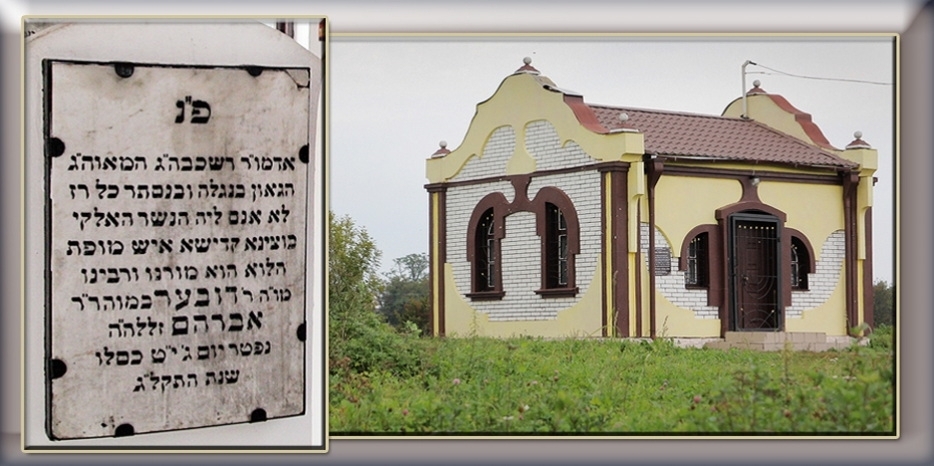
Today, the 19th of Kislev, marks the 253rd anniversary of the passing from the material world of Rabbi Dov Ber of Mezritch, the successor to the Baal Shem Tov and the second leader of the Chassidic movement.
The life and activities of Rabbi Dov Ber of Mezritch are detailed in the article by Rabbi Yosef Khersonsky titled “The Great Maggid.”
“Little is known about the origins and early years of Rabbi Dov Ber, later better known as the Maggid of Mezritch (the Preacher). We do not even know the exact year of his birth; he was most likely born at the end of the seventeenth century, around the same time as the Baal Shem Tov. (The free encyclopedia indicates 1704). His parents (Avraham and Chava) came from the glorious lineage of King David. It is said that when Rabbi Dov Ber was five years old, his house burned down. His mother stood among the charred remains of the house and wept bitterly. ‘I am not crying about the house,’ she explained to the child, ‘but over the burned records of our family tree, tracing our descent from King David.’ ‘I will start a new branch of the tree,’ the boy suggested.
These words remarkably accurately reflected the role he was destined to play; for the boy was fated by destiny to become the heir of the Baal Shem Tov.
He devoted all his time to the study of Torah and was later recognized as a great Talmudic scholar. And like many Torah scholars of his time, Rabbi Dov Ber immersed himself in studying the most important ethical works of the Middle Ages and treatises of Lurianic Kabbalah. It was from these works that he adopted the ethical norms of strictness and humility. He lived a simple life, constantly in need, but poverty was his own choice, not a forced necessity. There is written evidence that he repeatedly declined invitations to become a rabbi and spiritual leader of large communities, which would have provided him with a decent livelihood.
This is precisely what one of the famous stories of his life attests to. After the Maggid had become a disciple of the Baal Shem Tov, the latter asked one of his followers, who was to pass by Mezritch, to convey his humblest greetings to the Maggid. The messenger found, with difficulty, a small, neglected house and, entering Rabbi Dov Ber’s poor dwelling, found him sitting on a bundle of firewood. In front of him, on planks supported by similar bundles, sat his students. The only piece of furniture was a wooden table.
Since it was the middle of a lesson, the visitor agreed to return later. Upon returning, he saw that the setting had changed. The students were no longer in the room, and the ‘table’ had been turned into a ‘bed’; the Maggid was still sitting on the bundle, continuing to study Torah alone. The visitor could not hide his astonishment at the conditions in which the great rabbi lived. ‘I am not rich at all,’ he said, ‘but in my dwelling, there is a chair, a bench, a bed, and other household furniture.’ ‘At home,’ the host continued, ‘one indeed needs to have a good chair, a bed, a table, and a lamp. But when you are on a journey, things are different.’
The Maggid did not consider his earthly dwelling a ‘home.’ Here on Earth, he was merely a temporary sojourner, and in such a case, only those values that help the traveler reach the final destination are truly important and needed.
The Maggid was lame in his left leg and, in general, of frail build. His condition was exacerbated by his lifestyle of one who chose complete renunciation of material goods. Nevertheless, his ailment became one of the reasons for his first meeting with the Baal Shem Tov. It is said that his teacher, the famous author of the Talmudic commentary Pnei Yehoshua, made every effort to persuade him to visit the Baal Shem Tov to find a way to cure this illness.
Providence brought the Baal Shem Tov together with his disciples in inscrutable ways. The life philosophy and way of life of many of them were far from Chassidism, yet, despite initial opposition, they eventually became the pillars upon which the Chassidic movement stands. The first meeting between the Baal Shem Tov and the Maggid seems particularly interesting to us. It took place at the end of the year 5513 and the beginning of 5514 from the creation of the world (1753 according to the Gregorian calendar), that is, less than eight years before the death of the Baal Shem Tov.
The Baal Shem Tov and the Maggid corresponded throughout the year 5513 (1752). The Maggid deeply doubted whether to undertake this journey—rumors spread by opponents of Chassidism held him back from deciding to set out. In his replies, the Baal Shem Tov tried to dispel the Maggid’s suspicions and doubts, and as a result, convinced him to come, foreseeing that this meeting would become an event of incredible importance for Chassidism. Finally, the Maggid decided to form his own opinion about whether the Baal Shem Tov was truly as great as his followers claimed.
The journey to Mezhibuzh (where the Baal Shem Tov lived) was long and difficult, and moreover, the Maggid had no opportunity to study on the road. This caused him much suffering, and he began to regret his decision, comforting himself with the thought that upon arrival, he would immediately hear great words of Torah from the Baal Shem Tov. And finally, arriving in Mezhibuzh, he immediately sought out the Baal Shem Tov.
The latter warmly received the guest and told him a short story that seemed quite insignificant. Their conversation essentially ended there. The next day they met again, and the Baal Shem Tov again told him only a short story.
Rabbi Dov Ber, a diligent man who valued every minute, began to regret that he had come and wasted his time. He decided to return home and planned to leave that same night, at moonrise. But he did not manage to leave—a messenger from the Baal Shem Tov came and asked Rabbi Dov Ber to visit the Teacher’s house. As soon as he arrived, the Baal Shem Tov asked, ‘Are you well-versed in Torah?’ Receiving a positive answer, he posed a new question: ‘Are you familiar with the teachings of Kabbalah?’ Again a positive answer. Then the Baal Shem Tov asked the Maggid to comment on a passage from the book Etz Chaim, the primary work of Lurianic Kabbalah. Rabbi Dov Ber studied the passage carefully and offered his interpretations. The Baal Shem Tov did not accept his version. Rabbi Dov Ber pondered again and proposed the previous interpretation of the passage, adding, ‘The meaning of the passage is as I have explained it. If you have another version, tell it to me, and let’s see who is right.’
This time, the Baal Shem Tov read him the passage. As he read and commented, it seemed to the Maggid that the house filled with light, and they were surrounded by Divine fire. In the end, it seemed to the Maggid that he saw the angels whose names were mentioned in that passage. Then the Baal Shem Tov said, ‘Your interpretation was correct, but there is no soul in your study.’
For some time, Rabbi Dov Ber stayed with the Baal Shem Tov to learn from him.
Written sources indicate that the Maggid visited the Baal Shem Tov twice. The second time, he stayed with him for six months. Rabbi Dov Ber said that the Baal Shem Tov taught him everything, even the most intricate passages taken from various Kabbalistic works, as well as ‘the language of birds and trees.’
When he expressed a desire to return home, the Baal Shem Tov did not let him go, detaining him several times. When asked the reason, the Baal Shem Tov explained that as long as the Maggid remained with him, his own mind reminded him of ‘a gushing spring,’ and the more water drawn from the spring, the stronger its flow. Although Rabbi Dov Ber was not destined to see the Baal Shem Tov again, they maintained contact through messengers and continued correspondence. Sometimes, in the absence of the Baal Shem Tov or at his request, Rabbi Dov Ber performed the duties of the temporary leader of the Chassidim.
And although Chassidism as a whole is contrasted with self-denial and humility, it seems that for some time, the Maggid continued his previous way of life. The Baal Shem Tov warned him, ordering him to stop this practice and take good care of his health.
After his first meeting with the Baal Shem Tov, Rabbi Dov Ber, not yet being the head of the Chassidim, became the maggid (preacher) of the communities of Mezritch and Koritz.
The year 5520 from the creation of the world (1760 Gregorian) was the year of the death of Rabbi Israel Baal Shem Tov, the founder of the Chassidic movement in Judaism. His son, Rabbi Tzvi, took over the leadership of the Chassidim and for a year performed the functions of the Rebbe. The day after his father’s yahrtzeit (anniversary of death), Rabbi Tzvi addressed the assembly of Chassidim: ‘Today my father appeared to me. He told me that by the decree of the Heavenly Court, I must transfer the leadership of the movement to Rabbi Dov Ber.’ All those present rose, filled with respect, and remained standing throughout Rabbi Dov Ber’s first discourse.
The center of Chassidism moved from Mezhibuzh (where the Baal Shem Tov lived) to Mezritch. All the subsequent twelve years, during which Rabbi Dov Ber remained the leader of the Chassidim, the movement gained widespread distribution and took deep root in Eastern European Jewish communities. The seeds sown in Mezhibuzh sprouted in Mezritch. With the help of an extraordinary, unique group of followers representing the flower of the intellectual and spiritual elite of his time, Rabbi Dov Ber gave the creative, fruitful ideas of the Baal Shem Tov’s teaching concrete form, turning them into a multifaceted, living system.
The Maggid managed to fill Chassidism with new ideas already in the first three months of his leadership. In Poland and Lithuania, the social status of Chassidim rose. The influence of the centers established by the Baal Shem Tov in Volhynia and Podolia was felt even more strongly, and Mezritch itself became a place of constant activity of the Chassidic movement.
For his followers, the Maggid was a kind of stabilizing force, skillfully directing their energy towards the ideal combination of emotional uplift and intellectual restraint in the service of G-d. Like the Baal Shem Tov, he preached that the commandment of love for Jews (ahavat Yisrael) is the key to true love for G-d. ‘The meaning of ahavat Yisrael,’ said the Maggid, ‘is equal love for the worst sinner and the greatest righteous person.’ This principle of love he managed to instill in his followers. One of his closest disciples, Rabbi Levi Yitzchak, the rabbi of Berditchev, addressed a Jew as nothing less than ‘my heart.’
In the autumn of 5533 (1772 Gregorian), Rabbi Dov Ber became seriously ill. On the 18th of Kislev, he gathered the members of the ‘Holy Society’ (as the closest circle of the Maggid’s disciples was called) and told them: ‘My children, always stick together, and you will overcome any obstacles. This way, you will always move forward, not backward.’ On Tuesday, the 19th of Kislev 5533 (1772), the holy soul of Rabbi Dov Ber returned to the heavens. His mission was accomplished, and his era ended.
Thanks to Rabbi Dov Ber, not simply a new line in Chassidism was opened. Much more importantly, he laid the solid foundation of this movement. To continue the work begun was left to others.”
The founder of Chabad, Rabbi Schneur Zalman of Liadi, spoke about the Maggid, who was his teacher: “Abraham our father taught Jews love for the Almighty, and the Maggid—love for one’s fellow. Abraham our father left four hundred laws prohibiting idol worship, and the Maggid—four hundred rules of love for Jews.”
Once, after the Maggid’s passing, Rabbi Schneur Zalman cited his words in a conversation with his disciples: “Ahavat Yisrael—love for Jews—what is it? It means to love every Jew, all equally, the learned and the ignorant, to love as brothers, to treat them with awe—as one treats the covering of a Torah scroll.”
Rav Yair Dreyfus and Pinchas Polonsky formulated the main difference between the teachings of the Maggid and the Misnagdim (opponents of Chassidism): “‘The letters of the Torah are like fiery horses,’ it is said in the Kabbalistic book Tikkunei Zohar. Commenting on this verse, Rav A.-I. Kook says: Usually, a Jew is required to ‘walk’ the House of Study, but sometimes, ‘riding on the letters of the Torah,’ one should ‘gallop’ through it. ‘Walking’ means studying Torah with the help of the intellect. This is rational study, progressing slowly but thoroughly. It involves disputes and discussions, arguments and refutations, analysis of ideas and doubts. Quite different is ‘galloping.’ It is a leap, intuition, imagination. It is a personal connection with the text, where one can feel much even if almost nothing is understood. It is a situation where a young person (or, like all of us, one who did not receive sufficient religious education in youth) undertakes to read a complex book—and although he hardly understands the deep meaning of the text, the terms and allegories, he intuitively feels the ‘soul of the book,’ its letters become ‘fiery horses.’
A sedate walk through the House of Study is the Lithuanian, ‘Misnagdic’ style. The Lithuanian ‘limud‘ (Torah study) is based, first and foremost, on sophisticated analysis, clear logic; its ideal is a profound intellectual. A completely different style is the lot of the Chassidic House of Study. The Maggid of Mezritch (disciple and successor of the Baal Shem Tov) introduced into the study of Torah texts ‘devekut‘—’emotional burning,’ ‘a sense of ecstasy from cleaving to the Creator of the Universe.’ Through intuition, ‘devekut‘ gives us the ability to ‘leap over’ spaces not surmountable by logic, to touch things inaccessible to reason, to ‘pump’ into ourselves vital energy from sources closed to a rigid rationalist.
In the Lithuanian House of Study, ‘devekut‘ is not welcomed—because it interferes with study, whereas Chassidic study is inconceivable without it. Chassidim even said this: sometimes one needs to interrupt ‘limud‘ (rational study) to switch oneself to ‘devekut‘ for some time. The energy of ‘devekut‘ is precisely that ‘devek‘ (‘glue’) that bonds the pieces of comprehension of Divine truth built on rational study; it is what allows the letters of the Torah to become ‘fiery horses.’
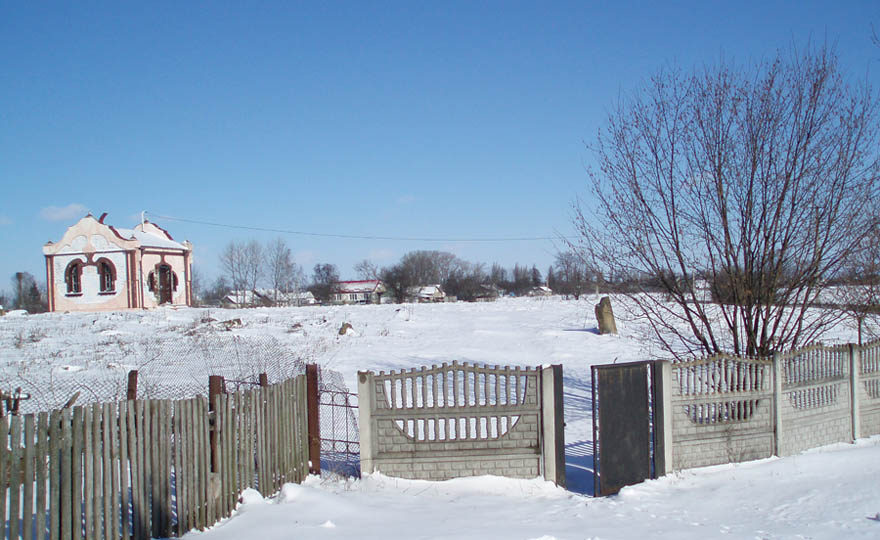
The ohel (resting place) of the Maggid, as well as that of the great tzaddik Rabbi Meshulam Zusia, is located in Annopol (Khmelnytskyi region, Slavutskyi district). This is important to know because there are many Annopols—four more in Ukraine, two in Poland, and also one in Belarus. The village of Annopol, with only 260 residents, once had its own website, where in the ‘History’ section it was stated:
‘In 1784, 215 Jews lived in Annopol, also in 1847 – 1,626 and in 1897 – 1,812 (82%), in 1923 – 1,008, in 1926 – 1,278 (67.4%), in 1931 – 1,280 Jews. Jews settled in Annopol in the 18th century.
From the 1770s, Annopol played a notable role in the Chassidic movement. Dov Ber of Mezritch and his son Avrom ‘HaMalach’ (‘The Angel’) (1741–1776, Fastov), who later became a tzaddik in Fastov, lived in Annopol. Schneur Zalman of Liadi studied in Annopol. After Dov Ber’s death, his disciple and follower Meshulam Zusia of Annopol (?–1800), who did much to spread Chassidism in Volhynia, settled in Annopol. Meshulam Zusia’s son Tzvi-Menachem-Mendel (?–1814) was a tzaddik in Annopol after his father’s death. In the 19th century, the Jews of Annopol participated in wholesale and intermediary trade in agricultural products and engaged in crafts.
In 1890, there were synagogues and a Jewish almshouse in Annopol. In 1910–1916, a Bundist circle and a Zionist group operated underground. On November 30, 1917, peasants who came to the fair in Annopol staged a pogrom. After World War I, the Civil War, and the October Revolution, the Jewish population of Annopol decreased.
In 1920–1934, the rabbi in Annopol was Aron-Uri-Leib Klimnovich. There were 5 synagogues, a four-year school with instruction in Yiddish, where children were not forced to write on Saturdays.
In 1925, the Jewish Union of Individual Artisans was founded. Among the Jews in Annopol in the mid-1920s, there were – 175 workers, 45 employees, 123 artisans, 232 poor peasants, 458 middle peasants, 3 wealthy, 22 clergy. In OZET (Society for Settling Toiling Jews on the Land) there were – 110 people. There was a Jewish reading hut.
In 1931, a Jewish national village council was created in Annopol.
In 1932–1933, the Jews of Annopol suffered from famine.
In 1941–1942, the Jewish population of Annopol was destroyed.
The graves of Dov Ber and Meshulam Zusia in the Jewish cemetery devastated during World War II are a place of pilgrimage for Chassidim. I. Lamden and B. Kraizman were also born in Annopol.
The building of the former synagogue housed a secondary school.'”