



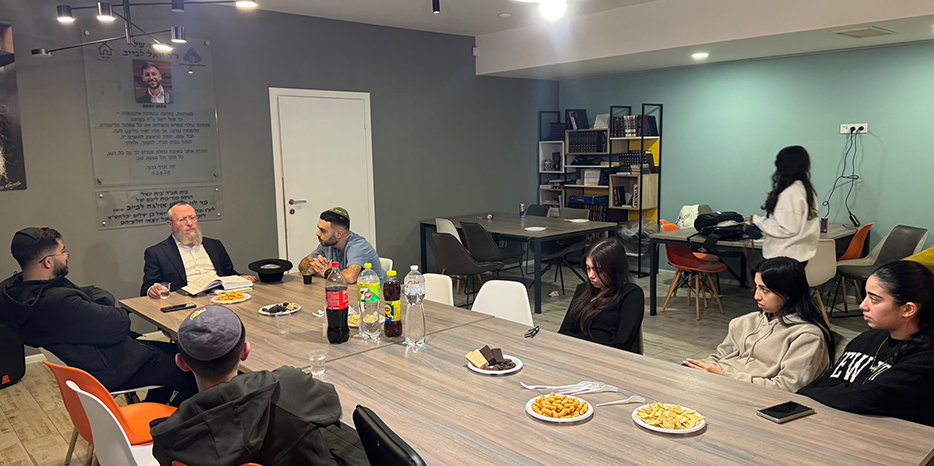
At the project of the Jewish Community of Dnipro, “Beit Yoel” – a Dnipro Beit Chabad for Israelis living and studying in the city – another lesson on the weekly Torah portion took place, conducted by Rabbi Moishe Leib Weber. The class was dedicated to one of the most important Jewish mitzvos – hospitality, the model for whose fulfillment was the Patriarch Avraham.
Rabbi Moishe Leib Weber told the participants about the three components of the mitzvah of hospitality, which in Hebrew are called “achilah” – food, “shtiyah” – drink, and “levayah” – escorting the guest. The first letters of these three words form the word “Eshel,” connected in Jewish tradition with the hospitality of Avraham. Special attention was given to why it is not enough simply to feed and give drink to a guest, but it is also necessary to escort him. This duty is especially emphasized by the Rambam in his foundational work “Mishneh Torah,” and its profound spiritual meaning is revealed in Chassidic teaching.
A special place is occupied by the mitzvah of hospitality in the teaching of the Lubavitcher Rebbe. Revealing the meaning of the Rambam’s ruling, the Rebbe drew attention to the fact that it is precisely the escorting of the guest that most fully testifies to the host’s sincere care, which does not end together with the refreshments. And in the maamar “Vayita Eshel bi-Veer Sheva,” the Rebbe explained an even deeper meaning of the hospitality of the Patriarch Avraham: by receiving travelers, offering them food and drink, and caring for his guests, Avraham revealed the most important spiritual content of this mitzvah – the understanding that all blessings come from the Almighty. Thus the fulfillment of the mitzvah of hospitality at the same time became a way of spreading knowledge of the Creator.
“The story of Avraham’s hospitality teaches us that the fulfillment of mitzvos should not be limited to formal actions, for behind every deed stands a profound spiritual meaning,” noted Rabbi Yaakov Dorfman, director of the “Beit Yoel” project. “It is especially important to us that the young Israelis who come to our lessons not only become acquainted with Jewish laws and traditions but also understand how to apply them in everyday life. It is precisely such an attitude toward the Torah and its mitzvos that we strive to cultivate in an atmosphere of care, attention, and support of the united and cohesive Jewish Community of Dnipro under the leadership of Chief Rabbi Shmuel Kaminezki.”