



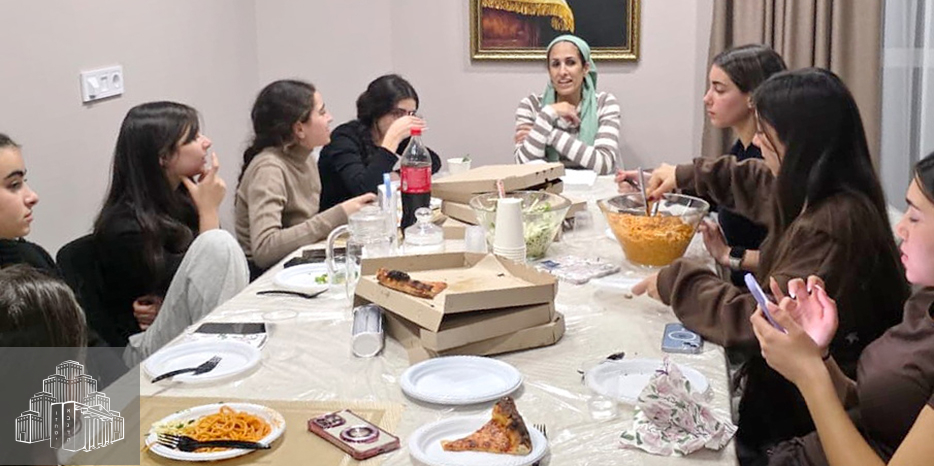
As part of an educational program at “Beit Yoel”—a Chabad center in Dnipro for Israelis living and studying in the city—a Torah lesson for young women was held, led by Rebbetzin Leah Dorfman. The regular weekly gathering took place at the home of the Dorfman family and focused on the weekly Torah portion, “Toldot.” The central theme of the session was remaining faithful to Jewish tradition and the spiritual heritage passed down from one’s parents.
The discussion centered on the story of Isaac (Yitzhak) and Rebecca (Rivka), who prayed to the Almighty for children. The Torah notes that the Almighty answered Isaac’s prayer specifically, even though both had prayed. Why? The Sages explain that Isaac was a righteous man, the son of a righteous man, whereas Rebecca was a righteous woman, the daughter of a wicked man. This insight served as a springboard for a conversation about the significance of a family’s spiritual heritage—emphasizing that it is not enough merely to receive this legacy from one’s parents; one must also preserve it, making it the foundation of one’s own life.
Rebbetzin Leah Dorfman encouraged the young women to reflect on the fact that those who grow up in an environment of faith and the observance of *mitzvot* (commandments) face a unique challenge. Practices that have been familiar since childhood can gradually turn into mere habit, losing their ability to resonate deeply within. Consequently, maintaining tradition requires as much spiritual effort as returning to it. It is not enough to simply repeat the actions taught by one’s parents; one must rediscover their meaning anew each day, performing the *mitzvot* with conscious intent, sincere emotion, and personal, inner engagement. Such efforts to preserve one’s spiritual heritage are held in especially high regard by the Almighty.
This topic holds particular significance for young Israeli women who find themselves far from home—in a foreign country, surrounded by new opportunities and temptations. Here in Dnipro, it is vital for them to maintain a connection to their roots, uphold the values instilled by their families, and consciously define the role that the Torah and the *mitzvot* (commandments) play in their own lives. The young women were able to explore these ideas not only during the formal lesson but also through intimate, heartfelt conversations over kosher refreshments—all within the warm, home-like atmosphere cultivated by the Dorfman family.
For the participants, these Monday gatherings have long since evolved into more than just an opportunity to study the Torah; they have become a time for friendship—a space where they can share their personal experiences, discuss pressing concerns, and receive guidance and support. For young women living far from their home country and loved ones, it is especially meaningful to feel that, in Dnipro, they are not outsiders or mere guests, but rather part of the fold—welcomed with open arms into the extended family of the Jewish community of Dnipro.
“It is deeply important to us that the young women who come to our home not only gain knowledge of the Torah but also feel understood, loved, and supported,” says Rabbi Yaakov Dorfman, director of the ‘Beit Yoel’ project. “The subject of this lesson resonates profoundly with our students; after all, remaining faithful to the traditions of one’s parents while living far away means making those traditions one’s own, conscious choice. We want each of them to know that she has a true Jewish family here, and to feel that she is an integral part of the unified, close-knit Jewish community of Dnipro, under the leadership of Chief Rabbi Shmuel Kaminezki.”