



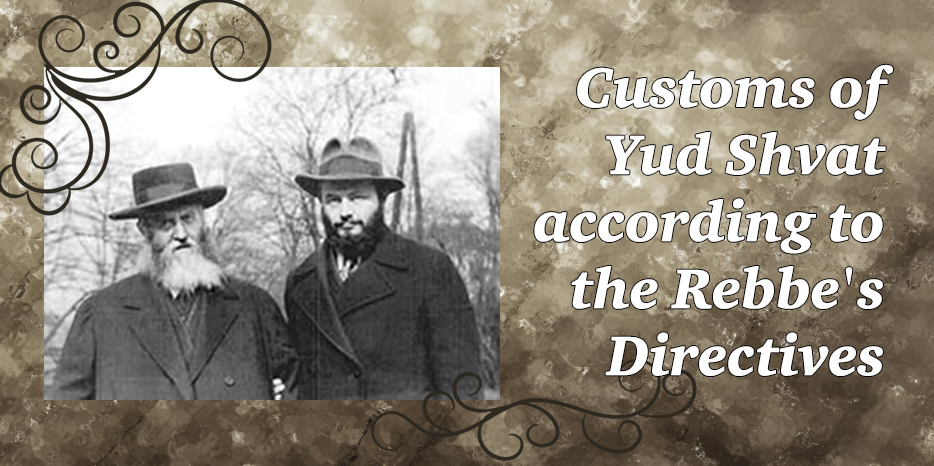
The solemn day of 10 Shvat, or Yud Shvat, is approaching. This day marks the 75th anniversary of the Rebbe’s leadership, for on this day, the Previous Head of the Lubavitch movement, the Sixth Rebbe, Rabbi Yosef Yitzchak Schneersohn, passed away, and on the same day one year later, his son-in-law, Menachem Mendel Schneersohn, assumed the leadership of the Jewish people and the title of the Lubavitcher Rebbe.
This day, 10 Shvat, is observed as the birthday of our generation, for it is customary to consider that a generation changes when its Head changes. It is customary to study the maamar “Basi LeGani” in connection with this day, as this is the maamar that the Seventh Lubavitcher Rebbe, Menachem Mendel Schneersohn, delivered when accepting the mantle of leadership.
In 5711, on Rosh Chodesh Shvat, ten days before the Rebbe assumed the leadership of the Jewish people, he sent a letter to Jewish communities explaining how to observe the day of the yahrtzeit of the Previous Rebbe.
From the Letters of the Lubavitcher Rebbe
Rosh Chodesh Shvat, 5711
Brooklyn, New York
To our community, the students of the Tomchei Temimim yeshivos, all those who were connected or had a relationship to my father-in-law, the holy Rebbe, may G-d bless you all!
Greeting and Blessing!
In response to numerous inquiries concerning customs related to the day of 10 Shvat—the yahrtzeit (anniversary of the passing) of my father-in-law, the Rebbe—I suggest:
On the Shabbos preceding the yahrtzeit, everyone should try to be called to the Torah.
If there are not enough aliyos for all present—the Torah reading should be conducted simultaneously in different rooms, but the number of aliyos (those called to the Torah) should not be increased.
The community should ensure that the maftir is read by the most respected person. This choice should be made based on the agreement of the majority of the community’s members or by lot.
A shaliach tzibur (prayer leader) should be chosen for the day of the yahrtzeit. It makes sense to share this privilege by choosing one person for the evening prayer, another for the morning, and a third for the afternoon. Thus, a greater number of community members will receive this privilege.
A memorial candle should be lit to burn for 24 hours. If possible, a candle made of beeswax should be used.
During the prayer, five candles should be lit.
After each prayer service (and in the morning—after the recitation of Tehillim), the chazzan should complete the study of the 24th chapter of Mishnah “Kelim” and the 7th chapter of “Mikvaot.” He should then recite the Mishnah “Rabbi Chanania ben Akashya…” then—to himself—several lines from Tanya, and then Kaddish D’Rabbanan.
After the evening prayer, part of the maamar “Basi LeGani,” published for the day of the passing, should be recited by heart. If there is no one to recite it by heart, it should be read from the text. This should also be done after the morning prayer, and after the afternoon prayer, the recitation of the maamar should be concluded.
Before the morning prayer, a chapter of Tanya should be studied, and the same should be done after the afternoon prayer.
In the morning, before prayer, donations should be made to the needs of those institutions connected with the Head of our people, the Rebbe, of blessed memory. Donations should be made for oneself and for each family member. The same should be done before the afternoon prayer.
After the morning prayer and the recitation of “Basi LeGani” by heart, everyone should recite a pidyon nefesh (a written petition) (with a gartel, of course). Those who were privileged to have a yechidus (audience) with the Rebbe or to see his face should picture his image and then imagine themselves standing before him. The pidyon nefesh should then be placed between the pages of a maamar or kuntres, etc., and sent (if possible, on the same day) to be read at his gravesite.
Throughout the day—study chapters of Mishnah that begin with the letters forming the Rebbe’s name.
Throughout the day—conduct a farbrengen (a Chassidic gathering).
Throughout the day, time should be found to tell one’s family about the life of our holy Rebbe and about his service to G-d, which he carried throughout his life.
Throughout the day (for those who are able), one should visit other synagogues and study halls and read excerpts or sayings from the Rebbe’s teachings. One should speak of his love for every Jew. One should also tell and explain his directives regarding the daily recitation of Tehillim, the daily study of the portion of the weekly Torah reading with Rashi’s commentary, and where appropriate, the daily study of Tanya according to the annual cycle. If possible, all this should be done during a farbrengen.
Throughout the day (for those who are able), one should visit religious youth centers and also try, as much as possible, to meet with youth who do not yet observe Torah law—and tell them of the special care that our holy Rebbe always showed for them. One should tell them what he asked of them, the hopes and aspirations he placed in them, and his faith that they would ultimately fulfill their task of strengthening Jewish life and spreading Torah with the energy, warmth, and vitality characteristic of youth.
It is understood that if circumstances allow, the above should be continued even after the yahrtzeit, especially on the Shabbos that follows it. May G-d hasten the coming of our Redeemer, and then “those who lie in the dust will arise and rejoice,” with the Head of our people among them. May he tell us of wonders and lead us on the path to the House of G-d.
From the Letters of the Lubavitcher Rebbe
© Copyright, all rights reserved. If you enjoyed this article, we encourage you to distribute it further, provided that you comply with Chabad.org‘s copyright policy.