



This evening marks the beginning of the 5th of Tevet, the day declared by the Seventh Lubavitcher Rebbe, Menachem Mendel Schneerson, as “Day of the Holy Jewish Books,” or, as it is also known, “Didan Notzach.” It commemorates the American court’s decision regarding the portion of the “Schneerson library” that was taken from Europe to the United States.
The history of “Didan Notzach” dates back to late 1986 and early 1987, and is connected to the Hasidim’s struggle to preserve this unique collection of Jewish books. Here’s how one popular online resource describes the story: “It happened in 1986, when the trial began regarding the return of books from the library of the Sixth Lubavitcher Rebbe, Rabbi Yosef Yitzchak Schneerson.” By a remarkable coincidence, the “Trial of the Books” began on the very day Hasidim around the world celebrate the Liberation of the Alter Rebbe from the Peter and Paul Fortress, that is, the 19th of Kislev, a day that has become a day of triumph and victory for the entire Hasidic movement. It was on this day, when the fate of the first Lubavitcher Rebbe and the entire movement was decided, that the case regarding the future of the “Schneerson Library” began.
This was the second part of the long-suffering library that was successfully removed from Russia. The first, as is well known, remained in the Soviet Union and still gathers dust in the storerooms of the Rumyantsev (formerly “Lenin”) Library. However, the fate of those books that escaped “nationalization” (or, to put it simply, were not fraudulently “appropriated” by the Soviet authorities) was also not entirely favorable.
The “heirs” of Rabbi Yosef Yitzchak filed a claim against them. One of them claimed that the books belonged to him, as he was the sole heir of the previous Rebbe.
But since America, unlike Russia, is a truly democratic country where justice can sometimes be achieved through the courts, the leadership of the Lubavitch organization Agudas Chasidei Chabad filed a lawsuit seeking the return of the holy books to their rightful owner.
The case began in late 1986, lasted about three weeks, and concluded in early 1987, when Federal Judge Charles Sifton delivered his 40-page verdict. It read (not a literal translation): “After carefully reviewing all the documents presented by both parties, I conclude that this library cannot be considered the private property of the Lubavitcher Rebbe (the 6th Lubavitcher Rebbe, Rabbi Yosef Yitzchak Schneerson), but is the property of the entire Hasidic community. Therefore, it is not subject to inheritance rights, and it must be transferred to the Agudas Chasidei Chabad organization, which represents the Lubavitcher movement.”
This news arrived on the 5th of Tevet, and that day became a day of celebration and rejoicing, a day of the victory of the light of Hasidism over the forces of darkness, when our victory—”Didan notzach!”—was achieved. These words mean “our victory” or “our victory.” The source of these words is a midrash (Vayikra Rabbah, Chapter 30:2), which states that on Rosh Hashanah we do not know who wins, but when the Jews come out with lulavim and etrogim in their hands, we know that the Jews are victorious. These words describe the Jewish holiday of victory.”
In a talk given immediately after the Fifth of Tevet verdict, the Rebbe explained that we should view the entire trial and Chabad’s false accusations of “inaction” as a sign from Above to redouble our efforts in all matters of spreading Jewishness and Hasidism, to achieve incomparably more than ever before.
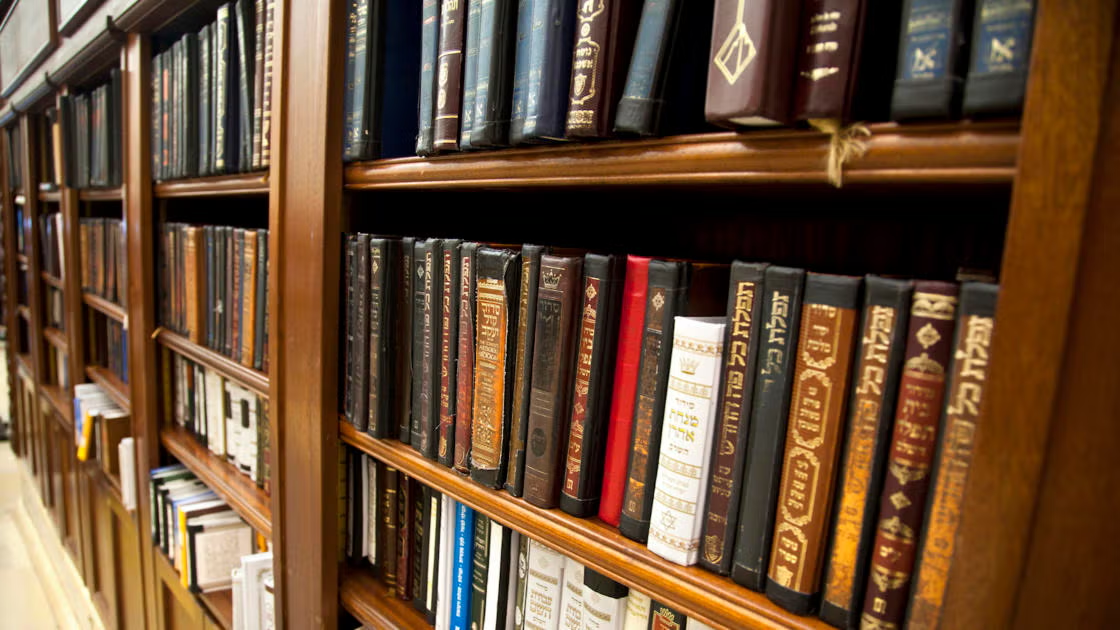
The blessing of this day should be fully utilized by acquiring new holy books, especially those devoted to the laws of daily Jewish life. Jewish books should also be purchased for the entire family. The Rebbe also instructed that books be purchased for synagogues and other institutions, as well as for the Agudas Chabad library. Purchasing books will lead to study and the sharing of acquired knowledge with others.
The Rebbe also emphasized the need to revive the custom of buying Jewish books as gifts, especially for small children on their birthdays and holidays.
After the collapse of the USSR, enormous efforts were made to recover books looted by the Bolsheviks from the library of the Previous Rebbe. The way to hasten their return, the Rebbe explained, was to bring more holy books into one’s home and into libraries.
The seventh Lubavitcher Rebbe, Menachem Mendel Schneerson, proclaimed this day the “Day of the Holy Jewish Books” and called on all Jews to acquire editions of the Torah, Tanakh, Siddur, Tegelim, copies of the Tanya, and so on. In one of his talks, the Rebbe explained that the return of stolen books is like the return of captives—one of the most important commandments of Judaism. Moreover, books that sit on store shelves for a long time cannot spread the spiritual light they contain, so purchasing them can also be likened to ransoming captives. Those who buy holy books don’t just make an important acquisition for their own home—they contribute to the liberation of other captives—both people and books.