



Kitzur Shulchan Aruch, Part 6: Holidays and Commemorative Dates
1. On the eve of Yom Kippur, at dawn—a time when, according to Kabbalah and the Talmud, the Almighty shows special mercy to His people—the Kapparot ceremony is performed. By custom, men first immerse themselves in the waters of a mikvah.
For Kapparot, it is customary to use a rooster for a man and a hen for a woman—preferably white ones (if white birds are unavailable, one should not go out of one’s way to find them, so as not to arouse suspicion that we are acting like non-Jewish sorcerers). For a pregnant woman, it is customary to use three birds: two hens and one rooster (one hen for herself, the other for the unborn child if it is a girl, and the rooster if it is a boy).
Many Halakhic authorities hold that the same hen can be used for Kapparot for multiple women, and the same rooster for multiple men—meaning that “the entire House of Israel could perform Kapparot with a single rooster and a single hen.” Therefore, someone facing financial hardship may rely on this opinion and perform Kapparot with the minimum number of birds.
If circumstances do not permit the purchase of roosters and hens for Kapparot, it is also permissible to use fish or money (which is subsequently given to tzedakah).
The only prohibition is performing Kapparot with pigeons or doves, so as not to create the impression that they are being offered as an atoning sacrifice, given that in the Temple, it was specifically pigeons and doves that were brought to the altar.
2. Kapparot is performed as follows: taking the rooster or hen, one recites the text printed in the Siddur (or *Machzor*) up to the words b’nei adam (“sons of man”). While reciting the words zeh chalifati, zeh temurati, zeh kapparati (“this is my substitute, this is in my stead, this is my atonement”), one swings the bird over one’s head three times. The entire procedure is then repeated twice more. Thus, the Kapparot text is recited a total of three times, and the bird is swung over the head nine times.
When a woman performs Kapparot, instead of saying zeh hatarnengol (“this rooster”), she says zot hatarnengolet (“this hen”); when a fish is used for Kapparot, one says zeh hadag (“this fish”), and when money is used—zeh hama’amon (“this money”).
3. The bird used for Kapparot is given to the shochet (ritual slaughterer). It is recommended to observe the slaughter—so that the emotions experienced at that moment might inspire a person to deeper repentance. Furthermore, this offers an opportunity to fulfill another commandment: with the shochet’s permission, one covers the spilled blood of the bird with sand (or sawdust) after reciting the blessing: “…Who sanctified us with His commandments and commanded us regarding the covering of blood with earth.”
It is preferable to give the money paid for the Kapparot bird to the poor as tzedakah (charity), rather than giving the bird itself.
4. One should by no means think that Kapparot actually atones for sins. The fate of the bird prompts a person to reflect on their behavior and to repent for sins committed against the Almighty and against fellow human beings.
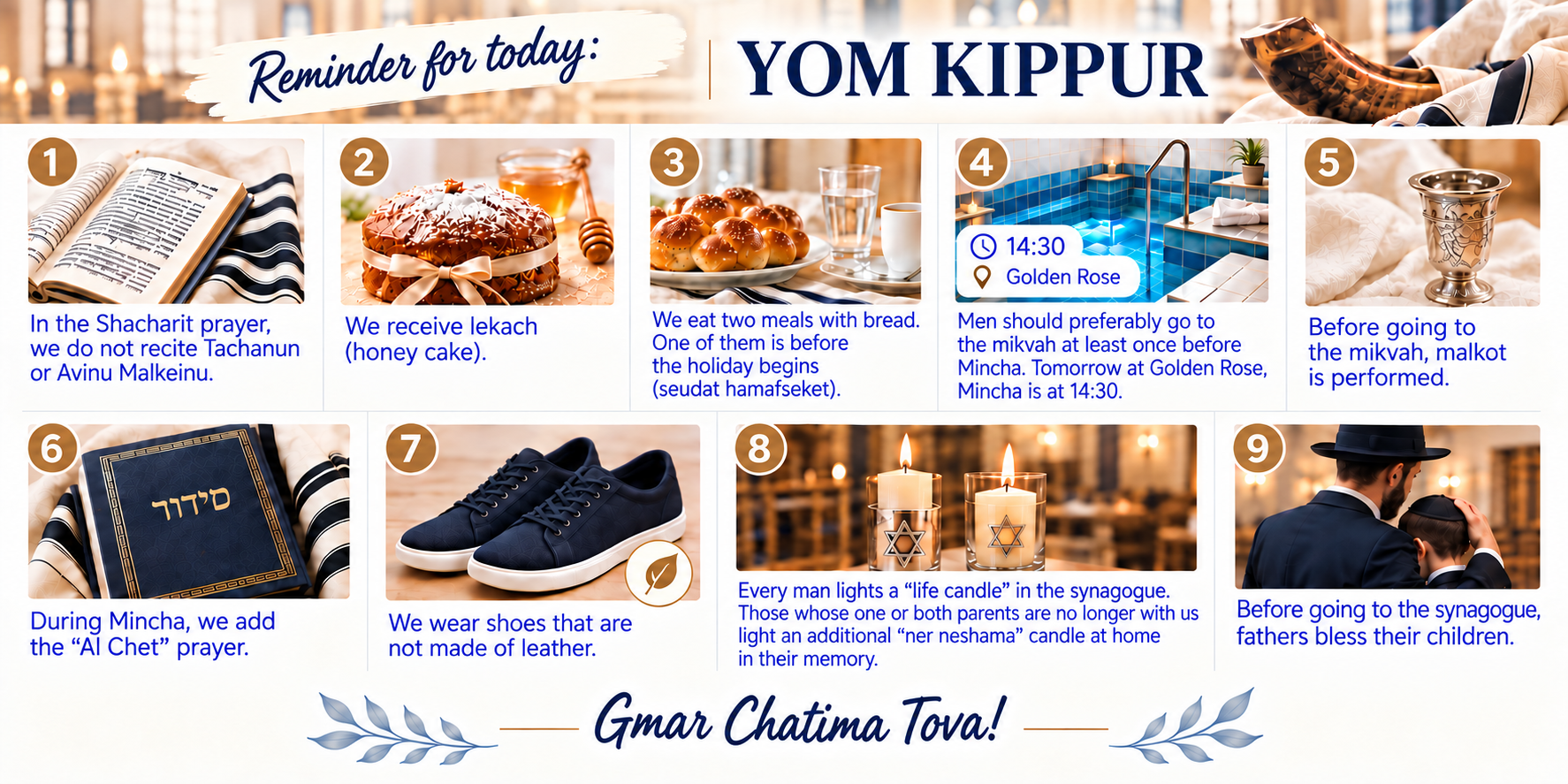
5. On the eve of Yom Kippur, the psalm Mizmor LeTodah (“A Psalm of Thanksgiving”) is not recited during the Shacharit. This is because, during the time of the Temple, the Todah (thanksgiving) offering was not brought on this day; offering it would have necessitated violating the Torah’s commandment to consume it during the night (cf. 110:2). “Avinu Malkeinu” is not recited even if Yom Kippur falls on Shabbat (since “Avinu Malkeinu” is not recited on Shabbat).
6. It is customary on the eve of Yom Kippur, following the Shacharit service, for the synagogue gabbai (attendant) to distribute honey cake (lekach) while saying: “Here is some lekach for you; may the Almighty grant you a good and sweet year.” Similarly, lekach is distributed among friends, and parents give it to their children.
7. Halacha recommends eating and drinking abundantly on the eve of Yom Kippur, just as one does on a festival. The Sages stated: “For anyone who eats and drinks on the eve of Yom Kippur—consuming twice the usual amount—it is accounted as though they had fasted for two days as well.”
It is customary, from the eve of Yom Kippur through Hoshana Rabbah, to dip bread in honey rather than salt at the beginning of a meal.
During the day’s first meal, it is customary to eat fish and kreplach—boiled meat dumplings. According to the explanation of Rabbi Yisrael Baal Shem Tov, these symbolize the triumph of Divine mercy over the Almighty’s stern judgment of us as a formidable Judge.
Nevertheless, both during the first meal and the Seudah Mafseket (the final meal before the fast begins), one should consume only light, easily digestible foods. Garlic and onions are avoided, as are hot spices and eggs. Dairy foods may be eaten during the first meal but not during the Seudah Mafseket. Foods that cause belching (such as sesame seeds) are also avoided.
8. Inviting the poor to one’s table on the eve of Yom Kippur—especially for the Seudah Mafseket (the final meal before the fast)—helps attain atonement for sins.
9. Yom Kippur does not atone for a sin committed against another person until the transgressor has received full forgiveness from the injured party. This is derived from the words of the Torah: “From all your sins before God shall you be cleansed” (Leviticus 16:30).
In other words, Yom Kippur cleanses only those sins committed “before God”—that is, against the Almighty (cf. Genesis 10:9). Therefore, before Yom Kippur, one must reflect on whether one has wronged another and ask forgiveness for any offense caused by word or deed. If the injured party also suffered financial loss as a result, one must endeavor to make restitution or express sincere remorse. If a financial dispute arises between two Jews, they should display the utmost goodwill before Yom Kippur and agree to appear before a rabbi immediately after the holiday to resolve the matter, pledging to abide unconditionally by his decision, whatever it may be.
If forgiveness can be obtained more easily and quickly through an intermediary, that course of action is preferable.
10. The person from whom forgiveness is sought must not display a hard heart—a trait characteristic not of Israel, but of Esau. One should grant forgiveness wholeheartedly and immediately. However, if one knows that the offender, having obtained forgiveness too easily, will fail to appreciate its significance, one may initially refuse the request in order to prompt the offender toward deeper repentance. Moreover, if the injured party sees that the offender has no intention of asking for forgiveness, he should try to create an opportunity to meet and encourage the offender to acknowledge his guilt and the need to seek forgiveness. Our Sages warn: whoever has not banished hatred for their fellow man from their heart should not hope that their prayer on Yom Kippur will be heard. Conversely, the Almighty forgives the sins of anyone who forgives their fellow man.
11. If the aggrieved party has died, the offender goes to the grave accompanied by ten people and says: “I have sinned against the God of Israel and against this person,” and the group responds three times: “You are forgiven!” It is customary for the penitent not to wear leather shoes when visiting the grave, just as on the Ninth of Av.
If the distance to the grave exceeds 24,000 cubits (11.5 km), the penitent is not required to go there personally; they may send a representative instead. This representative must gather a minyan at the grave and declare: “I, the representative of [Name], state publicly that I have been sent by [Name] to ask for forgiveness for having sinned against the God of Israel and against this person.” All those present respond three times: “He is forgiven!”
12. A person who spoke insultingly about the deceased is not required to visit the grave but must ask for forgiveness at the very place where they insulted the deceased’s memory.
However, if they spread rumors defaming the deceased’s honor, they are obligated to consult a rabbi and ask how to repent in order to be cleansed of this sin.
13. There is a custom on the eve of Yom Kippur to visit the mikvah three times: before Shacharit, before Mincha, and after the Seudah Mafseket (the final meal before the fast), just before sunset. During each visit, one immerses in the *mikvah* waters at least three times. It is advisable to prepare for the visit to the mikvah on the eve of Yom Kippur with the same care a woman takes when preparing to immerse herself to purify herself from the ritual impurity associated with menstruation.
A person who is ill or frail and unable to go to the mikvah should instead pour at least 12.5 liters of water over themselves—ideally from a single vessel, though using two or three vessels is permissible provided the pouring is continuous. One may also stand under a shower for the duration of time it takes for 12.5 liters of water to flow out.
14. One who is observing the seven-day mourning period for a deceased relative is permitted to bathe in hot water and immerse in the mikvah on the eve of Yom Kippur, though not earlier than two hours before nightfall. He is required to observe all other mourning customs until nightfall.
15. Before immersing in the mikvah prior to the Mincha prayer, it is customary to perform the symbolic ceremony of malkot (“flogging”). This was the method used during the era of the Sanhedrin (the supreme court of Torah sages) to punish those who transgressed Torah prohibitions. The person undergoing malkot must kneel, lean forward—resting his face on his left arm, just as is done during the *Tachanun* prayer in Mincha—and face north. The person administering the lashes takes a leather strap (preferably made of calfskin) and lightly strikes the other person first on the right shoulder, then on the left, and then on the back. With each strike, both the administrator and the recipient simultaneously recite, word for word, verse 38 from Psalm 78: “But He, being merciful, atones for iniquity…” This verse consists of thirteen words; thus, the recipient receives 39 lashes—the maximum number permitted by the Torah.
16. It is customary to wear Shabbat clothing for the Mincha prayer. Typically, several plates for collecting tzedakah (charity) are set out in the synagogue. Rabbi Yisrael Baal Shem Tov taught that the mere sound of coins given for tzedakah contributes to spiritual purification.
17. The Mincha prayer is recited unhurriedly, while awakening a yearning for repentance within the heart. After the Shemoneh Esreh, the Al Chet confession is recited—just as on Yom Kippur. After reciting the opening phrase “May [the words of my mouth] be acceptable…”, one continues with “Our God and God of our fathers…” and so forth; only after completing Al Chet does one recite “My God! Guard [my tongue]…”. The Chazzan (cantor) does not recite Al Chet during the repetition of the Shemoneh Esreh. Anyone who does not finish Al Chet before the Chazzan begins the repetition of the Shemoneh Esreh should respond “Amen” to the third and sixteenth blessings, etc., just as one does during the recitation of the Shema (see 17:12).
Al Chet is recited while standing with one’s head bowed to emphasize repentance and submission to the will of the Almighty. Each time the phrases al chet (“for the sin”), ve’al kulam (“and for all of these”), and ve’al chata’im (“and for the sins”) are recited, one strikes one’s chest with the right fist.
Anyone who forgets to recite Al Chet after the Shemoneh Esreh is required to do so later, after Mincha.
18. On the eve of Yom Kippur, Mincha is prayed earlier than usual to allow time to return home, partake in the Seudah Mafseket (the meal preceding the fast), and immerse in the *mikvah* once more.
19. It is not customary to eat fish during the Seudah Mafseket. The meal should be light and not overly filling. The meal must be concluded before sunset; typically, it is finished by the time of candle-lighting (see also 119:2).
20. It is not customary to leave food cooking on the fire from the eve of Yom Kippur for the meal following the conclusion of the fast. 21. Everything stated above regarding the greatness and sanctity of the Sabbath and the commandment to honor it applies equally to Yom Kippur (see 74:1, 5).
22. A candle is lit in the couple’s bedroom so that its light serves as a reminder of the prohibition against marital intimacy on this night.
It is customary for those whose parents have passed away to light a memorial candle (*ner neshama*) in their home; this candle burns for a full twenty-four hours (and is used for Havdalah at the conclusion of Yom Kippur).
In addition, a married man lights another candle—known as the “light of life”—in the synagogue; this candle also burns for the entire twenty-four-hour period. It is considered an ominous sign for the person who provided the candle if it happens to go out during Yom Kippur. Therefore, the candle is handed to the synagogue gabbai (attendant)—so that the owner does not know exactly where it is placed—and the gabbai lights it. Since people are often rushing to complete final preparations just before Yom Kippur begins, it is best to bring this candle to the synagogue in time for the Mincha service.
23. As people set out for the synagogue to recite the Kol Nidrei prayer—which marks the beginning of the Yom Kippur services—the sanctity of Yom Kippur already takes effect, and the gates of Divine mercy open wide. At this moment, a father blesses his children—both sons and daughters. He recites the Priestly Blessing (Birkat Kohanim) and then addresses the Almighty with a prayer from the depths of his soul, asking that his children be inscribed in the Book of Life, that their hearts be filled with the fear of God, and that they walk the path of the righteous; with tears in his eyes, he implores the Almighty to accept this prayer.
24. It is customary for a married man to wear a simple white garment known as a kittel on Yom Kippur. This garment resembles a burial shroud, thereby prompting a person to detach from earthly concerns and turn their thoughts toward God. A person observing the seven-day mourning period (shivah) for a close relative is permitted to wear a kittel. However, according to custom, a groom who wore a kittel under the chuppah (wedding canopy) does not wear one on the first Yom Kippur following his wedding.
25. Before sunset, a married man dons the tallit gadol (large prayer shawl), reciting the appropriate blessing. One who did not manage to do so before sunset puts on the tallit gadol later but does not recite the blessing.
From the book “Kitzur Shulchan Aruch”. Published by Shamir & F.R.E.E.