




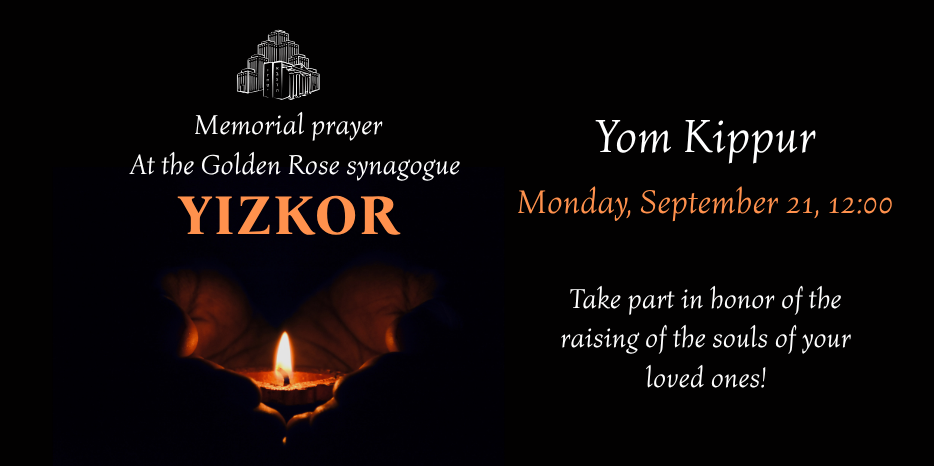
One of the most important moments of the holy day of Yom Kippur is the recitation of the funeral prayer “Izkor”. We should read for our fathers, relatives and loved ones who have gone because they have no children, as we would read “Izkor” for them. If you want to read “Izkor” on the remaining day of Passover, and on another day of Shavuot, and on the day of Shemina Atzeret, reading “Izkor” on the day of Yom Kippur is most important, because Yom Kippur is the Day of Peace for both the living and the dead. Those who, as a rule, do not go to synagogues on Holy Saturday, are encouraged to come and read “Izkor” for their deceased fathers on the designated days of fate, and especially on Yom Kippur.
In Dnipro, the Yizkor prayer will take place on September 21, 2026, at 12:00 PM.
In this prayer (its full name is “Azkarat Neshamot”), we ask for peace for the soul of the deceased. The prayer is very short. It is beautiful and somewhat solemn. However, it is recited individually. According to custom, during the recitation of the “Yizkor” prayer, those whose parents are both alive must leave the synagogue hall. Those whose parents died less than a year ago remain in the synagogue but do not recite “Yizkor” for that parent.
The main part of the Yizkor prayer is a private promise to make a donation in honor of the deceased after the holiday. By giving tzedakah, we physically do a good deed in this material world—something that the deceased is no longer able to do. Nevertheless, when this is done by someone in memory of him, his soul receives additional merit and spiritual elevation.
In Kitzur Shulchan Aruch, regarding the reading of “Yizkor,” it is stated: “On Yom Kippur, the Remembrance of the Dead (Azkarot Neshamot) is read, because remembering the dead humbles the heart of man; and, moreover, this is done because the dead also need atonement, as it is stated in Sifri: ‘Redeem Your people, Israel’—this refers to the living; ‘whom You have redeemed’—this refers to the dead. This teaches us that the dead also need redemption.” And it is customary to make a vow to give charity for the sake of these dead (and see above, chapter 67, paragraph 3, where it is said that when making this vow, one should add: “Without accepting the vow”). And the basis for this custom is that at the end of the chapter Tetzaveh it is said: ” Once a year shall atonement be made…,“ and immediately after this verse it says: ”And let everyone give a ransom for his soul to God.” And alms given on behalf of the dead helps them, since God, who sees what is in the heart, knows that if this dead person were alive, he would also give alms. And the living have the right to ask for leniency for the dead—as David did when he prayed for Absalom (Tractate Sota, 10:2)—and the righteous dead intercede for their descendants.”
Text of the Izkor prayer
For a father (or other male relative):
May G‑d remember the soul of my father, my teacher (mention his Hebrew name and that of his mother) who has gone to his [supernal] world, <єврейське (якщо є) ім’я покійного>because<єврейське (якщо є) ім’я його матері> I will — without obligating myself with a vow — donate charity for his sake. In this merit, may his soul be bound up in the bond of life with the souls of Abraham, Isaac and Jacob, Sarah, Rebecca, Rachel and Leah, and with the other righteous men and women who are in Gan Eden; and let us say, Amen.
Transliteration:
Yeez-kohr eh-loh-heem nee-shmaht ah-bah moh-ree (husband: bah-ah-lee son: bi-nee brother: ah-khee uncle: doh-dee grandfather: zi-kay-nee) (mention Hebrew name and his mother’s name) <єврейське (якщо є) ім’я покійного>sheh-hah-lakh <єврейське (якщо є) ім’я його матері>loh-lah-moh. Bah-ah-voor sheh-beely nay-dehr eh-tayn tzdah-kah bah-ah-doh bee-skhahr zeh ti-ha nahf-shoh tzroo-rah beetz-rohr hah-khah-yeem eem nee-shmaht ahv-rah-hahm yeetz-khahk vi-yah-ah-kohv sah-orah reev-kah rah-khayl vi-lay-ah. Veem shahr tzah-dee-keem vi-tzeed-koh-nee-oht shehb-gahn ay-dehn vi-noh-mahr: ah-mayn.
For my mother (or another woman):
May G‑d remember the soul of my mother, my teacher (mention her Hebrew name and that of her mother) who has gone to her [supernal] world, because I will – <єврейське (якщо є) ім’я покійної>without<єврейське (якщо є) ім’я її матері> obligating myself with a vow – donate charity for her sake. In this merit, may her soul be bound up in the bond of life with the souls of Abraham, Isaac and Jacob, Sarah, Rebecca, Rachel and Leah, and with the other righteous men and women who are in Gan Eden; and let us say, Amen.
Transliteration:
Yeez-kohr eh-loh-heem nee-shmaht ee-mee moh-roh-tee (wife: ee-shtee daughter: bee-tee sister: ah-khoh-tee aunt: doh-dah-tee grandmother: zi-kayn-tee)<єврейське (якщо є) ім’я покійної> (mention Hebrew name and her mother’s name) <єврейське (якщо є) ім’я її матері>sheh-hahl-khah loh-lah-mah bah-ah-voor sheh-beely nay-dehr eh-tayn tzdah-kah bah-ah-dah bee-skhahr zeh ti-hay nahf-sah-oh tzroo-rah beetz-rohr hah-khah-yeem eem nee-shmaht ahv-rah-hahm yeetz-khahk vi-yah-ah-kohv sah-rah reev-kah rah-khayl vi-lay-ah veem shahr tzah-dee-keem vi-tzeed-koh-nee-oht shehb-gahn ay-dehn vi-noh-mahr: ah-mayn.
After that, say:
May the All-Merciful Father Who dwells in the supernal heights, in His profound compassion, remember with mercy the pious, the upright and the perfect ones, the holy communities who gave their lives for the sanctification of the Divine Name.
They were beloved and pleasant in their lives, and [even] in their death were not parted [from Him]; they were swifter than eagles, stronger than lions to carry out the will of their Maker and the desire of their Creator.
May our G‑d remember them with favor together with the other righteous of the world, and avenge the spilled blood of His servants, as it is written in the Torah of Moses, the man of G‑d: O nations, sing the praises of His people, for He will avenge the blood of His servants, bring retribution upon His foes, and placate His land — His people.
And by Your servants the Prophets it is written as follows: I will cleanse [the nations of their wrongdoings,] but for the [shedding of Jewish] blood I will not cleanse them; the Lord dwells in Zion.
And in the Holy Writings it is said: Why should the nations say, “Where is their G‑d?” Let there be known among the nations, before our eyes, the retribution of the spilled blood of Your servants. And it is said: For the Avenger of bloodshed is mindful of them; He does not forget the cry of the downtrodden. Further it is said: He will render judgment upon the nations, and they will be filled with corpses; He will crush heads over a vast area. He will drink from the stream on the way; therefore [Israel] will hold its head high.
Transliteration:
Ahv hah-rah-khah-meem shoh-khayn mi-roh-meem bi-rah-khah-mahv hah-ah-tzoo-meem hoo yeef-kohd bi-rah-khah-meem hah-khah-see-deem vi-hai-sah-oreem vi-haht-mee-meem khee-loht hahk-desh sheh-mahs-roo nahf-sah-om ahl ki-desh-aht hah-say-om hah-nah-eh-hah-veem vi-hah-nee-meem bi-khah-yay-hehm oov-moh-tahm loh neef-rah-doo. Meen-sah-oreem kah-loo oo-may-ah-rah-yoht gah-vay-roo lah-ah-sooht ri-tzohn koh-nahm vi-khay-fehtz tzoo-rahm. Yeez-kraym eh-loh-hay-noo li-toh-vah eem shor tzah-dee-kay oh-lahm vi-yeen-kohm neek-maht dahm ah-vah-dahv hah-shfookh. Kah-kah-toov bi-toh-raht moh-sheh eesh hah-eh-loh-heem. Hahr-nee-noo goh-yeem ah-moh kee dahm ah-vah-dahv yee-kohm vi-nah-kahm yah-sheev li-tzrahv vi-khee-fehr ahd-mah-toh ah-moh. Vi-ahl yi-day ah-vah-deh-khah hah-nah-vee-eem kah-toov lay-mohr. Vi-nah-kay-tee dah-mahm loh nah-kay-tee vah-ah-doh-noi soh-khayn bi-tzee-ohn oov-kheet-vay hahk-desh neh-eh-mahr. Lah-mah yohm-roo hah-goh-yeem ah-yayh eh-loh-hay-hehm yeev-dah bah-goh-yeem lay-nay-noo neek-maht dahm ah-vah-deh-khah hah-shfookh. Voh-mayr: Kee doh-raysh dah-meem oh-tahm zi-khahr loh sah-okhakh tzah-ah-kaht ah-nah-veem. Voh-mayr: Yah-deen bah-goh-yeem mah-lay gi-vee-oht mah-khahtz rohsh ahl eh-rehtz rah-bah. Mee-nah-khohl bah-deh-rekh yee-shtah ahl kayn yah-reem rohsh.