




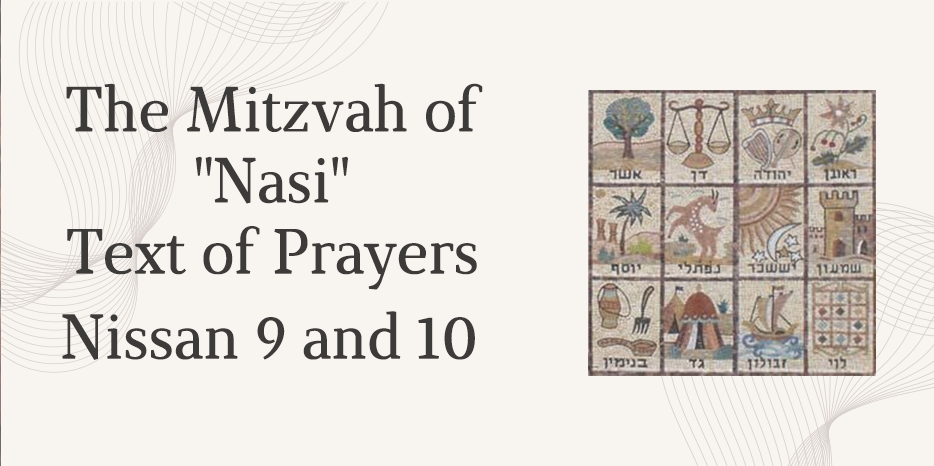
“Nasi” – The Offerings of the Tribal Princes of Israel
One year after the Exodus, on the first of Nissan, the dedication of the portable Sanctuary began. The dedication lasted twelve days, during which offerings were brought daily to the Mishkan, delivered by the prince of one of the twelve tribes of Israel.
In memory of this, it is customary during the days of the month of Nissan preceding Pesach to read daily the passage from the Torah describing the offerings of the prince of a different tribe.
Our website provides the text of the prayers from the Siddur “Tehillat Hashem” published by “F.R.E.E. Publishing House.”
9 of Nisan
The day of Benjamin has arrived. In the Torah, he is referred to as “the other,” as is stated at the birth of his older brother, Joseph: “May the Almighty grant me another son.” Yet, while the task of Joseph—and his sons, Manasseh and Ephraim—is to transform “the other” into a “son,” Benjamin faces a distinct challenge: to recognize his own sense of otherness and distance, and then to overcome it. This is a form of repentance—not one born of sin (for his narrative contains none), but rather one stemming from the realization of the imperative to draw closer to the Almighty.
The spiritual attribute of Benjamin constitutes one of the fundamental pillars of contemporary Jewish identity; yet, it manifests only on the ninth day. This timing is characteristic of his nature. He is a righteous man—but, unlike Joseph, he is a righteous man of the lower, earthly realm. The Altar of the Holy Temple was situated within his tribal territory, and the *Targum Yonatan* interprets the blessing bestowed upon him by Jacob as an allusion to the daily sacrificial offerings.
Steadfastness in the service of the Almighty, humility, and wholeness (for the sacrifices offered in the Temple were required to be free of blemish)—these are his defining attributes. It is a state of simplicity—a simplicity, however, whose paths are intricate and may, at times, cause us to lose sight of the ultimate goal.
10 of Nisan
Dan possesses a complex and eventful history. The symbol of this tribe—the figure of Samson, to whom Jacob’s blessing to Dan alludes—is itself an unconventional archetype for a Jewish leader. Yet, underlying all of this lies the central theme: “The Spirit of God that guides the Tribe of Dan.” It is a remarkable capacity to remain attuned to precisely what is required of one in the present moment, and to perceive one’s own unique destiny amidst the unfolding events of the world around.
During the wanderings in the wilderness, Dan marched in the rearguard; their sacred duty was to retrieve and restore the lost possessions of the other tribes marching ahead of them. The Rebbe speaks of this very function as it applies to the generation immediately preceding the coming of the Messiah—the generation that brings the journey of all generations to its culmination.
In the Talmud, Dan is characterized by its unwavering adherence to the Law and by its alignment of every action with it. There exists a concept known as the “Jew of the *Shulchan Aruch*”—an individual whose every deed is grounded in Jewish law. It is a remarkable quality, yet one that does not appeal to everyone, given the rigidity of its strict boundaries.
We thank https://chabad.org for the provided information.