



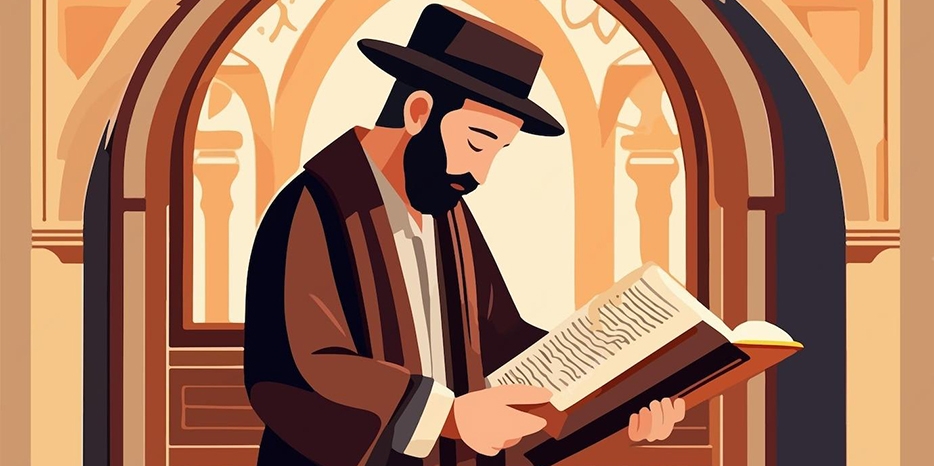
Beginning with the first Shabbos after the conclusion of Pesach, the study of Tractate Pirkei Avos (“Ethics of the Fathers”) commences in synagogues. The tractate is studied each Shabbos, following the Mincha afternoon prayer.
This is what Jewish sources write regarding this tradition: “According to an ancient custom, on the Shabbasos between Pesach and Shavuos, the Mishnaic tractate Pirkei Avos (‘Ethics of the Fathers’) is studied. This tractate deals with questions of ethics and human psychology. Unlike other tractates of the Mishnah, Avos contains no practical instructions, but rather establishes moral norms and rules of conduct, and extols lofty spiritual qualities.
It collects the sayings of our greatest sages – the ‘Avos Olam’ – the ‘Fathers of the World.’ Hence the name of the tractate – ‘Avos.’ Some add that the principles set forth in this tractate are the fathers of all wisdom and virtues, showing the way to all who strive for moral perfection.
At the end of his commentary to this tractate, Rashi writes: ‘It is called Avos because it contains, in order, the sayings of our first sages and fathers of Torah, who transmitted it to one another from Moshe to Yehoshua to the Elders, all the way to the Men of the Great Assembly, Shamai and Hillel, Rabban Yochanan ben Zakkai, and his students. This is done to inform us of the wisdom of their deeds, to relate how they warned their contemporaries and guided them on the correct path, and that similarly, every sage should, like the first ones, warn his contemporaries and direct them on the correct path.’
This tractate presents the loftiest principles, and as we study them, we inevitably ask ourselves: ‘Can we possibly rise to the level where fulfilling all these high rules is achievable? And if not – why do we study them?’ On the other hand, Pirkei Avos mentions numerous rules that only hardened villains and criminals fail to observe – and most Jews are certainly not that. Therefore, any decent person cannot help but ask: ‘What new information do these obvious rules tell us? Why do we need to study them? Don’t we already observe them?’ The answer to these questions is found in the Mishnah from Tractate Sanhedrin, which serves as an epigraph to all the chapters of Pirkei Avos: ‘Every Jew has a share in the World to Come.’ Similarly, each chapter of the Ethics of the Fathers concludes with the words: ‘The Almighty wanted to bestow a benefit upon Israel. Therefore, He gave them the Torah and the mitzvos.’
Every Jew has a share in the World to Come, to which he is intrinsically and inseparably connected. Therefore, none of us can say: ‘High concepts are beyond my understanding. They are intended for sages and saints, not for ordinary mortals.’ This is not so. Each of us is directly connected to them – just as we are connected to the Heavenly world.
Similarly, we should not disregard the words of the sages when they state seemingly simple things or teach laws that we already observe. The Torah contains many laws that we would likely have instituted ourselves, even if it had not given them to us. However, the Almighty bestowed a great kindness upon us by giving them to us as mitzvos, so that their fulfillment is mandated by the Torah as His directive. Because of this, we act as our hearts dictate and receive reward from the Almighty for doing so! Likewise, one who studies the seemingly simple words of our sages receives priceless reward, for it is an integral part of Torah study, given to us at Mount Sinai.
Originally, the tractate had five chapters. A sixth was added later, due to the custom of studying Avos on Shabbos; the chapter entitled ‘The Value of Torah’ was added to be read on the Shabbos before Shavuos – the holiday of the Giving of the Torah. This Shabbos is the sixth (and last) between Pesach and Shavuos. This custom is mentioned already in the siddur of Rav Amram Gaon, compiled over eleven hundred years ago. It states there: ‘In our Talmudic academy, in Babylon, it is customary after Mincha on Shabbos to study Avos and the chapter “The Value of Torah.”‘