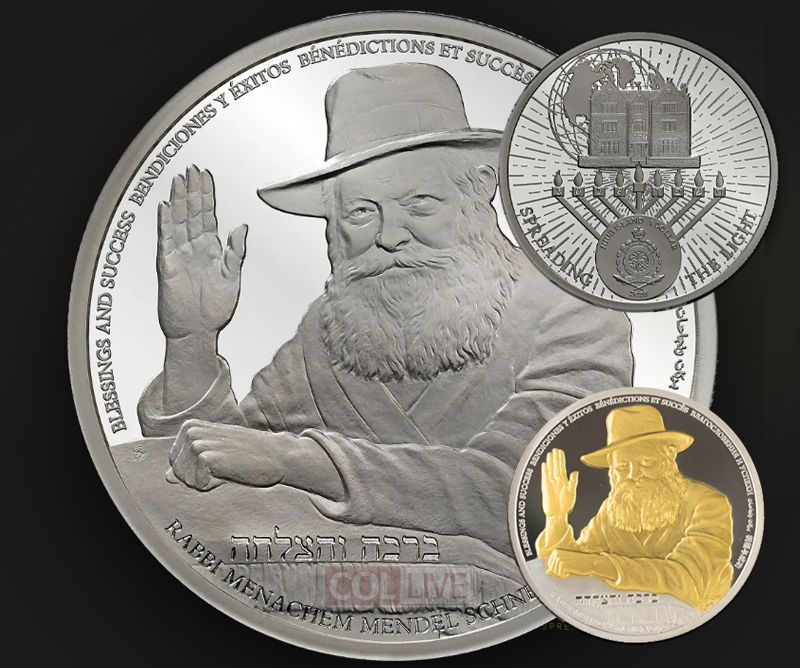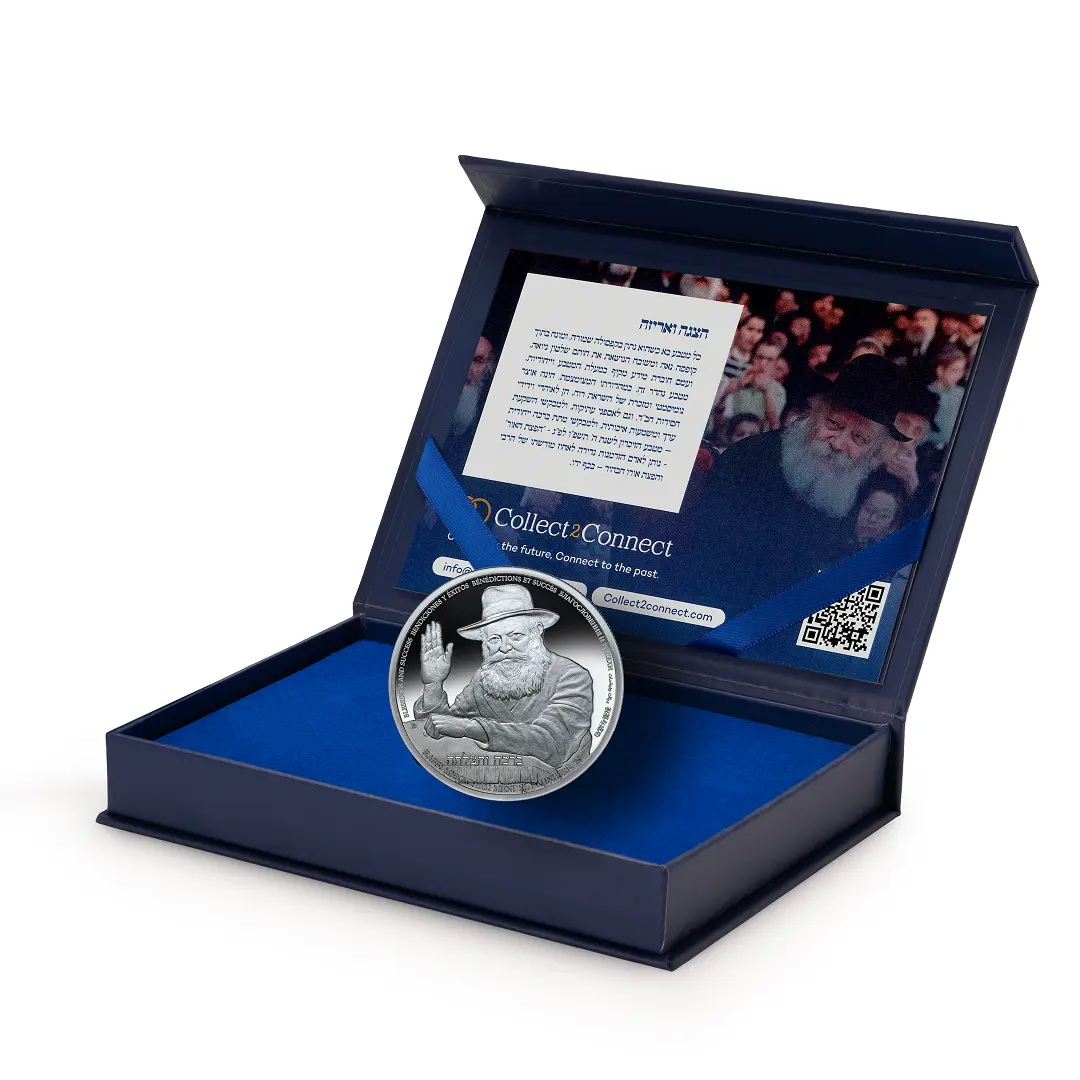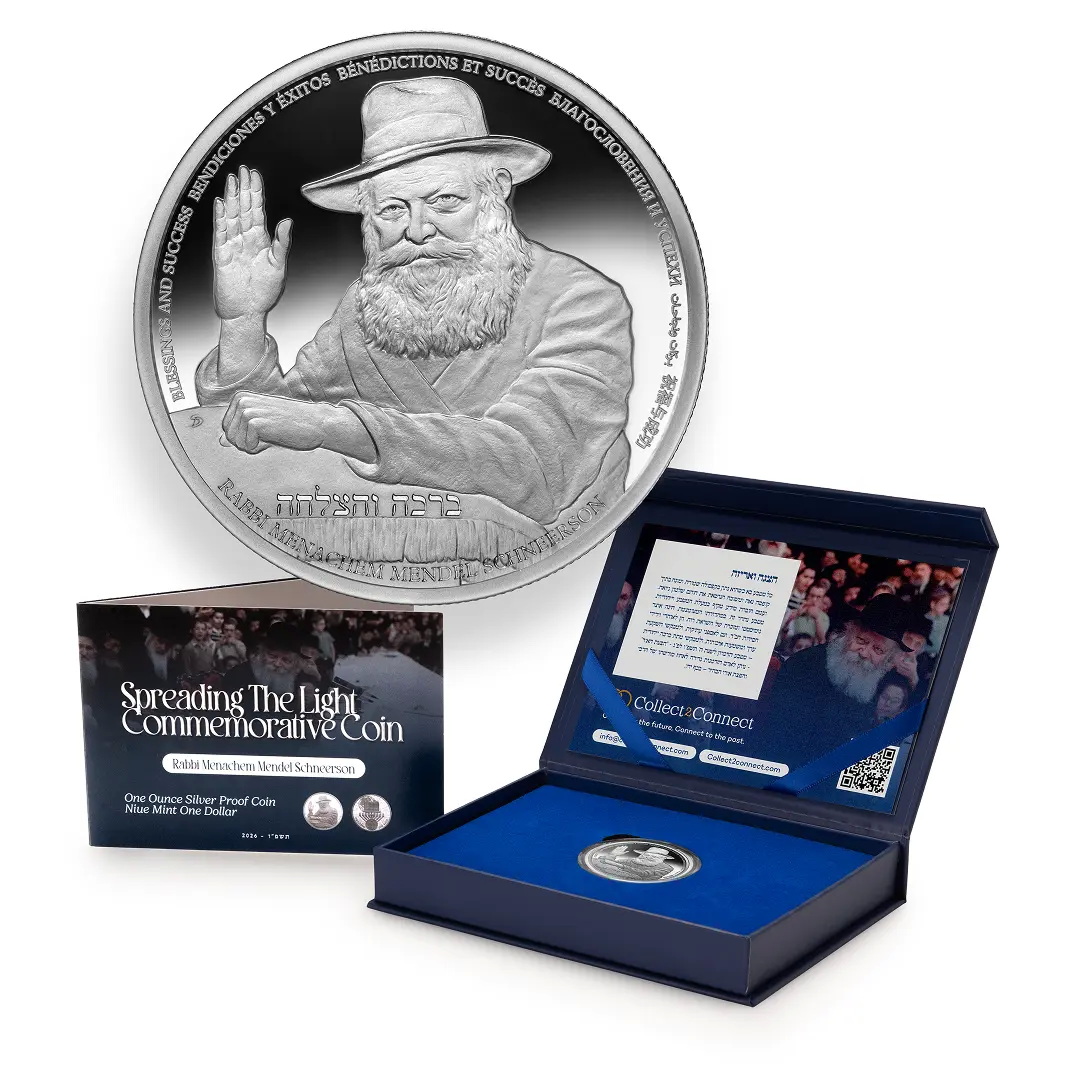



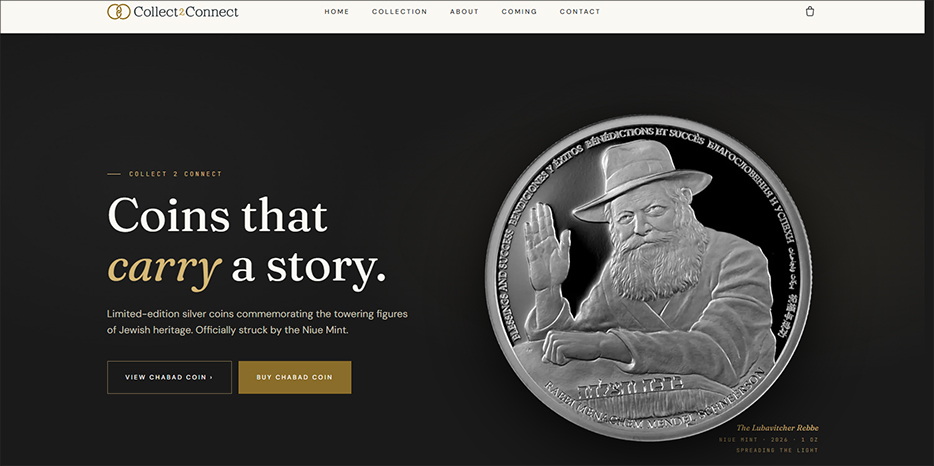
A commemorative silver coin with a denomination of one New Zealand dollar has been issued to mark the 75th anniversary of the Lubavitcher Rebbe, Menachem Mendel Schneerson, assuming leadership of the current generation of the Jewish people. The coin was issued under the jurisdiction of the Pacific nation of Niue, which is in free association with New Zealand. This gives the coin an official denomination in New Zealand currency and the status of legal tender.
The coin was issued in a limited mintage of only 5,786 pieces (corresponding to the current year in the Hebrew calendar). It is struck from one troy ounce of 999 fine silver in collector’s Proof quality with high relief. The artistic design was created by renowned Italian designer and medalist Sandra Deiana, whose works have been produced by leading mints worldwide. One of the most unusual features of the issue is that the silver alloy used for the entire mintage was infused with a dime (a ten-cent U.S. coin) once given by the Rebbe himself. This detail symbolizes the special spiritual connection of the new coin to the Rebbe’s blessing and legacy.
Despite its official denomination of one New Zealand dollar and its status as legal tender in Niue, the coin was issued from the start as a collector’s item. It can currently be purchased for $295 USD on the official website https://collect2connect.com, which released this commemorative series. According to the issuer, this is the world’s first coin featuring the Rebbe’s image with the status of legal tender.
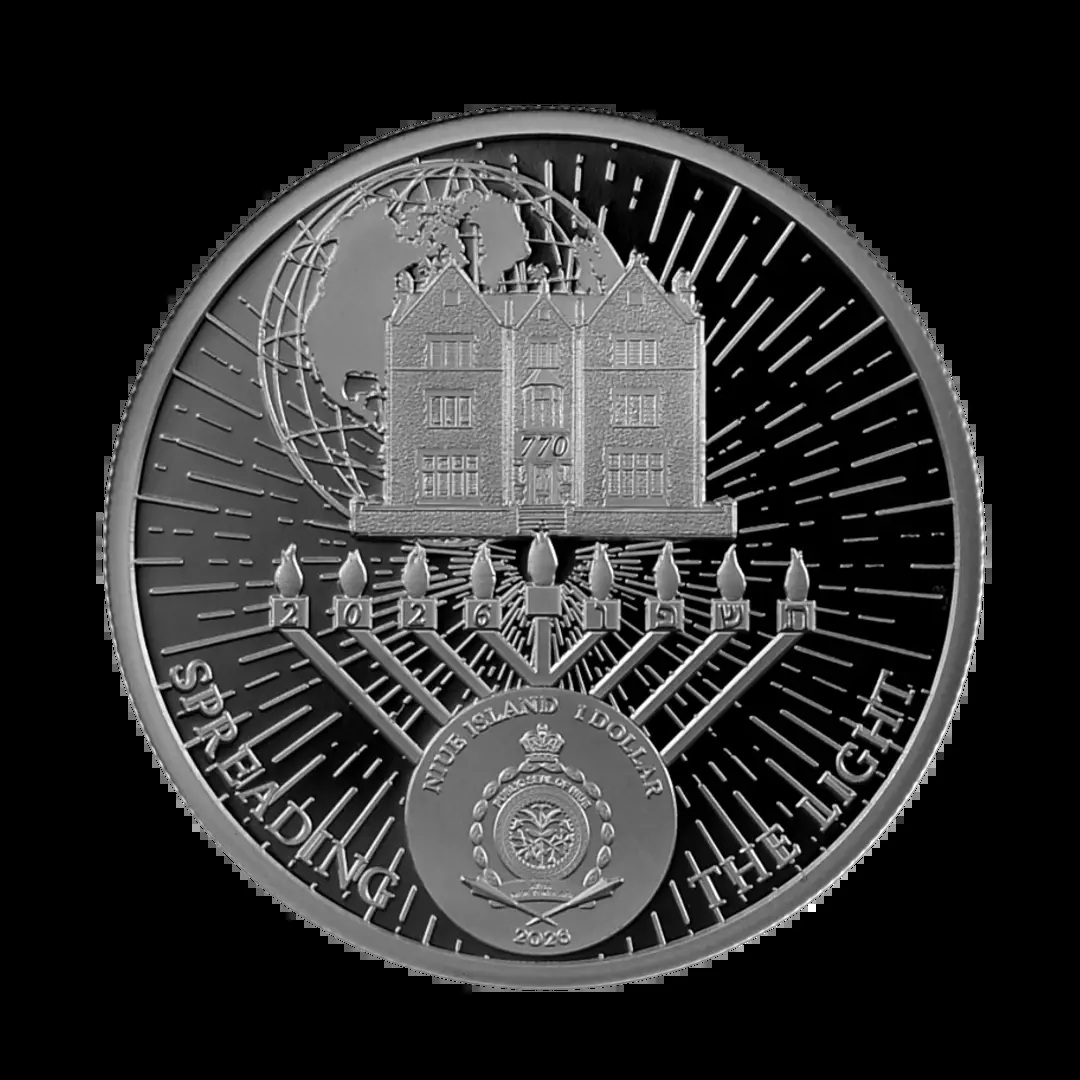
The overall artistic concept of the issue is titled “Spreading the Light.” It unites the image of the Rebbe, the “770” building, the menorah, and rays of light spreading across the globe, symbolizing the Rebbe’s ongoing mission to bring the light of Torah, goodness, and holiness to every Jew and to the entire world.
The obverse of the coin features a meticulously executed portrait of the Lubavitcher Rebbe. Around it, the words “Blessing and Success” appear in several languages, recalling the Rebbe’s famous blessing – “Brocha v’hatzlacha” – with which he blessed people who turned to him for advice, support, and spiritual guidance for decades.
The reverse depicts the world-famous building at 770 Eastern Parkway in the Crown Heights neighborhood of Brooklyn, New York – the center from which the Rebbe led the Jewish people and from which his emissaries set out to all corners of the world. Beneath the image of the building is a stylized menorah, whose rays spread across the globe, symbolizing the dissemination of the light of Torah, the fulfillment of mitzvos, and Jewish values.
It is interesting to note that the honor of issuing the first official coin featuring the Lubavitcher Rebbe’s image went to a country that has neither a Jewish community, a synagogue, nor even a Beit Chabad.
For reference – about the issuing authority:
Niue is a small island nation in Polynesia, located in the southern Pacific Ocean approximately 2,400 kilometers northeast of New Zealand, between the Tonga and Samoa archipelagos and the Cook Islands. The country’s territory consists of one of the world’s largest raised coral islands, which is why Niue is often called the “Rock of Polynesia.” The island covers an area of about 260 square kilometers, and its capital and largest settlement is Alofi. According to the Niue government, approximately 1,700 people currently live in the country.
Niue is not a colony or part of any other territory, but a self-governing state in free association with New Zealand. This status was chosen by the island’s residents and has been in effect since October 19, 1974, when the Niue Constitution came into force. The country has its own parliament, government, legislation, and judicial system, and makes its own decisions on internal matters. New Zealand provides economic and administrative assistance and, at the request of the Niue government, assists with foreign policy, defense, and security matters. Niue residents are New Zealand citizens, and the national currency is the New Zealand dollar; coins issued by Niue are legal tender only within the island’s territory, although they are denominated in New Zealand dollars. It is worth noting that all residents of Niue have New Zealand citizenship, but New Zealanders do not have Niue citizenship.
The head of state is King Charles III of the United Kingdom, who acts in relation to Niue as King of New Zealand. The country is part of the Realm of New Zealand and, through this connection, belongs to the historically established family of the British Commonwealth of Nations.
The population of Niue is not made up of European settlers but of Niueans – the indigenous Polynesian people, historically and culturally related to the inhabitants of Tonga, Samoa, and other Polynesian islands. There are two official languages on the island – Niuean, or Vagahau Niue, which belongs to the Polynesian language group, and English. Niueans preserve their own traditions, crafts, social customs, and cultural identity. At the same time, significantly more Niueans live outside the island than on their historical homeland: about 30,000 members of this people reside in New Zealand, while the population of Niue itself does not reach two thousand.