




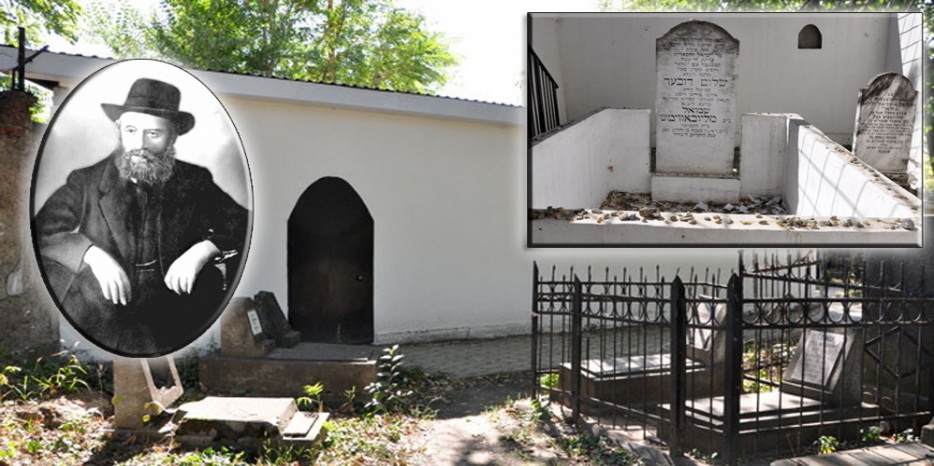
Today, the 2nd of Nissan, marks 106 years since the passing from the material world of the Rebbe Rashab, the Fifth Lubavitcher Rebbe, Rabbi Sholom DovBer Schneerson.
The Rebbe Rashab led the Jewish people at the turn of the 19th and 20th centuries. In 1897, he founded the famous network of “Tomchei Tmimim” yeshivas. He waged an uncompromising battle against assimilation and attempts to alienate Jews from their eternal religion, and zealously defended his people from the antisemitism of the Russian and later Soviet authorities. He paid particular attention to spreading the ideas of Chassidus among the Jews of Georgia.
Together with many Jews of Belarus, he endured the 1915 ethnic cleansing orchestrated by the Russian government, during which Jews were forcibly resettled into the interior of the empire. Separated from his beloved Lubavitch, which had been the capital of Chabad for one hundred and two years, but surrounded by devoted chassidim, the Fifth Lubavitcher Rebbe moved the center of Lubavitcher Chassidus to the city of Rostov-on-Don.
It was in Rostov that he received the news of the overthrow of the monarchy, and then that the democratic Provisional Government had also fallen, that the Bolsheviks had dissolved the Constituent Assembly, unleashing terror and civil war.
The Fifth Rebbe’s attitude towards the Bolsheviks and the Soviet authorities is well described by Marina Karpova in her article “In Spite of Everything”: “Once, in the spring of 1920, the Fifth Lubavitcher Rebbe, Sholom DovBer Schneerson, approached the window of his Rostov home – to see what the commotion was in the city, recently occupied by the Bolsheviks. Another demonstration of workers was moving down the street, with flags and placards threatening ‘merciless destruction’ to the enemies of the new regime. Looking at this, the Rebbe turned away and said sadly: ‘No, I cannot live in the same world with these.’ His words proved prophetic. Two weeks later, on March 21, 1920, Rebbe Sholom DovBer passed away.”
More detailed memories of the last hours of the Rebbe Rashab’s earthly life were left by one of his household members, Reb DovBer Rivkin:
“The eve of the holy Shabbos of the weekly portion Vayikra. At 5 o’clock in the evening, I entered the Rebbe Rashab’s room and saw that his face had greatly changed and become frightening. It was truly ablaze with fire, and his eyes bulged prominently. Doctors were standing around, doing everything medicine could do. They did not reveal to us the true state of the Rebbe, but they themselves already knew that in the natural course of events, there was no hope…
Shortly before evening, all the chassidim gathered in the prayer hall, reciting Psalms and tearfully begging for mercy. Towards evening on the holy Shabbos, Dr. Landa told several of the chassidim that unless one counted on a miracle, there was no hope, and therefore, in his opinion, the Rebbe’s son should be informed, as perhaps he would want to ask his father something. When Dr. Landa told the Rebbe Rayatz the true state of affairs, his mind could not accept such thoughts. He continued to think the situation was serious, but no more than that.
At the conclusion of the Holy Shabbos, around 10 o’clock, as the Rebbe Rayatz stood by his father’s bedside, the Rebbe Rashab addressed him and said in a clear voice:
– I am ascending to Heaven. I leave the manuscripts to you. Take me into the hall. We will be together.
When the Rebbe Rayatz heard these words, he became very agitated. The Rebbe Rashab saw his son so agitated and said to him:
– Agitation?.. Agitation?.. Mind!.. Mind!..
He was immediately moved, bed and all, into the hall – the hall where he had sat engrossed in Torah and prayer, from which he had spread great light to the entire world – and his bed was placed against the eastern wall. Doctors did not leave his bedside and for 10 minutes administered various injections.
The community of chassidim gathered and, amidst sobs, multiplied their prayers and pleas that the Almighty, blessed be He, prolong the Rebbe’s days. After this, the name Chaim was added for him. The chassidim also assembled a beis din of three people so that anyone who wished could give time from their own lives for the Rebbe. And each of the chassidim gave the Rebbe half a year of their life. Rebbetzin Shterna Sarah also came to the beis din and wanted to give the Rebbe ten years of her life, but the beis din refused to accept more than two years from her.
Around two in the morning, as the Rebbe Rayatz stood, bending over our Rebbe’s bedside, the Rebbe slightly raised his hand and his lips began to whisper something. The Rebbe Rayatz understood that his father wanted to bless him and bent down even lower so that the Rebbe’s hands rested on his head. After this, the Rebbe Rashab also blessed the Rebbe Rayatz’s daughters. At that moment, it became clear that his strength was leaving him; his eyes were closed, and his breathing weakened and nearly ceased…
All the Jews of Rostov participated in the funeral. The Rebbe Rashab was buried in the old Rostov cemetery. In the year 5700, the authorities wanted to demolish the old cemetery, and the Rebbe’s grave had to be moved to the new cemetery.”
Alexander Olenev, a local historian from Rostov, clarifies that in those times the Bolsheviks practiced deliberate and demonstrative desecration of “bourgeois” graves, and it became known that they had already planned an “action” at the Rebbe’s grave. Therefore, “the Rebbe’s burial was opened at night, and according to eyewitnesses, his body had not turned to dust. He was secretly reinterred in the southeastern corner of the new Jewish Cemetery,” deliberately leaving the spot unmarked to protect the Rebbe’s body from the communists. This same precaution saved the Rebbe Rashab’s grave during the Nazi occupation of Rostov. This same source reports: “For a long time, the Lubavitcher Rebbe’s grave remained unmarked. It was only in the 90s that the burial was located thanks to eyewitness accounts.” After the fall of the communist dictatorship, adherents of the Lubavitch movement erected a dignified ohel, installed a marble matzeivah, and the resting place of the Rebbe Rashab became one of the world’s pilgrimage centers.