




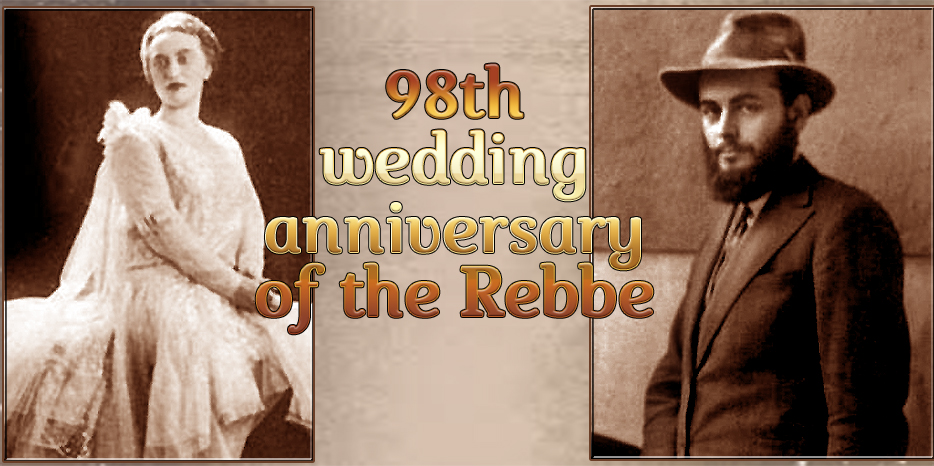
Ninety-eight years ago, on the 14th of Kislev, the wedding of Rabbi Menachem Mendel Schneerson, who would later become the Seventh Lubavitcher Rebbe, and Rebbetzin Chaya Mushka Schneerson, daughter of the Sixth Lubavitcher Rebbe, Rabbi Yosef Yitzchak Schneerson, took place. The wedding was held in Warsaw, at the Tomchei Temimim Yeshiva, in the presence of a large gathering of Chassidim and the Sixth Chabad Rebbe.
However, the wedding of the future Seventh Lubavitcher Rebbe and Rebbetzin Chaya Mushka Schneerson was celebrated not only in Warsaw. The groom’s parents, Rabbi Levi Yitzchak Schneerson, Chief Rabbi of Yekaterinoslav-Dnipropetrovsk from 1909 to 1939, and his wife, the righteous Rebbetzin Chana, were denied permission to leave the Soviet Union and were therefore unable to attend their son’s wedding. In response, Rabbi Levi Yitzchak arranged a second wedding ceremony in Dnipropetrovsk, which took place at the very same time. Many Rabbonim and Chassidim living in the Soviet Union came to participate.
An account titled “From the Diary of a Student of Tomchei Temimim Yeshiva” describes how the Lubavitcher Rebbe’s wedding unfolded. A shortened version of this account has been published on numerous websites. We are pleased to present our readers with the most complete version we were able to find online in Russian, originally published on the now-defunct website of Nachlas Levi Yeshiva.
“The wonderful news that the wedding of the Rebbe Rayatz’s daughter, Rebbetzin Chaya Mushka, to the Rebbe would take place in Warsaw brought immense joy and stirred a tremendous wave of emotion among Jews throughout Poland, particularly among Chabad Chassidim and the Temimim – students of Tomchei Temimim Yeshiva, where the wedding was to be held at the Rebbe Rayatz’s insistence.
On the 13th of Kislev, thousands of people gathered at the railway station to welcome the Rebbe Rayatz and his family, who at the time were living in Riga, the capital of what was then the independent Republic of Latvia. Throughout the day, large numbers of Chabad Chassidim arrived in Warsaw from cities across Poland and Lithuania. Many guests also came from distant places, among them the Rebbe Rayatz’s father-in-law, Reb Avraham Schneerson, from Kishinev.
That day, a seudah was arranged for the students of Tomchei Temimim Yeshiva. The Rebbe, the groom, all the relatives of the bride and groom, and many Chassidim attended. After the seudah, which continued well past midnight, the Rebbe Rayatz expressed a desire to dance with the students of the senior yeshiva. They formed a large circle, and the Rebbe Rayatz danced inside it for a long time.
The following day, the 14th of Kislev, at five o’clock in the evening, the Kabbalas Panim began in the yeshiva hall. Special guards had been stationed at the entrance, as admission was restricted to those holding invitations. Thousands of people tried to make their way inside and pleaded to be admitted, but the hall was simply too small to accommodate everyone.
A huge table stood in the main hall, with the groom seated at its head. The Rebbe Rayatz sat to his right, while Reb Avraham Schneerson sat to his left. Distinguished guests sat on both sides of the table: Admorim, Rabbonim, and community leaders from throughout Poland.
Absolute silence filled the hall as the Rebbe Rayatz began to speak:
‘It is known and widely accepted that during the wedding celebrations, the souls of fathers from up to three preceding generations come from the World of Truth. This takes place in every Jewish home. However, sometimes the souls of fathers from more than three preceding generations also come to a wedding. And as an invitation to the souls of the Tzaddikim, our forefathers, our holy Rebbes, who will come to the wedding to bless the bride and groom, we will say Chassidus: a section belonging to the Alter Rebbe, a section belonging to the Mitteler Rebbe, a section from the father of my grandfather (the Tzemach Tzedek), a section from the grandfather, the father of the bride’s grandfather (the Rebbe Maharash), a section from the groom’s great-grandfather, and a section from my father, the bride’s grandfather (the Rebbe Rashab). For it is said: “One who relates something in the name of the person who originally said it should envision that person as standing before him.”’
The Rebbe Rayatz then recited a maamar beginning with the words “Lecha Dodi Likras Kallah” (“Come, my beloved, to greet the bride”). After concluding the maamar, the Rebbe Rayatz and the groom went into a separate room, where they remained for a short while. The groom was then brought out for the badekenish, after which everyone proceeded together to the chuppah, which had been set up in the yeshiva courtyard.
More than five thousand people crowded into the courtyard. The shoshvinim were the Rebbe Rayatz and his wife, Rebbetzin Nechama Dina; the Rebbe Rayatz’s uncle, Reb Moshe Orenstein, and his wife; and Rebbetzin Chaya Mushka, daughter of the Rebbe Maharash. As the bride and groom were escorted to the chuppah, the Rebbe Rayatz instructed everyone to sing the Alter Rebbe’s niggun, “Arba Bavos.” The Rebbe himself also sang the niggun, with profound deveikus to Hashem.
The Rebbe Rayatz personally conducted the chuppah. He recited the Sheva Brachos with extraordinary intensity and deveikus, while the entire gathering stood in awe of the remarkable scene before them.
The wedding seudah took place in one of Warsaw’s large halls. The Rebbe Rayatz moved from table to table, personally pouring mashke for everyone attending the wedding. Reaching the students, he delivered a sicha to them and afterward went out to dance with the yeshiva’s directors and educators.
After dancing, the Rebbe Rayatz returned to his seat and recited a maamar beginning with the words “He Who created rejoicing and gladness…” The maamar continued well past midnight, and only afterward did the guests wash their hands and begin the seudah. During the meal, the Rebbe instructed that everyone present be given a gift: a reproduction of the Alter Rebbe’s handwritten signature, accompanied by explanations written by the holy hand of the Rebbe Rayatz himself. The great joy, wedding songs, and dancing continued until dawn. It was only at seven o’clock in the morning that the participants began returning to their homes. Poland had never witnessed such an extraordinary wedding.
Regarding the 14th of Kislev, the Rebbe once remarked: ‘This day bound me to you – the Chassidim.’ (From the Rebbe’s Sichos for 5714, p. 119).”
(Sefer Toldos Rebbe Rayatz)