



Today, on the 20th of Teves, Jews around the world mark the yahrtzeit of one of the greatest sages and codifiers of Jewish law—Rabbi Moshe ben Maimon, known as the Rambam (Maimonides).
The Rambam was an exceptional figure of his time: a philosopher and rabbi, a physician and scientist, an educator who had a colossal impact on both Jewish tradition and world science. It was said of him, “From Moshe to Moshe, there arose none like Moshe,” and the Vilna Gaon saw an allusion to his greatness in the Torah itself, pointing out that the first letters of the verse “My wonders are multiplied in the land of Egypt” (Shemos 11:9) spell out the name Rambam.
Although his burial place is in Teveria, in Eretz Yisroel, the Rambam was born in 1135 in Cordoba (Spain, which was under Arab rule at the time). His life’s journey was filled with wanderings and trials, and a significant part of his life and work is connected to Egypt.
According to tradition, the Rambam’s childhood was not easy. Despite early Torah study with his father, he initially showed no interest in learning. However, a profound shock experienced in his youth became a turning point: from then on, he began to study with extraordinary diligence and soon revealed his outstanding genius.
At the age of 23, the Rambam began work on his “Commentary on the Mishnah,” completing it later in Egypt. There, he became the rabbi of Fostat (a suburb of Cairo) and the head of a yeshiva. After the tragic death of his brother David, who supported the family, the Rambam was forced to earn a living through medicine. His medical talent brought him great renown—he became the personal physician of Sultan Saladin and later of his heir.
It was during these years of intense medical practice that the works that immortalized his name forever were created. In 1190, the Rambam completed the “Mishneh Torah”—a comprehensive codification of Jewish law that became one of the central pillars of the Oral Torah. His philosophical work “Moreh Nevuchim” (“Guide for the Perplexed”), addressed to those seeking to reconcile faith and reason, also had an enormous influence. Additionally, the Rambam wrote works on medicine and mathematics, later translated into Latin, which entered the treasury of world science.
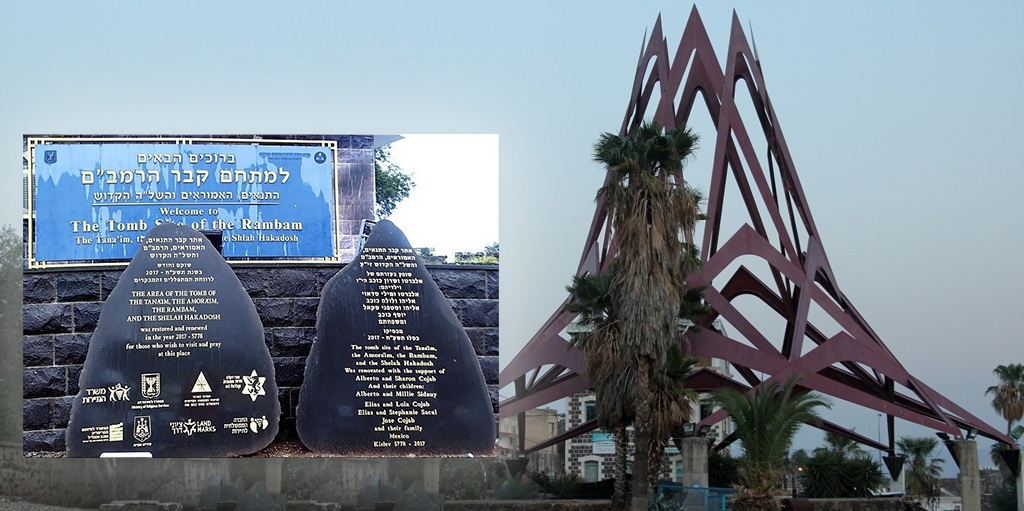
The Rambam passed away on the 20th of Teves, 1204, in Fostat. When news of his passing reached Yerushalayim, a day of mourning and fasting was declared in the city. Later, his body was brought to Eretz Yisroel and buried in Teveria.
The Rambam emphasized the particular importance of Torah study, outlining three interconnected paths:
– the study of laws and practice (Halacha),
– understanding the meaning of the mitzvos through commentary and philosophy,
– and study as a path to personal and spiritual refinement.
According to his teaching, it is precisely the combination of knowledge, understanding, and inner growth that makes Torah study truly alive and complete.
The legacy of the Rambam gained special significance in our time due to the directive of the Lubavitcher Rebbe, instituted in 1984 (5744), regarding the daily study of his works. This initiative has united Jews worldwide and includes three formats: the annual cycle (three chapters per day), the three-year cycle (one chapter per day), and the study of the “Sefer Hamitzvos,” making the teachings of the Rambam accessible to everyone.
In this video, you will see how the Lubavitcher Rebbe initiated this directive and learn about his special connection to the completion of the Rambam study cycles.