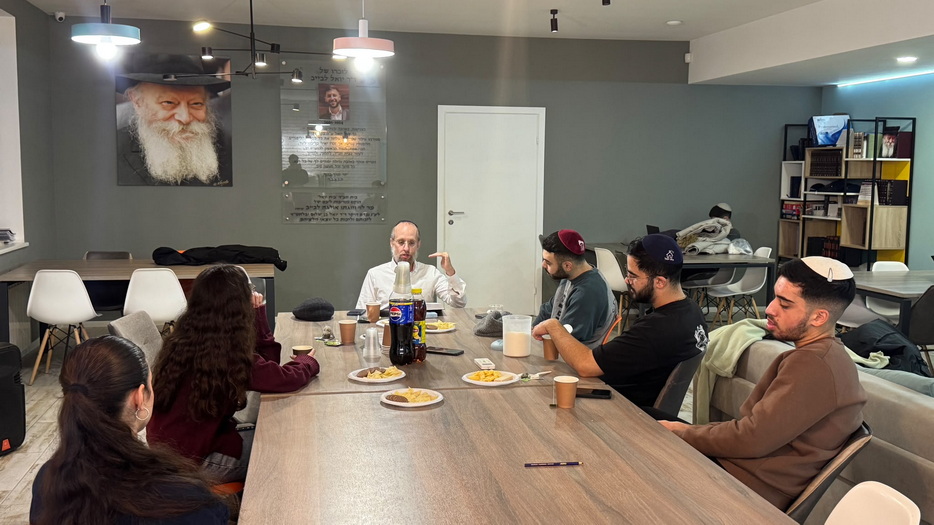




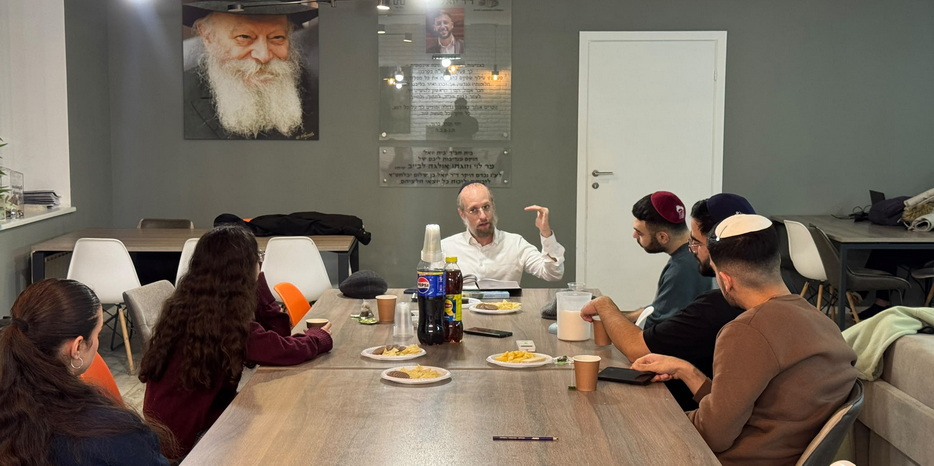
Two classes dedicated to the weekly Torah portion of Vayetze were held as part of the Dnipro Jewish Community’s Beit Yoel project, a Beit Chabad in Dnipro serving Israeli students who live and study in the city. The first class was led by Rabbi Menachem Mendel Marinovsky at the project’s premises in the Golden Rose Central Synagogue complex, while the second was conducted by Rebbetzin Leah Dorfman for a group of young women at the Dorfman family home. Both classes focused on the story of the patriarch Yaakov, his challenges while living far from his home, and the building of the family destined to become the foundation of the Jewish people.
The name of the parsha, Vayetze, means “And he went out.” It begins with Yaakov leaving his hometown of Be’er Sheva and setting out for Charan. While spending the night along the way, he has an extraordinary dream: a ladder standing on the earth and reaching toward the heavens, with angels ascending and descending upon it. Hashem promises to protect Yaakov on his journey and bring him safely home. Upon awakening, Yaakov realizes the holiness of the place that had initially seemed like an ordinary stop along his journey. This story reveals one of the parsha’s central messages: Hashem’s presence and the opportunity to connect with holiness are not limited to familiar or predetermined places.
Another important theme of the parsha is loyalty and responsibility. In Charan, Yaakov meets Rachel and agrees to work for her father, Lavan, for seven years in order to marry her. However, Lavan deceives him, giving him his elder daughter Leah instead. Despite this deception, Yaakov remains true to his word and accepts the obligation to work another seven years for Rachel. This story invites us to reflect on why honesty and faithfulness to one’s commitments are especially important even when others treat us unfairly.
The conclusion of this story holds particular significance for young Israelis living far from their homeland. Yaakov leaves his parents’ home alone, but twenty years later returns at the head of a large family. It is in Charan, far from his native land, that the foundations of the future Jewish people are laid. Thus, Parshas Vayetze reminds us that even periods of wandering, challenges, and separation from home can become times of spiritual growth, fulfilling one’s purpose, and building the future.
“For our students, who today live and study far from Israel, Yaakov’s story has special significance. It shows that a person can remain faithful to Hashem and to their values under any circumstances, and that challenges can become part of a journey toward building something great and meaningful,” said Rabbi Yaakov Dorfman, director of the Beit Yoel project. “We strive to make the study of the weekly Torah portions a way for young people not only to deepen their understanding of the history of our people, but also to find answers to questions in their own lives, strengthen their Jewish identity, and feel that they are part of the large, united, and close-knit family of the Dnipro Jewish Community, under the leadership of Chief Rabbi Shmuel Kaminezki.”