




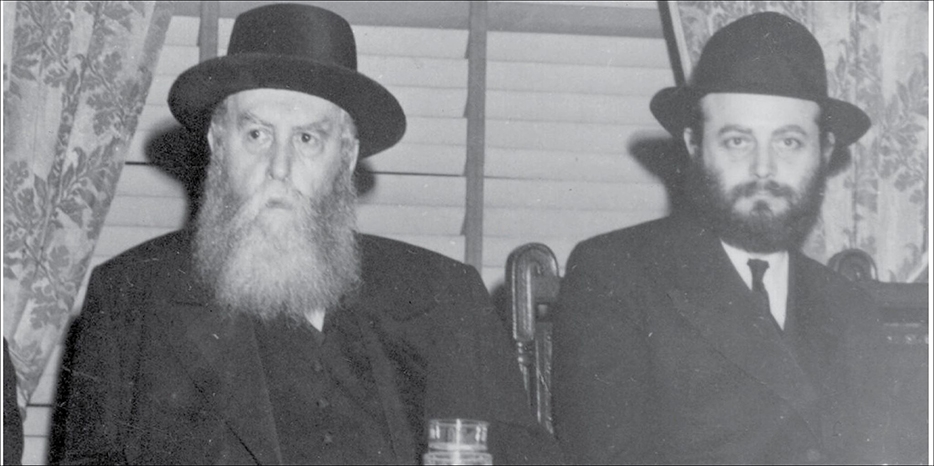
Tonight, the Tenth of Shvat – a most significant date in the Chassidic calendar – begins. This is a special day for all followers of Chabad-Lubavitch. Precisely the 10th of Shvat is observed as the birthday of our generation, as it is accepted that a generation changes when its Head changes.
On this day 76 years ago, the Previous Head of the Chabad-Lubavitch movement, Rebbe Yosef Yitzchak Schneersohn, passed away. Exactly one year later, 75 years ago, his son-in-law, Menachem Mendel Schneersohn, assumed the leadership of the Jewish people and the title of the Lubavitcher Rebbe. A good description of those historic days can be found in the book “To Live and Live Again” by Yaakov Hanin and Eliyahu Elkin.
“…Upon arriving in America, Rebbe Yosef Yitzchak Schneersohn delivered a maamar once a week for two years, but then he began to do so less frequently. The last time he delivered a maamar was on his birthday, 12 Tammuz 5705 (1945).
Over the next five years, the Rebbe prepared for print the maamarim he had delivered or written in Europe. Booklets of these maamarim were published for special dates, so that Chassidim, by studying them on these days, could feel and strengthen their connection to the Rebbe.
The first part of the treatise “Basi LeGani” was prepared by the Rebbe for study on 10 Shvat 5710 (1950), the yahrtzeit of his grandmother, Rebbetzin Rivka. The second part was intended for release on 13 Shvat, the yahrtzeit of the Rebbe’s mother, Rebbetzin Sterna-Sarah; the third for Purim; and the fourth for 2 Nisan, the yahrtzeit of his father, the Rebbe [Rashab]. The treatise discussed the idea of the purpose of Creation and how a Jew can and must actualize it.
On Shabbos, 10 Shvat, the Chassidim began studying the first part of this treatise. Suddenly, someone noticed that in the word shlita (the acronym for ‘may his days be long and good’), accompanying the Rebbe’s name on the title page, the letter yud was missing.
In the morning, at 7:50, Dr. Zelikson was summoned by a phone message that the Rebbe had taken ill. Rushing to the scene, the doctor found that the Rebbe had suffered a massive heart attack. Zelikson gave two injections, but it did not help. The police officers bringing an oxygen pillow were also too late. At 8:07, the Rebbe’s soul departed. At that moment in the room were Dr. Zelikson himself, the Rebbe’s secretary Rabbi Shalom Levitin, and the Rebbe’s assistant Rabbi Shalom Ber Eichhorn. All three represented the three parts of the Jewish people: Dr. Zelikson was an Yisrael, Rabbi Levitin a Levi, and Rabbi Eichhorn a Kohen. Since, according to Torah law, a Kohen is forbidden to be in the same room with a deceased person, Rabbi Eichhorn immediately went outside, and soon the entire community learned of what had happened.
The days of mourning passed, and the Chassidim turned to the Rebbe’s son-in-law, Rabbi Menachem Mendel, asking him to accept the leadership of Chabad, but he refused. “Der Rebbe lebt” (“The Rebbe lives”), he consistently answered whenever someone brought up the topic. When the requests became insistent, Rabbi Menachem Mendel threatened to go to a place where he could not be found. The Chassidim did not know what to do.
One day, Rabbi Eliyahu Simpson, who had served as Rabbi Yosef Yitzchak’s secretary for the past ten years, had a dream in which the Rebbe himself appeared and asked:
‘Why are the Chassidim so sad?’
‘Because we have no one to turn to,’ answered Rabbi Simpson.
‘Is my son-in-law Mendel not with you?’
‘But he refuses to accept the leadership.’
‘He has already been ordered to do so.’
At the first opportunity, Rabbi Simpson recounted his dream to Rabbi Menachem Mendel.
‘I have not received any instructions,’ he replied.
Then Rabbi Simpson and several elder Chassidim went to the grave of Rabbi Yosef Yitzchak and read there a letter in which they asked the Rebbe to give the appropriate order. From then on, when the matter of accepting the leadership of Chabad was discussed, Rabbi Menachem Mendel no longer refused but remained silent, and it was evident that he did not know how to respond.
On 26 Tevet 5711 (1951), Rabbi Aharon Kazarnovsky placed an announcement in Yiddish newspapers that on 10 Shvat of that year, Rabbi Menachem Mendel Schneersohn would accept the leadership of Chabad at the request of the Chassidim. The next day, the future Rebbe summoned Rabbi Kazarnovsky and ordered him to issue an immediate retraction.
‘May I say something about this?’ asked Rabbi Kazarnovsky, and receiving permission, continued, ‘Last night I saw the Rebbe in a dream. “Tell my son-in-law,” he said to me, mentioning your name, that it says in the Torah: “And the L-rd said to Moses: ‘Why do you cry out to Me? Speak to the children of Israel, that they should go forward!'” Ask him why he claims that I am still the Rebbe? Tell him my words: “Speak to the children of Israel, that they should go forward and ascend together with you until the coming of our righteous Moshiach!”‘
Rabbi Menachem Mendel listened to Rabbi Kazarnovsky and replied:
‘Thank you for the good news. But I also have something to cheer you up with.’
And the future head of Chabad showed a telegram he had just received, in which the Chief Ashkenazi Rabbi of Israel, Yitzchak Herzog, congratulated the addressee on accepting the leadership of the movement and blessed him for success.
On 10 Shvat 5711 (1951), Rabbi Menachem Mendel went to his father-in-law’s gravesite and read there the letters of all those who had asked for blessings. Last, weeping bitterly, he read the michtav hitkashrut (a letter in which the Chassidim accept the Rebbe as their undisputed leader and declare their bond with him), at the end of which were thousands of signatures.
When he returned, the Chassidim, having recited the afternoon and evening prayers, filled “770” in anticipation of the farbrengen. Rabbi Menachem Mendel had conducted farbrengens throughout the year, but this time everyone hoped he would finally accept the leadership of Chabad.
At a quarter to nine, the farbrengen began. Rabbi Menachem Mendel began by stating the need to strengthen one’s connection with his father-in-law, the Rebbe, through service to G-d, and then said:
‘It is stated in the Talmud: “When you enter a city, follow its customs.” The tradition that has developed here, in the U.S., is this: before embarking on any new project, an official announcement is made. Here is the official announcement I wish to make: “Proceed with action. And the result of these actions should be three types of love that should be revealed in oneself and in others – love of G-d, love of Torah, and love of one’s fellow. If any one of these components is deficient, it should be perfected, and through this, we will finally emerge from this bitter exile.”‘
The Rebbe gave a sign, and those gathered began to sing a niggun. At that moment, one of the elder Chassidim, Rabbi Avraham Sender Nemtzov, rose and declared loudly:
“Sichos (talks) are very good, but we want to hear a maamar from the Rebbe!” Silence fell. Everyone awaited the Rebbe’s reaction. The Chassidim knew that by delivering a maamar, he would accept the leadership of the movement. And the Rebbe delivered his first maamar, “Basi LeGani,” based on the maamar of the Previous Rebbe. In it, the Rebbe spoke about how the goal of the seventh generation of Chabad is to complete the spiritual work of all previous generations and to bring Moshiach into our material world.
‘And now I want to say this,’ announced the Rebbe, concluding the maamar. ‘The Rebbeim of Chabad always demanded that the Chassidim serve G-d with their own strength, not relying on the righteous. Do not deceive yourselves, do not hope that I will do all the work for you while you remain idle. I will help as I can, but each of us must dedicate our entire being – all our body and soul – to fulfilling the task placed upon us by my father-in-law.’
‘And now we will say l’chaim,’ said the Rebbe, concluding his address.
At that very moment, the eighty-year-old Rabbi Nemtzov climbed onto a table and exclaimed:
‘Chassidim! Listen to me! Today is a great day for us! We now have a Rebbe! And on this occasion, we must recite the blessing Shehecheyanu!’
For nearly half a century, Rabbi Menachem Mendel – from the very day he assumed the leadership of Chabad – worked tirelessly to fulfill his mission: to transform our world into a dwelling place for G-d and to bring Moshiach and the Redemption.’