



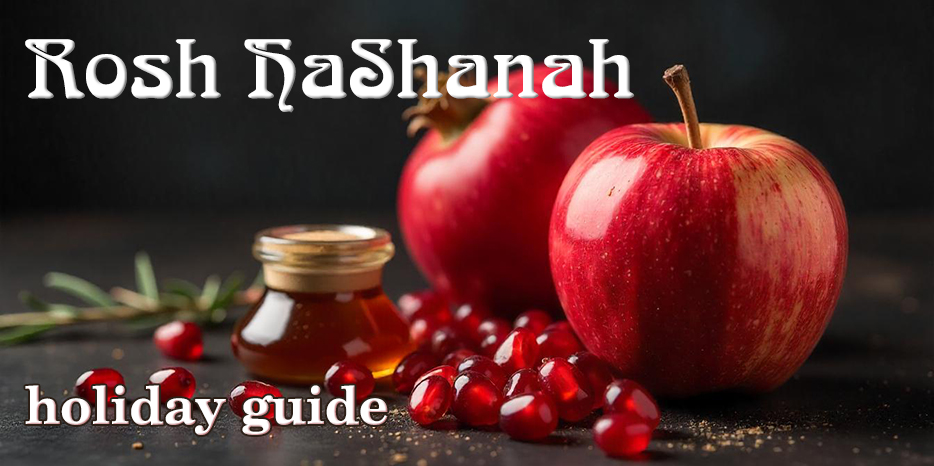
On the eve of Rosh Hashanah, our website presents to its readers a brief guide to this holiday.
On Rosh Hashanah – the Jewish New Year (1–2 Tishrei, in 2026 falling on September 11–13) – the kingdom of G-d over the entire world is proclaimed. On this day, the forefather of humanity – Adam – was created. And on that same day, he violated the prohibition given to him by G-d and was sentenced to exile from Eden. This was the first Rosh Hashanah, and the first judgment of man took place then. Since then, every year on this day, the Almighty judges humanity, determining what is to happen to people and nations in the coming year.
On the eve of the first day of Rosh Hashanah, it is customary to light festive candles before sunset (this year, the first day falls on Shabbos). The following blessings are recited:
Baruch Atah Ado-noi Elo-heinu Melech HaOlam Asher Kiddeshanu B’Mitzvosav V’Tzivanu L’hadlik Ner Shel Shabbos V’Shel Yom HaZikaron.
Baruch Atah Ado-noi Elo-heinu Melech HaOlam Shehecheyanu V’Kiyemanu V’Higianu LaZman HaZeh.
After the Maariv prayer on the evening of Rosh Hashanah (i.e., on the evening of September 11, 2026), it is customary to greet one another: “Leshana tova tikatevu v’techatem” (to a woman: “Leshana tova tikatevi v’techatmi”), which means “May you be inscribed for a good year, and may this inscription be sealed!”
During the first (evening) meal of Rosh Hashanah, a number of customs are observed that symbolize the desire to merit a good new year. After the blessing over bread, the first piece of challah is dipped not in salt, as usual, but in honey. Then a slice of sweet apple is taken, dipped in honey, the blessing “…who creates the fruit of the tree” is recited, and then one says: “May it be Your will that the new year be good and sweet!” This is done even when there are fruits on the table for which the Land of Israel is famous (e.g., dates, pomegranates), although usually in such a case, it would be over them, rather than over the apple, that the blessing should be recited. In addition, during the meal, many eat a ram’s head – in memory of the ram offered instead of Yitzchak – or a fish head – so that in the coming year one may “be a head, not a tail”; pomegranates – “so that our merits be numerous as the seeds of a pomegranate”; dishes made from carrots, beets, and other vegetables whose names in Yiddish, Hebrew, or Aramaic are associated with good wishes. Fish is eaten – so that we “multiply like fish in the sea.” The blessing is recited only over the apple dipped in honey. In some communities, each dish is accompanied by a corresponding wish recited aloud. To avoid encountering bad omens on Rosh Hashanah, sour, bitter, and spicy foods are not eaten during the first festive meal, nor are nuts (the gematria – numerical value – of the letters of this word equals the gematria of the word chet (sin)).
On Rosh Hashanah, the Almighty judges the entire world and determines the fate of every person for the coming year. As the Talmud states (Mishnah, Tractate Rosh Hashanah, 1:2), on this day, all people without exception pass before the Creator, “like sheep before the shepherd when he counts his flock.” The deeds of every person are carefully analyzed, and a corresponding verdict is rendered.
Therefore, Rosh Hashanah is not a holiday in the ordinary sense of the word. The delicious foods and festive clothes express not merriment, but hope for G-d’s mercy, who loves and pities His children and desires their vindication in judgment. At the same time, Rosh Hashanah is distinguished by a special atmosphere of seriousness and anxiety. Therefore, on these days, one should not engage in entertainment or strolls; it is not recommended to sleep during the day, and even at night it is preferable to sleep less than usual. It is customary to abstain from marital intimacy on both nights of Rosh Hashanah. As much time as possible should be devoted to prayer, Torah study, and the recitation of psalms. On Rosh Hashanah, one does not smoke, although this is not prohibited by law.
The most important mitzvah of this holiday is to hear the shofar being sounded, which symbolizes the coronation of the Almighty as Master of the universe. In addition, the voice of the shofar, resembling a child’s cry, symbolizes the cry of our soul emanating from the depths of the heart, addressed to the Heavenly Father.
Before the shofar is sounded, one does not eat or drink (unless this would be harmful to one’s health). It is customary to hear the sounds of the shofar while standing.
Before blowing the shofar, the one honored to do so recites two blessings: “…Who has commanded us to hear the voice of the shofar” and Shehecheyanu. He recites these blessings on behalf of all who hear him, and those present respond “Amen!” According to custom, another person stands near the one blowing the shofar and silently indicates to him from the siddur or machzor which type of sounds should be sounded. Between the recitation of the blessings and the final series of shofar blasts during the chazzan’s repetition of the Musaf prayer, it is forbidden to say anything unrelated to the prayer or to the performance of the shofar mitzvah. On the second day of Rosh Hashanah, the one blowing the shofar should wear a new suit or shirt in order to be able to recite Shehecheyanu. But even if there is no such possibility, he still recites this blessing.
On Rosh Hashanah, it is customary to bring children to the synagogue to hear the shofar and to accustom them to behave appropriately. Very young children should be held by their mothers, as, in principle, women are exempt from the obligation to hear the shofar, and if a child disturbs the mother’s concentration, it will not be considered a violation of the mitzvah. During the Musaf prayer, the shofar is sounded one hundred times, no more. One who has already heard the shofar being sounded, or has blown it himself, is permitted to blow it during the day for those who have not yet fulfilled this mitzvah. It is preferable that the blessing before this be recited by one of the listeners.
Since the first day of Rosh Hashanah falls on Shabbos, the shofar is sounded only on the second day.
On the first day of Rosh Hashanah (and if it falls on Saturday, then on the second, as is the case this year) after noon and before nightfall, it is customary to perform the Tashlich ceremony. Its essence lies in the recitation of prayers invoking the “Thirteen Attributes of Mercy” and in the symbolic “shaking out” of sins. The ceremony is performed near water, which according to Kabbalah symbolizes mercy, preferably near a body of water where fish live, symbolizing fertility, vitality, and the “All-Seeing Eye.”
The second day of Rosh Hashanah differs from the second days of other festivals in that it is in all respects considered equal to the first day (unlike other “second days,” it was not established due to doubt about the exact date). Moreover, the Talmud states that both days of Rosh Hashanah are “one long day.” Therefore, there is doubt as to whether the blessing of Shehecheyanu should be recited before the onset of the second day of Rosh Hashanah. To resolve this doubt, it is customary to deliberately create some reason to recite it. Thus, a woman who lights the candles should wear a new dress or place a new fruit before her on the table. In this way, she creates a reason for reciting Shehecheyanu, and this blessing will also apply to the lighting of the candles. However, if it is not possible to create such a reason, Shehecheyanu is still recited. The new fruit over which this blessing was recited is eaten immediately after Kiddush, before the washing of the hands for the meal.
On the second day of Rosh Hashanah, candles are lit after nightfall, after the stars appear, just before Kiddush.
“Rosh Hashanah” literally means “head of the year.” This alludes to the fact that just as the functions of the entire body depend on the head, so a person’s behavior on Rosh Hashanah determines what the coming year will be like for them.