




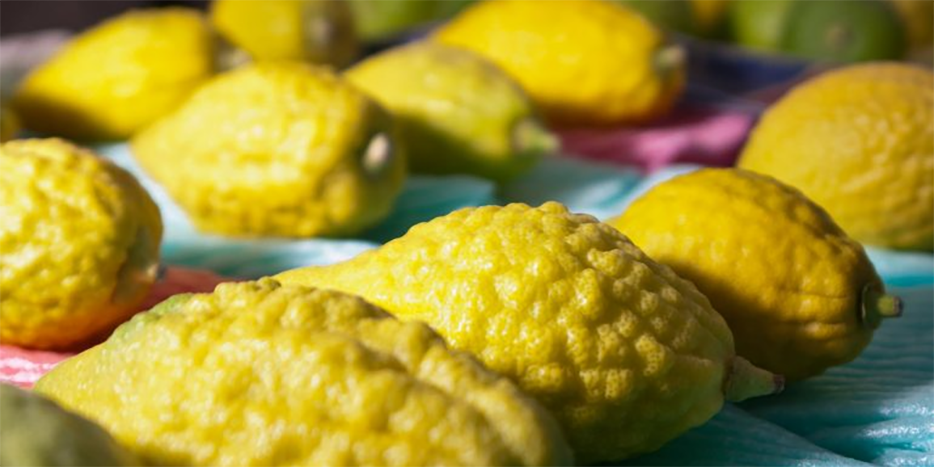
The esrog – the fruit of the “splendid tree,” an indispensable attribute for fulfilling the mitzvah of the “four species” – requires attention after the holiday of Sukkot. Of course, on the days when it serves for the fulfillment of the mitzvah, it possesses a very high status of holiness, and there can be no question of any utilitarian use of it. But how should one properly deal with it after the holiday concludes?
It no longer serves for the fulfillment of the mitzvah, but blessings were recited over it, and therefore it cannot be treated as an ordinary object – for example, thrown away – but it may be used for culinary purposes. Moreover, jam or preserves made from the esrog possess amazing properties, in addition to being very tasty and healthful. It is a segulah for easy childbirth; it helps promote a favorable course of pregnancy; and moreover, it helps one conceive, which is why a jar of this jam is one of the most popular gifts for couples who do not yet have children. Of course, all of this applies only to jam made from those esrogim that were part of the “arba minim” on Sukkot, over which blessings were recited, which were part of the “time of our rejoicing” – the holiday of Sukkot. Jam made from esrogim bought in a grocery store does not possess these magical properties – it is simply tasty and healthful.
Of course, one can prepare not only jam from the esrog. Schnapps and other strong drinks are made from it, candied fruits are made, and it is widely used in the preparation of authentic British puddings.
In Israel, one can obtain a special liqueur called “Esrog.” By the way, few know that the popular Italian liqueurs Chedro and Limoncello are also based on precisely this fruit, as are many other drinks. Therefore, infusions, liqueurs, and other variations on the citron are a real treat. If not in the literal, then in the figurative sense. Before giving my recipe for esrog jam, let us tell a little about the fruit itself.
A Little About Esrogim
The esrog is very popular in culinary arts. Of course, there it is called the citron, and scientists, in fact, call it Citrus medica, and assert that it comes from the genus Citrus of the family Rutaceae.
What Kinds of Esrogim Are There?
Very different ones – there are many varieties and cultivars. Let us point out the most well-known in Eretz Yisrael and those most popular among Jews of various cultures.
The largest and smoothest-skinned esrogim, sometimes resembling an artillery shell in shape, sometimes more rounded, belong to the variety called, according to Yiddish tradition, “yenever” – that is, Genoese. In Italy, this same variety is called “diamante.” The Genoese variety descends – just like the Corsican, Corinthian, and Cretan ones – from those esrogim that Alexander the Great brought to Europe. In fact, such esrogim were grown only in southern Italy, in Calabria, and from the port of Genoa they were transported in former times throughout the Ashkenazi world. In the Russian Empire, this variety became beloved in Chassidic circles and to this day has remained practically indispensable for Lubavitcher Chassidim, who have cultivated Genoese esrogim since the founding of Kfar Chabad in Israel. The special attitude toward the esrog is based on the traditional account of how Moshe was deliberately transported from Mount Sinai to Italy to see what a true “fruit of the splendid tree” – of which the Almighty’s mitzvah speaks – looks like.
Sephardic Jews prefer the Moroccan variety, which still grows in the mountains of northern Morocco. Its slightly elongated, egg-like shape with a soft tapering at the end is indeed the most harmonious. The precious rind seems like the work of an inspired goldsmith. The Moroccan esrog, though usually not large, nonetheless meets the most exalted notions of formal perfection.
The Yemenite esrog, the teimani, brought to Eretz Yisrael from southern Arabia, has a more pear-like shape with the most distinct division into a narrow front and a wide rear part.
Particularly sharp-nosed, with a long shoot, are the esrogim of the RAMI variety (Rabbi Michael Yehuda Lefkowitz), of which the Chazon Ish said: “This is an esrog.” He also blessed and ordered the cultivation of the Halpern variety, the most elongated and bumpy, strongly resembling cucumbers in the paintings of Italian and Spanish Renaissance masters.
And finally, Braverman – a smallish, crooked, gnarled, extremely lumpy esrog, practically devoid of pulp, but the most ethereal variety, which, perhaps more than all other varieties, expresses, as Nekod Singer believes, “the aesthetic ideal of our strange country.” This esrog has been grown in Israel since the founding of Petah Tikva by the Braverman family, and the variety is named in their honor. It was precisely about this esrog that Rabbi Yehoshua Leib Diskin (the Brisker Rebbe) once said: “This is my tree.”
Let us also mention a completely non-kosher variety of citron that has nothing to do with us – the “Buddha’s Hand” from China and Indochina. These fruits look fully in accordance with their name.
What Is Healthful About It?
The fruits contain flavonoids (hesperidin), pectin substances; essential oil is obtained from the rind. It is used in Asian medicine and in Great Britain for kidney diseases and malaria.
In ancient times and in the Middle Ages, citrons were used as a remedy for seasickness, pulmonary, and intestinal diseases. Citron juice with wine was considered an effective antidote.
The fruits are used in folk medicine. The rind of the fruits was used as a remedy for dysentery. Candied fruits are sold as a stomach stimulant, an expectorant, and a tonic.
Why Is It Like That?
In the composition of the pressed oil from citron rind, the following have been found:
β-pinene 1%, limonene 68%, trans-β-ocimene 2.5%, γ-terpinene 1%, linalool 1%, nerol 2.5%, neral 6%, carvone 2.4%, geranial 9.5%.
The oil from citron leaves (petitgrain-citron) has a fresh, pleasant lemon scent with a floral note. It contains: neral 9%, geranial 20%, linalool, nerol 5%, geraniol 30%.
It is used to impart tones of freshness in eau de cologne.
What and How Do People Eat of It?
In ancient times, along with cultic use, the esrog was also used for other purposes: its thick rind was eaten – it was marinated in vinegar or boiled into a mush, and from its segments an incense was made, which was also highly valued as an antidote to snakebite (Suk. 6b, Ma’as. 1:4, Shab. 109b).
At present, the fruits are practically not consumed fresh. They are used for the preparation of candied fruits, jam, and preserves.
For the production of candied fruits, unripe fruits are used, which appear after the spring flowering of the trees. The fruits should have a bright green rind and be no more than 12–15 cm long and 7–10 cm wide.
Traditionally, citron peel is an important item in international trade. The fruits are cut in half, the pulp is separated, and they are soaked in a solution of sea or ordinary salt for approximately 40 days. The water is changed every two weeks, then they are washed and placed in wooden barrels, filled with fresh brine. In this form, citrons are supplied for export. The best-quality citrons are grown in Italy.
Then, locally, after washing off the salt and boiling to soften the rind, the citrons are boiled in sugar syrup; this is done mainly in England, France, and the United States. The candied peel is dried in the sun or preserved for further use in confectionery products – fruit cakes, plum pudding, buns, candies, dragees, and lollipops.
Another method of preserving the peel is vacuum drying followed by rehydration with the addition of water. True, in this case the aroma of the citron weakens somewhat, and leaves of lemons and oranges are added to the syrup for boiling the candied fruits.
And Now – a Simple Recipe for Esrog Jam.
You will need:
– esrog – 1 pc.
– orange – 1 pc.
– sugar – to taste
– water.
Wash the esrog and orange, cut in half lengthwise, and slice very thinly. Remove the seeds. Soak the fruits overnight in water.
Change the water and bring to a boil. Change the water again and boil once more. Drain the water. Weigh the fruits and add an equal weight of sugar. Cook over low heat for 45 minutes, until the jam begins to gel.
Changing the water twice is very important – otherwise it will be bitter. As for the orange, it may be omitted – many even insist that true esrog jam is made only from esrogim, with no oranges at all. And even more so, no additions of “orange marmalade for thickness” if the gelling process does not satisfy you. Simply call it preserves rather than jam – and all will be well.
And also, as knowledgeable people have informed our website, esrog peel is added for piquancy to meat (for example, in making dolma) and even (in the form of essence) – to pasta. They say it’s delicious.
But best of all – make the jam. May everyone have easy childbirth!