



The month of Elul is very important spiritually: it is meant to help us prepare for the Day of Judgment – Rosh Hashanah.
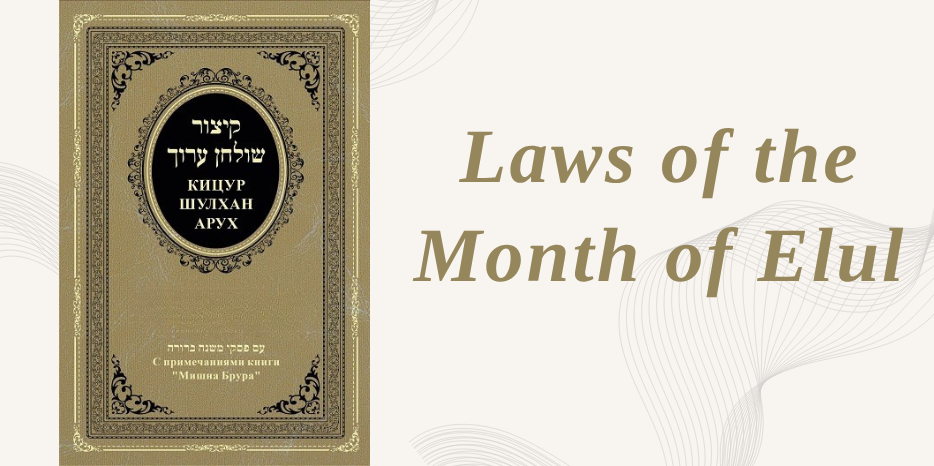
The month of Elul is dedicated to a special chapter in the Kitzur Shulchan Aruch, one of the most popular halachic textbooks, created by Rabbi Shlomo Ganzfried in the second half of the 19th century. (The Kitzur Shulchan Aruch, first printed in 1864 in Austria-Hungary, should not be confused with the Shulchan Aruch, compiled in the 16th century by Rabbi Yosef Karo. They are composed differently, and their purposes are different.)
Kitzur Shulchan Aruch 128. Laws of the Month of Elul
1. The days from the beginning of the month of Elul until the end of Yom Kippur are days when the Almighty readily accepts human repentance. Although the Almighty accepts the repentance of those who return to His service with a full heart throughout the year, these days are especially suitable for repentance and are especially designated for it, as they are days of mercy, when the Almighty specifically expects repentance from man. After all, on Rosh Chodesh in the month of Elul, Moses ascended Mount Sinai to receive the Tablets of the Covenant for the second time, spent forty days there, and descended on the tenth of Tishrei, the day on which the atonement (for the sin of the Golden Calf – trans.) was completed. From then on, these days were made days when God awaits the repentant, and the tenth of Tishrei, Yom Kippur, became the Day of Atonement. In many places, it is customary to fast and observe a “small Yom Kippur” on the eve of Rosh Chodesh Elul to prepare one’s heart for repentance. If Rosh Chodesh Elul falls on Shabbat, the fast is observed a day earlier—on Thursday.
Here is what the Arizal writes:
“And he who did not intend, yet God brought it into his hand, and I gave it to you”—the first letters of several words in this Hebrew passage spell out the word “Elul,” and by this, the Torah meant to convey that the month of Elul is a time when the Almighty is ready to receive those who repent of all the sins committed throughout the year. It also hints that even sins committed by mistake must be repented of during this month.
The sages, who understand the hidden meaning of the letters of the Torah, also said:
“And the Lord your God will circumcise your heart and the heart of your descendants”—the first letters of some words in this Hebrew passage also spell out the word “Elul.” And also: “I am my friend’s, and my friend is mine”—the first letters of the words in this Hebrew passage also spell out the word “Elul.” The same applies to the passage: “…one to another, and gifts to the poor.” These three passages allude to three things: repentance, prayer, and almsgiving, which should be practiced with particular diligence during this month. Here’s how it works: the passage: “…and He will circumcise…” speaks of repentance; the passage: “I am…” speaks of prayer, which represents the joy of lovers; “…one to another…” alludes to almsgiving.
2. It is customary to blow the shofar during this month. They begin this practice on the second day of Rosh Chodesh (as Derech HaChaim writes. Some begin on the first day), and they blow it every day after the morning prayers in the following order: tkiyah, shevarim teruah, tkiyah (according to Matei Efraim—tkiyah, shevarim, tkiyah), except on the eve of Rosh Hashanah, when they stop blowing to allow a break between the non-commandment blowings and the Torah-commanded blowings. They blow it during this month to stir the people’s hearts to repentance, since the very nature of the shofar is such that it awakens and causes trembling, as Scripture says: “Can a shofar be blown in a city, and the people not tremble?”
There is another custom in our countries: from the second day of Rosh Chodesh Elul until Shmini Atzeret (the MB says: from Rosh Chodesh Elul until Shmini Atzeret inclusive. (The reason why in the Land of Israel this passage is not read on Shmini Atzeret may be that only outside the Land of Israel do they sit in the Sukkah on Shmini Atzeret and, perhaps, therefore, continue reading until Shmini Atzeret) they read in the morning and evening after prayer (morning prayer and Mincha) a passage from Thillim: “A Psalm of David. The Lord is my light and my salvation…” This passage was chosen for reading at this time due to its meaning according to the Midrash: “The Lord is my light” – it is said about Rosh Hashanah, “and my salvation” – about Yom Kippur, “for in the day of trouble He will hide me in His tent…” – a hint at the holiday Sukkot.
It is also customary to recite passages from Thillim during these days as a community, in each community according to its own custom.
From the beginning of the month of Elul until the end of Yom Kippur, anyone writing a letter to a friend should hint in it, either at the beginning or the end, that they pray for this friend and bless them, so that they may merit being inscribed and sealed in the book of good life in the days of judgment, which come for good.
3. Those diligent in fulfilling the mitzvot have the custom of checking their tefillin and mezuzahs during this month, and in all other cases where something necessary for a mitzvah needs to be corrected, they correct it.
4. Beginning with the Shabbat following the Ninth of Av, seven consecutive Shabbat readings of the seven passages dedicated to the consolation of Jerusalem are read as Haftarah. If the first day of Rosh Chodesh Elul falls on Shabbat, one does not read “O wretched and angry woman…” but instead reads “The heavens are My throne…,” since this passage also contains words about the consolation of Jerusalem. And on Shabbat of the weekly portion “When you go forth…,” whose Haftarah is “Rejoice, barren woman…,” one also reads “O wretched and angry woman…” along with this passage, since this passage is a continuation of the first.
If one reads the Haftarah on Shabbat Rosh Chodesh Elul and makes a mistake and begins to read “O wretched and angry woman…”—if one remembers the mistake before beginning the blessings after the Haftarah—one should also read “The heavens are My throne…” and recite the concluding blessings. If he only remembered after reciting the concluding blessings, then he should read the passage, “The heavens are My throne…” without the blessings.
If Rosh Chodesh of Elul falls on a Sunday, then the Haftarah, “Tomorrow is a new month…,” is not read on Shabbat, since it does not mention the consolation of Jerusalem at all. Instead, it is read, “The poor and angry one…”
5. Beginning on the last Sunday before Rosh Hashanah, rise early in the morning and recite Selichot. If Rosh Hashanah falls on a Monday or Tuesday, Selichot begins on the Sunday of the previous week. When rising to recite Selichot before dawn, one must perform netilat yadayim and recite the blessings (see above, Chapter 2, Section 7) on netilat yadayim and on the Torah. After Selichot, one must wash one’s hands a second time (if the first netilat yadayim was performed before dawn), without reciting the blessing.
6. The chazan who recites Selichot must wrap himself in a tallit with tzitzit before beginning “Ashrei.” And since the sages doubt whether one should recite the blessing when putting on one’s tallit at night, one should not put on either one’s own tallit or one belonging to the community, but should instead ask for a tallit from someone else (and when taking one, one must keep in mind that it is not being purchased, but merely borrowed). If one does not have a tallit, one may recite Selichot and the “thirteen qualities” without a tallit.
In some places, it is customary for the chazan who recites Selichot to also recite the morning prayer, Mincha, and the preceding evening prayer, and he has the right to do so even if a mourner, a mohel, or someone who is observing a yahrzeit is present in the synagogue (however, Eliyahu Rabbah doubts this, and holds that someone observing a yahrzeit has the preferential right to be chazan if they are fasting that day. Beginning with the passage, “A song of praise from David for the choirmaster,” a mourner may also be a chazan). It would be better (Mate Ephraim), to stand while reciting Selichot. If it is difficult for a person to stand for the entire duration of Selichot, he should at least stand during the recitation of “God, the King who sits upon the throne of mercy…” and “the thirteen attributes.”
For the pronunciation of Viduy (confession of sins), see below, chapter 131, paragraph 9.
7. One should strive to select as a chazan for the reading of Selichot and for the prayers on the nine days of repentance a suitable person, known for his study of Torah and good deeds, insofar as such a person can be found. He should also be over thirty years old, since by this age the youthful blood has ceased to boil and the heart has become humble. He should also be married and have sons (the requirement that he have sons is taken from Mate Efraim (which also cites this requirement in the laws of public fasting). In the MB, where our topic is discussed, this requirement is not cited), so that he will pour out his whole heart and draw prayers from the very depths of his soul. One should also strive to select a shofar blower on Rosh Hashanah, as well as one who will read the shofar blowing order, from among Torah scholars who tremble before Heaven, as much as one can find. However, by law, all Jews are eligible for all mitzvot, so long as the community agrees to see them in these positions. If a person sees that there is controversy in the community regarding his position, he should decline the honorable position, even if a less suitable one is chosen in his place.
8. One who is observing mourning for his father and mother during the entire twelve months of mourning should not be a chazan on Rosh Hashanah or Yom Kippur, nor should he blow the shofar in front of the congregation on Rosh Hashanah (the statement that he should not blow the shofar in front of the congregation on Rosh Hashanah is taken from the Matei Efraim, but the MB does not mention this) on Rosh Hashanah, unless there is no one else as qualified for these fasts as he is (MB: “If there is no other chazan, then this one may be chosen”). If a person is observing thirty days of mourning for other relatives, then if he was previously a chazan on these days or blew the shofar on Rosh Hashanah, he may be chosen for these purposes (the MB speaks generally and does not give a reason for this permission), since Rosh Hashanah and Yom Kippur cancel the thirty days of mourning. If he has not done so previously, and the community has another person equally suitable, the mourner should refrain from appointing him as chazan. However, on all days of Selichot, even on the eve of Rosh Hashanah, any mourner is permitted to serve as chazan, provided he (Mate Ephraim, not mentioned in the MB. And see above, chapter 26, paragraph 14) is not observing the first seven days of mourning.
9. If a person reads Selichot without a minyan, he may not recite the “thirteen qualities” as a prayer and petition, but must read them as one reads a Torah scroll, observing cantellation. He should also omit all the passages that mention the “thirteen qualities,” such as: “…and remember for us today the covenant made with the thirteen…” (in chapter 565, the MB writes that these passages do not have to be omitted, since a worshipper outside of a minyan is forbidden to recite only the “thirteen qualities” themselves. See also what he writes in chapter 581, paragraph 4). Also, those petitions that are given in Aramaic are permitted only in the presence of ten worshippers.
10. A mourner is forbidden from leaving his home and going to the synagogue to recite Selichot, except on the eve of Rosh Hashanah, when Selichot are especially long.
11. The chazan who will pray during the ten days of repentance, as well as the one who will blow the shofar on Rosh Hashanah, must abstain from anything that could lead to impurity for three days before Rosh Hashanah, and must study, to the best of their ability, the explanations of the prayers and hymns recited during these days, and the laws of blowing the shofar. They must also read books on moral matters that awaken the human heart, and they must tremble with fear of G-d and His majesty when He arises to judge the entire earth.
If the congregation cannot find a shofar blower who is a Torah scholar, they should at least find a Torah scholar who is well versed in the laws of blowing the shofar to read the order before the shofar blower, so that if someone makes a mistake while blowing the shofar, he will know what to do, and he will also be able to inspect the shofar and determine whether it is kosher.
12. Many people fast during the ten days of repentance. Since there are four days among these ten days on which fasting is prohibited—the two days of Rosh Hashanah, Shabbat, and the eve of Yom Kippur—they instead fast for four days during the Selichot reading before Rosh Hashanah. That is, they fast on the first day of Selichot, on the eve of Rosh Hashanah, and also on two other days between them; these days are chosen to be Monday and Thursday. If a mitzvah meal is served on one of these days, they may partake of it, and fast on another day instead. Or, if it is known in advance that a mitzvah meal will be served on one of these days, they may fast on another day in advance instead. (See above, Chapter 127, paragraph 3 and paragraph 14.) (The day on which one fasts in place of the day of the Mitzvot Meal must also be one of the days on which Selichot is recited. If all these days are occupied, one should not fast on another day.)
13. It is customary on the eve of Rosh Hashanah, after the morning prayer, to go to the cemetery to prostrate oneself on the graves of the righteous. There one distributes alms to the poor and prays at length to inspire the holy righteous buried in the earth to intercede for us on the Day of Judgment. Also, since the righteous are buried in this place, it is a holy and pure place, and a prayer recited there is greatly desired by G-d, since it is recited on holy ground; and the Holy One, blessed be He, will show us mercy because of the merits of the righteous.
However, one praying in a cemetery should not address the dead buried there, as this would be too close to violating the prohibition of speaking to the dead. Rather, one should ask God, blessed be His name, to have mercy on us for the sake of the merits of the righteous who rest in the dust.
When one arrives at the cemetery, if one has not seen the graves for thirty days, one should recite the blessing: “…Who created you in judgment…” (see above, chapter 60, paragraph 11). When approaching a grave, one should recite the following: “May it be God’s will that [so-and-so] buried here rest in honor, and that his merits be a help to me.” When a person places his hand on a grave, he should place it with his left hand, not his right, and should recite the verse: “And may God rest you forever, and satisfy your soul with the good things of life, and strengthen your bones; and you will be like a watered garden, and like a spring of water whose waters never dry up. Rest in peace, and sleep in peace, until the Comforter comes, who brings peace.” (And when he places his hand on the grave, he should mentally recite the verse: “And may He rest you…,” which contains fifteen words—the same number as the joints of a hand.)
One should not visit the same cemetery twice in one day.
If a person reads an inscription on a grave, if the letters protrude from the stone, this negatively affects the memory (the fact that this is only true if the letters protrude from the stone is not stated in the MB). The remedy against this influence is to say: “You have loved us with a great love…” before the words: “…and with love proclaim that You are one.”
14. On the eve of Rosh Hashanah, it is customary for everyone to fast until the end of Mincha (whether this is Mincha Gedolah or Mincha Ketana depends on the custom of the locality. At Mincha, they recite “Answer us…” (The same applies to the law stated above, in paragraph 12). Most communities also do the same on the first day of reading Selichot), and after Mincha, they eat a little, so as not to begin Yom Tov exhausted. The entire day should be spent studying Torah, fulfilling mitzvot, and repenting, and especially repenting of offenses committed against one’s friends. This should not be postponed until the eve of Yom Kippur; on that day, one should go and ask forgiveness of the friend against whom one has offended.
15. On the eve of Rosh Hashanah, one should wash clothes and get a haircut in honor of Yom Tov. And it is necessary to ensure that the haircut is completed before noon (if a person lacks time, he has the right to postpone the haircut until Mincha Ketana; if he hasn’t managed to get a haircut then, he can do it all day). We immerse in the mikveh and put on Shabbat clothes in honor of Rosh Hashanah to show our confidence in the mercy of the Blessed One, Who will render us an acquittal.
16. It is customary to absolve vows on the eve of Rosh Hashanah (and this is hinted at by the fact that the last letters of the verse speaking about vows, “…he will not break his word in anything…,” spell out the Hebrew word “Elul”). If a person does not understand the text of the absolution procedure, which is recited in the Holy Tongue, let him recite it in a language he understands.