




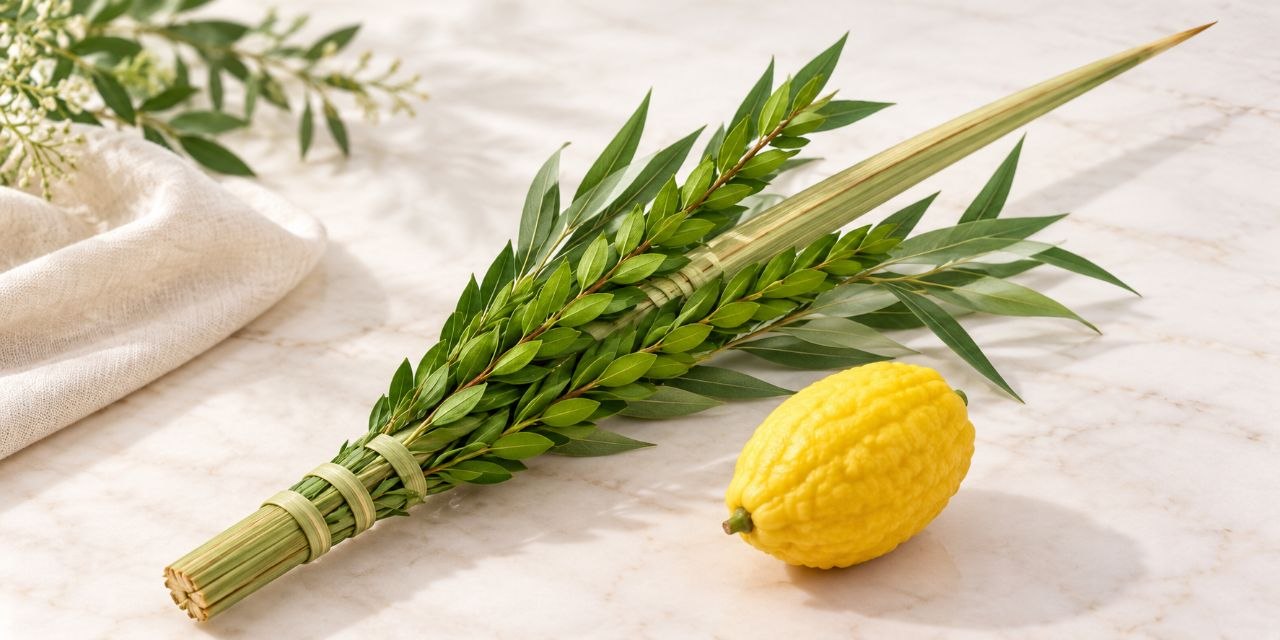
The mitzvah of “Netilas Lulav” is performed while standing. One takes the lulav (here and below we will refer this way to all three species: lulav, aravah, and hadas, bound together) in the right hand – so that the sdera (the side on which the spine is visible) faces the one performing the mitzvah – and the esrog in the left hand, and recites the blessing “Who has commanded us to perform netilas lulav”:
Baruch Atah Ado-noi Elo-heinu Melech HaOlam Asher Kiddeshanu B’Mitzvosav V’Tzivanu Al Netilas Lulav.
Then the esrog is joined to the lulav in such a way that the upper third of the esrog touches the lower part of the lulav. On the first day of the holiday, when the mitzvah of netilas lulav is performed for the first time, after this blessing one recites “Shehecheyanu”:
Baruch Atah Ado-noi Elo-heinu Melech HaOlam Shehecheyanu V’Kiyemanu V’Higianu LaZman HaZeh.
The “Netilas Lulav” itself is a complex series of movements: the lulav is taken in the right hand, one stands facing east, and, holding it near the heart, recites the blessing. Then one takes the esrog in the left hand, joins it, holding the fruit with the stem pointing down, to the lower part of the lulav. Then one should extend the hands toward the southeast, press them to the chest near the heart, and repeat these movements three times. Then one does the same, extending the hands in the northeast direction, then east; then raises the hands, returns them to the heart; then lowers them and returns them to the heart; then extends them in the southwest direction; and finally – in the direction of the west. Each back-and-forth movement (in one of the six directions) is repeated three times.
The meaning of the mitzvah of the “four species” is interpreted in various ways. First of all, the question arises – why, out of the entire plant world, were precisely these four species chosen? One of the answers – because each of them is unlike all the others: the “fruit of the splendid tree,” that is, the esrog, possesses a beautiful fragrance and taste; the “shoot of the date palm,” the lulav – is taken from a tree whose fruits are sweet but have no fragrance; the “branch of the thick-leaved tree,” the hadas (myrtle) – has a beautiful fragrance but is inedible; the “branch of the river willow,” the aravah – is inedible and has no fragrance.
From this it is derived that each of these plants symbolizes a certain category of Jews: there are those who possess two virtues at once – both the fragrance of Torah and the taste for fulfilling mitzvos; they are likened to the esrog. There are those who have studied Torah a little and possess rather modest knowledge of it, but are distinguished by diligent fulfillment of mitzvos – they are like the lulav. Others, on the contrary, teach Torah beautifully to others but do not themselves fulfill its mitzvos – they are symbolized by the hadas. And finally, there are Jews likened to the river willow: they neither study Torah nor fulfill mitzvos… But what does the Almighty do? “They cannot be cast away! Let them be bound into a single bundle and complement one another, atoning for their sins.” That is why we must bind these four species, so different in everything, together, thereby demonstrating the worldview of Judaism: the aspiration to educate all these four types of Jews on the basis of Torah and mitzvos, and to grant them a sense of unity and mutuality in the relationship between the individual and society. And so we pray during the “Days of Awe”: “…and they shall become a single bundle, to fulfill Your will with all their heart.” And in the Talmud, in Tractate Sanhedrin, it is said: “All Jews are responsible for one another.”