



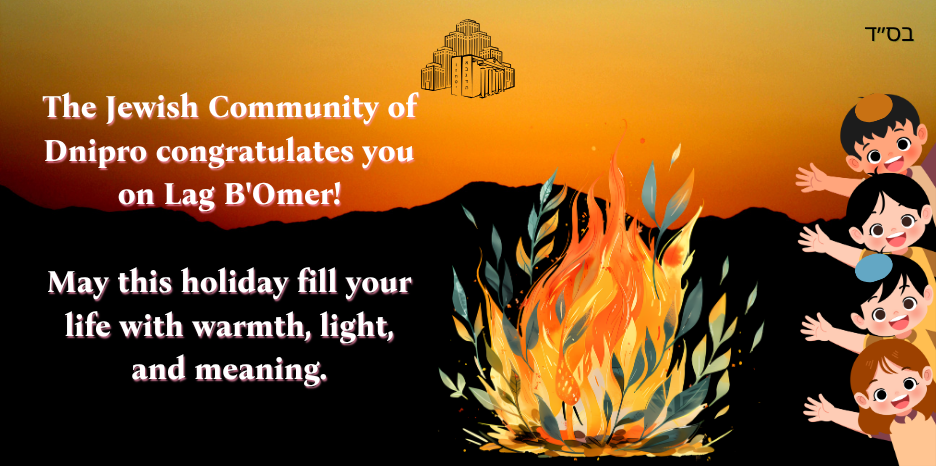
Today marks the 33rd day since the beginning of the Counting of the Omer—the period when Jews count the fifty days from the beginning of Passover to the holiday of Shavuot.
As is well known, each letter of the Hebrew alphabet has a numerical value. The letter “Lamed” corresponds to the number thirty, the letter “Gimel” to three, and their combination, the number thirty-three, is pronounced “LaG,” so the name of the holiday simply denotes the number of the day in the Counting of the Omer. The Omer itself is the offering of a sheaf of barley from the new harvest to the Temple—a ritual performed during Passover.
Tradition does not provide us with a precise source for why we celebrate this day, but it was on the thirty-third day of the period between Passover and Shavuot that many important events in Jewish history took place.
First, the manna that the Jews ate during their wanderings in the desert after the Exodus began to fall, according to tradition, on Lag B’Omer.
Secondly, it was on Lag B’Omer that the terrible epidemic that had claimed the lives of twenty-four thousand of Rabbi Akiva’s disciples and lasted thirty-three days ended. The sages point out that the epidemic began due to a lack of love and respect among the disciples, and therefore the day of its end became a symbol of the importance of the mitzvah of Ahavat Yisrael. (However, some argue that the deaths of Rabbi Akiva’s disciples were not caused by the epidemic, but by a series of military defeats in the struggle against the Roman occupiers due to a lack of solidarity and cohesion. On Lag B’Omer, the Jews, united, were able to achieve a major victory over the Romans.)
Thirdly, it was on this day that the great righteous Rabbi Shimon bar Yochai, one of Rabbi Akiva’s greatest disciples, passed away. Upon his departure from this world, he requested that this day be joyfully celebrated, for it was on this day that he received permission to reveal the hidden portion of the Torah to humanity, and the light of the Inner Torah began to spread. To this day, on Mount Meron in Israel, near the city of Safed, where the grave of Rabbi Shimon bar Yochai is located, mass celebrations and festivities are held on Lag B’Omer.
The holiday’s traditions include the custom of lighting bonfires, archery, and holding merry games and sports competitions. Each of these customs has many explanations, given in various sources.
Among the disciples of Rabbi Isaac Luria, a custom developed of performing a boy’s first haircut, the opshernish ceremony, on Lag B’Omer, since certain laws of mourning are observed after Passover, in memory of Rabbi Akiva’s disciples, including the prohibition on cutting hair.
In Israel, on Lag B’Omer, in addition to Mount Meron, people also visit Eliyahu’s Cave near Haifa. On the night of Lag B’Omer, Jerusalem residents have a custom of visiting the grave of Shimon Tzaddik, a high priest and great Torah scholar who lived during the early period of the Second Temple.
In the 20th century, the Lag B’Omer tradition was further enhanced by the introduction of children’s parades in Jewish communities at the behest of the Seventh Lubavitcher Rebbe, Menachem Mendel Schneerson. Today, such parades are held on every continent, in hundreds of cities, demonstrating Jewish unity and solidarity and the importance of raising children in the spirit of “Ahavat Yisrael.”
In Dnipro, such parades have been held since the early 1990s. Our website will keep readers informed about this year’s Lag B’Omer celebrations in our news feed.