



Tonight, with the onset of the 28th of Sivan, marks 85 years since the arrival of the Seventh Lubavitcher Rebbe, Menachem Mendel Schneerson, and his wife, the righteous Rebbetzin Chaya Mushka, in the United States of America, and their salvation from the Nazi danger.
World War II found Rabbi Menachem Mendel Schneerson and his wife, Rebbetzin Chaya Mushka, in Paris. The Sixth Lubavitcher Rebbe, Yosef Yitzchak Schneerson, who was already living in the United States at the time, made great efforts to save his daughter and son-in-law. The Rebbe Rayatz managed, after numerous phone calls and letters, to arrange the evacuation of the future Seventh Lubavitcher Rebbe, Menachem Mendel Schneerson, and his wife, the righteous Rebbetzin Chaya Mushka, marking a new era in the dissemination of Chassidus.
The Chabad.org website writes about this as follows: “While his father-in-law did everything to get the future Rebbe and Rebbetzin safe passage to America, Rabbi Menachem M. Schneerson, then known by his acronym Ramash, faced the Parisian coup d’état. Several months of quiet were followed by the German invasion on June 5, 1940, along a 400-mile stretch of land between Abbeville and the Upper Rhine. By June 14, the swastika could be seen atop the Eiffel Tower.
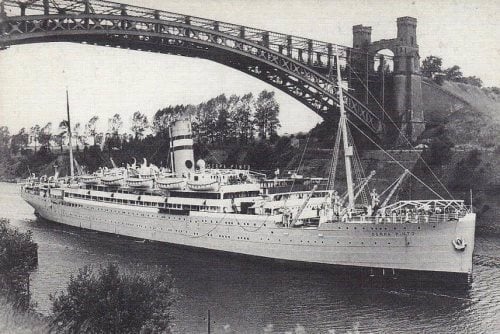
Two days before the occupation of Paris, the future Rebbe and Rebbetzin fled to Vichy. From there they made their way to Nice, and then to Marseille. From there they escaped France and onwards to Lisbon, Portugal, where they boarded the SS Serpa Pinto bound for the New World.
During the flight, most passengers carried one or two suitcases, but the Ramash carried on all his travels and commotion numerous boxes of scholarly books and manuscripts written by the Chabad-Lubavitch leaders, many handed down from one Rebbe to the next.
Among the items he brought were recordings of the Ramash’s many public lectures on the weekly Torah portion and Talmudic classes. Many of the teachings the future Rebbe continued to record until the end of his life included in-depth analytical interpretations of a particular source text, which he then would pour into mystical kabbalistic and Chassidic lessons he crafted so that everyone could apply these teachings in their daily lives.
“Little is known about the Rebbe’s stay in Portugal,” says the website of the local Jewish community, Comunidade Israelita de Lisboa, which to this day notes the fact that the Ramash stayed there on his way to the United States. “It is known that among the Rebbe’s collected writings there is a note of a lecture at the local synagogue, written during his stay in Portugal on a very obscure text in the Talmud.”
The Rebbe once analyzed a cryptic Talmudic expression about searching for a fish for a sick person, basing his analysis on other Talmudic sources and numerous commentaries before framing the discussion in terms of Kabbalistic teachings. He described the life of a fish as a metaphor for Jewish existence.
Fish survive because they know their habitat and remain immersed in it, wrote the Rebbe. If you see a fish flailing on a dock, its prognosis is instant and universal.
The same could be said about the Jewish people, he concluded. A Jew has his own habitat and source of spiritual nourishment: the Torah. Like the sick person in the Talmud, a Jew sometimes tries to live “out of water,” and unlike the fish, his source of vitality is not always obvious to all. The key for a Jew is to recognize his source of life.”
Read more here: Chabad.org – Inspiring the Jewish American Revolution