




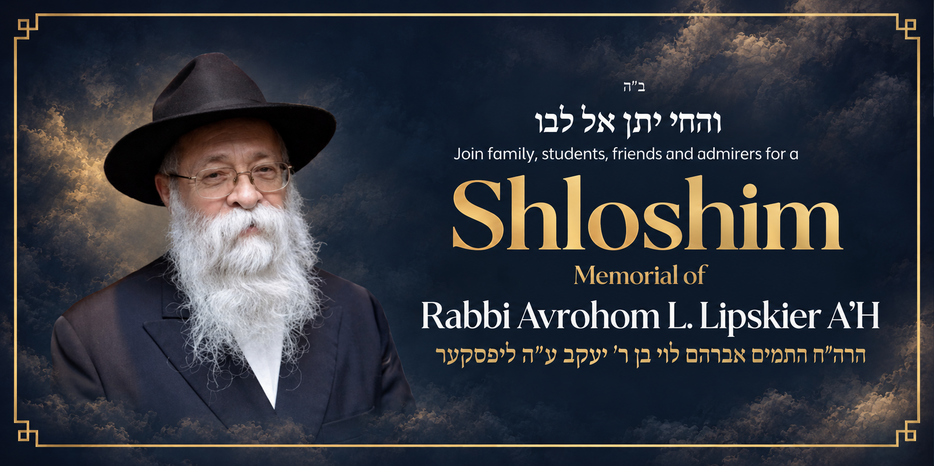
Reb Avraham Levi Lipskier departed this world on the 28th of Elul, 5786—two days before Rosh Hashanah.
According to Jewish law, holidays supersede mourning observances: Rosh Hashanah interrupts shivah, and Yom Kippur interrupts shloshim (Shulchan Aruch, Yoreh De’ah 399:6). Consequently, the family did not observe a full shivah or shloshim.
In this way, Reb Avraham Levi spared his loved ones the experience of mourning. The holidays arrived in place of grief, and the thirtieth day—the 28th of Tishrei—became a warm, heartfelt memorial evening in his honor.
Reb Avraham Levi loved seeing joy all around him. Yet, he always worried that he was not doing enough—that he was unable to bring even more Jews back to their Jewish roots.
A few days ago, Reb Avraham Levi’s daughter, Chana, opened Igrot Kodesh (a collection of the Rebbe’s letters) to Volume 3, page 139.
The response she found was strikingly apt.
The Rebbe writes about the importance of gathering and disseminating stories about the older generation of Hasidim. He asks the recipient to write down his father’s life story and submit it for publication, as well as to encourage others to do the same.
An excerpt from the letter reads: “You are undoubtedly aware of the desire of my father-in-law and teacher, the Rebbe—may he live a long and good life—to receive and record stories and biographies of the older Hasidim. You should write down your father’s life story (and the like) and send it to the editorial office of the ‘Hasidic Treasury’ project for their collection of memoirs, and also encourage those whom you influence to do the same.”
Here is a recollection from a yeshiva student, Aviram Kornienko:
“In memory of Rabbi Lipskier—may his soul ascend to greater heights.
I studied at the Sea Gate yeshiva for about six months. During that time, I was fortunate enough to attend Rabbi Lipskier’s classes on several occasions. Years have passed, yet I still remember one specific episode from his lesson.
I have told this story to my wife several times over the years of our marriage. Perhaps it is because there is something very simple about it, yet something that—once heard—is hard to forget.
One day, Rabbi Lipskier asked us a question.
He asked us to imagine a person walking down the street who sees an elderly man or woman struggling to cross the road. It is obvious that the person needs help, and you realize that you can assist them.
You start heading toward them.
But while you are walking, someone else gets there first and helps them across the street.
Then Rabbi Lipskier asked: ‘What would you feel? What would you do?’
Answers began to come from the group.
Someone said, ‘I’d be upset that I wasn’t the one who helped.’
Another said, ‘I’d go over anyway and ask if everything is all right.’
Someone else said he would regret not having done it himself.
Rabbi Lipskier listened to us and asked again, ‘What other possibilities are there?’
And once more: ‘What other possibilities?’
Then, a young man said, ‘I’d just keep walking.’
Rabbi Lipskier immediately seized upon that answer.
‘Oh! Now you—you are a true Jew.’
That young man was me.
And that specific phrase has stayed with me for years.
At that moment, of course, the discussion wasn’t really about crossing the street.
It was about how a person should relate to doing good.
If you see someone who needs help, you should help. But if you have already started moving toward them, only to find that someone else got there first, the most important thing has already happened: the person received help.
The world has become a little better.
What else do you need?
You don’t have to be the one who performed the deed. You don’t need to receive gratitude. You don’t need to feel the satisfaction of knowing you were the one who helped.
You can simply keep walking.
Because there will surely be someone else ahead who needs help.
I think that was one of the lessons Rabbi Lipskier was particularly good at conveying.
You simply have to go through life ready to do good.
If an opportunity arises, do it.
If someone else has already done it, rejoice that good has been done.
And then keep walking.
Look for the next opportunity.
There is an amazing freedom in that. You don’t have to constantly prove to yourself that you are a good person. You don’t need to collect merits as proof of your own worth. If you truly want to make the world better, it is enough to know that, somewhere nearby, there is a little less pain and a little more good.
And then you can move on.
I can’t say I always manage to live exactly like that.
But perhaps one sign of a true lesson is that, years later, you no longer remember exactly where you sat, what was written on the board, or how long the shiur lasted.
You remember one phrase.
“I’ll just keep walking.”
To the next person.
To the next good deed.
To the next opportunity to make this world a little better.
I am grateful to Rabbi Lipskier for giving me this very perspective on life during one of his lessons.
And perhaps some lessons really do continue long after the lesson itself is over.
In that same letter, the Rebbe speaks of alacrity in fulfilling the commandments, citing the example of the Patriarch Abraham. Abraham himself saddled his donkey and rose early in the morning to carry out the will of the Almighty. Such readiness to serve God serves as an example for all who follow in his footsteps. The Rebbe emphasizes that true service entails bringing others into that service as well. This was the path that Reb Avraham Levi Lipskier walked.
Rabbi Avraham Levi Lipskier founded and led the first yeshiva for Baalei Teshuvah (those returning to Jewish observance); thanks to this yeshiva, thousands of Jews were able to return to Jewish life. As a result of his work—undertaken at the Rebbe’s direction—the Baal Teshuvah movement flourished and continues to thrive to this day.
The month of Tishrei is drawing to a close, and Shabbat Bereishit is upon us.
After Tishrei, it is customary in Chabad to recall the words of the Torah: «ויעקב הלך לדרכו» — “And Jacob went on his way” (Genesis 32:2). For a full month, we were filled with holidays, joy, and inspiration. Now it is time to go “on our own way”—into the routine of everyday life—and carry that light and strength with us throughout the year.
It is also said that the mindset a person adopts on Shabbat Bereishit sets the tone for the entire year ahead.
Reb Avraham Levi loved to see everyone filled with joy. So let us, too, take the joy of Tishrei with us into the new year, sharing his story and continuing along the Rebbe’s path—the very path that Reb Avraham Levi walked.
May the Rebbe King Moshiach be revealed now.
📜 Read the Rebbe’s letter
📖 Read the Tshura (commemorative booklet) marking the Shloshim (30-day memorial) of Reb Avraham Levi Lipskier
🎥 Watch the video in memory of Reb Avraham Levi Lipskier
✍️ Share your memories. In keeping with the Rebbe’s words in this letter, we are collecting stories about Reb Avraham Levi. If you knew him, please send your memories, photos, or anecdotes to: +380503202521.